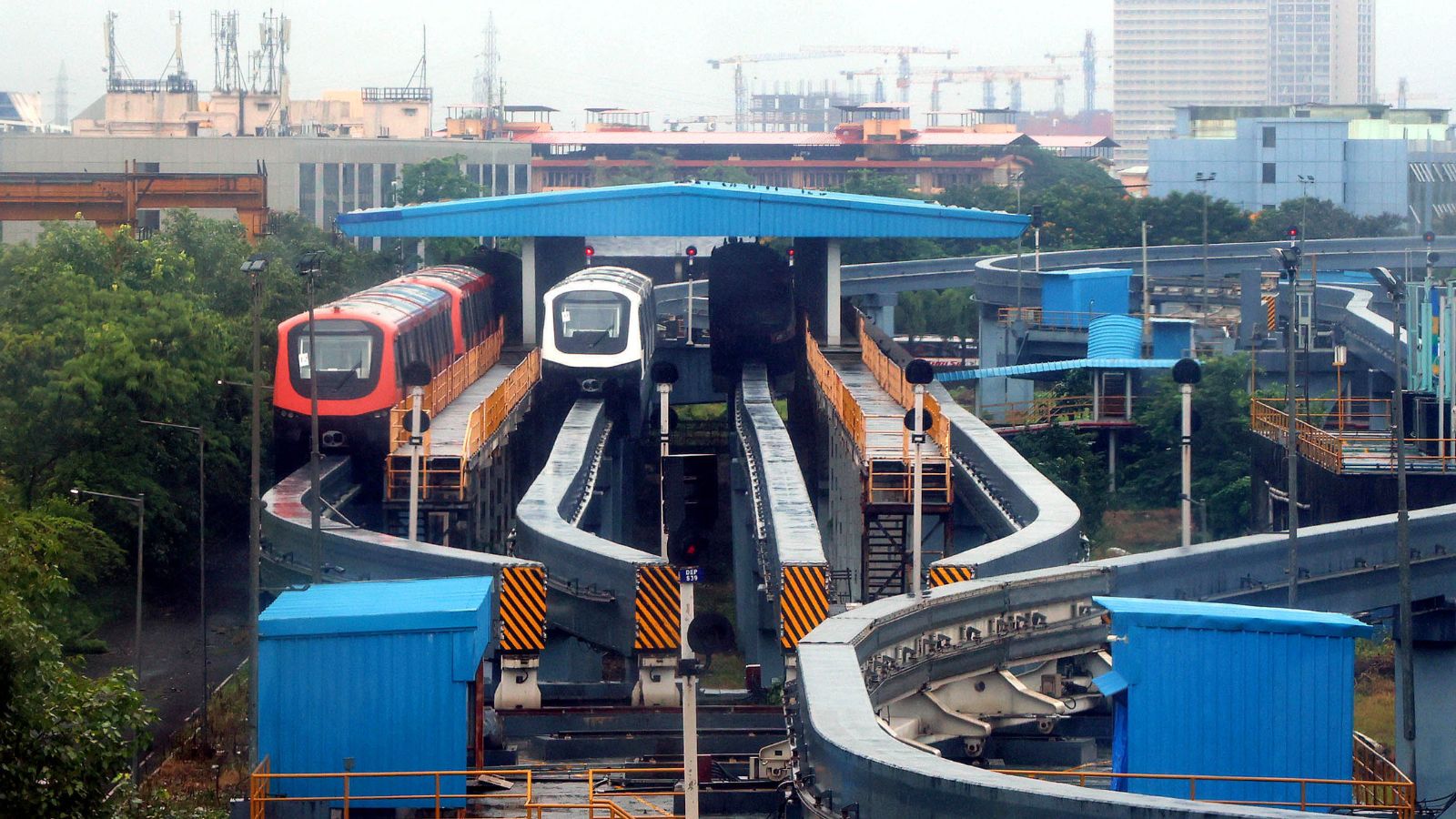
The long-awaited restart of Mumbai's Monorail has hit a major roadblock as MMRDA struggles to finalize a foolproof evacuation plan for stranded trains. Despite safety certifications, the fear of repeating past rescue disasters keeps the service grounded.
- MMRDA has delayed the Monorail reopening due to the absence of a comprehensive passenger evacuation strategy.
- The decision follows a previous crisis where 600 passengers were stranded in Chembur, requiring a two-hour fire brigade rescue.
- IIT Bombay and MEIL are consulting on solutions, including walkways and rescue rakes, though feasibility remains a concern.
The Mumbai Metropolitan Region Development Authority (MMRDA) has once again pushed back the reopening date of the city's Monorail service. While the project has successfully obtained the necessary safety certifications and introduced new rakes, a critical gap remains: the lack of a viable plan to evacuate passengers if a train becomes stranded on the elevated guideways.
This administrative caution stems from a traumatic incident in Chembur, where nearly 600 passengers were trapped in an overcrowded train following a power failure. The Mumbai Fire Brigade was forced to break glass doors to rescue commuters in an operation that lasted two hours, highlighting the extreme vulnerability of the current system.
Why This Matters
BozokMedia analysis shows that this delay is not merely technical but a matter of liability and public trust. In a city as densely populated as Mumbai, any failure in high-capacity transit can lead to mass panic. The MMRDA's hesitation reveals a systemic struggle to integrate emergency response protocols into elevated transit designs that pass over congested slums and narrow nullahs.
To resolve this, the operating agency has engaged IIT Bombay and Megha Engineering and Infrastructure Ltd (MEIL). One proposed solution involves constructing dedicated walkways along the guideways. However, IIT Bombay has expressed skepticism regarding the structural feasibility of adding such weight to the existing elevated columns.
The failure to implement a standard evacuation protocol for elevated transit is a significant oversight that prioritizes operational launch over passenger survival.
Alternative strategies include the use of a 'rescue rake'—a second train positioned on the opposite line to transfer passengers via a temporary bridge. While this has worked in the past, officials admit a backup mechanism is essential for scenarios where a rescue rake cannot reach the stranded vehicle.
Further complicating the issue is the risk of 'rake tilt' on sharp curves due to overcrowding. Since the Monorail draws power from the guideways, a slight tilt could sever the electrical connection, disabling emergency doors and air-conditioning, effectively turning the cabin into a heat trap.
Beyond evacuation, the MMRDA is also addressing the risk of falling objects. They are studying ways to cover gaps in the elevated structure to ensure that debris does not fall onto the roads and pedestrians below, which could lead to fatal accidents in high-traffic zones like Wadala and Mahalaxmi.
Frequently Asked Questions
Q1: Why can't the Monorail open if it already has safety certifications?
While the trains and tracks are certified as safe for operation, the 'evacuation plan'—the process of getting people out during a total system failure—is not yet finalized.
Q2: What are the proposed solutions for passenger rescue?
Proposed solutions include building walkways along the tracks, using rescue rakes to transfer passengers, and utilizing man-lifts, though the latter is difficult in congested areas.

-1787365784934.webp)