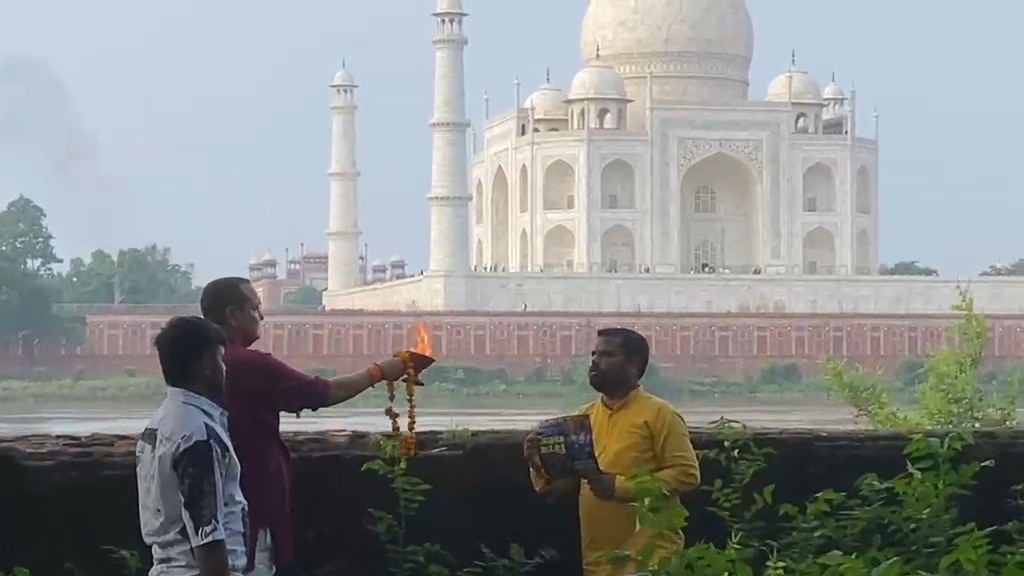
A police case has been registered in Agra after videos surfaced showing individuals performing Hindu rituals, including puja and aarti, inside the Taj Mahal premises. The Archaeological Survey of India (ASI) and local police are investigating the incident, which has sparked intense debate over the monument's strict regulations.
- A police case has been registered after videos of Hindu prayers (puja and aarti) inside the Taj Mahal went viral.
- The Archaeological Survey of India (ASI) restricts unauthorized religious activities inside the UNESCO World Heritage Site.
- Security protocols at the monument are under intense scrutiny following the breach.
In a major security and administrative lapse, the Agra Police have registered a formal case against unidentified individuals after video clips showing Hindu religious rituals being performed inside the Taj Mahal premises went viral on social media. The incident, which has sparked a massive political and social debate, reportedly took place near the main mausoleum of the iconic 17th-century monument.
The viral videos, which began circulating widely on platforms like X (formerly Twitter) and Facebook, depict a group of tourists performing 'puja' and offering 'aarti' with incense sticks inside the protected monument's complex. According to the Archaeological Survey of India (ASI), performing any unauthorized religious practices—other than the traditional Friday prayers (Namaaz) by local residents at the mosque inside the complex—is strictly prohibited under the Ancient Monuments and Archaeological Sites and Remains Act.
Following the outrage and official cognizance of the video, the ASI security wing and CISF (Central Industrial Security Force), which is responsible for the monument's internal security, launched an internal inquiry. A First Information Report (FIR) was subsequently lodged at the local Tajganj Police Station under relevant sections of the Indian Penal Code (IPC) and the Ancient Monuments Act.
Historical Background of Religious Regulations at Taj Mahal
The Taj Mahal, built by Mughal Emperor Shah Jahan in memory of his wife Mumtaz Mahal, is a UNESCO World Heritage Site. Over the decades, the Supreme Court of India and the ASI have maintained strict guidelines to preserve its secular and historical character. While a historic mosque exists within the complex where local Muslims are permitted to offer Friday prayers, no other religious rituals, including Hindu prayers or generalized congregational prayers, are legally permitted on the premises to maintain communal harmony and structural integrity.
Why This Matters
BozokMedia analysis shows that incidents of this nature highlight the growing tension between cultural heritage preservation and religious identity assertions in India. As one of the world's most visited monuments, any breach of protocol at the Taj Mahal not only raises serious questions about the multi-layered security managed by the CISF but also risks inflaming communal sentiments across the nation.
"The preservation of World Heritage Sites requires absolute adherence to established legal frameworks. Any unauthorized religious activity, regardless of faith, undermines the secular administration of historical monuments," stated a senior heritage conservationist.
| Activity Type | Permitted Under Law? | Exceptions / Conditions |
|---|---|---|
| Friday Namaaz | Yes | Only for local residents of Agra on Fridays |
| Hindu Puja/Aarti | No | Strictly prohibited under ASI guidelines |
| Photography/Videography | Restricted | Allowed in outer courtyard; banned inside main mausoleum |
Frequently Asked Questions
Q1: Are religious activities allowed inside the Taj Mahal?
A1: No, unauthorized religious activities are strictly prohibited. The only exception is the weekly Friday prayers (Namaaz) offered by local Agra residents at the mosque located inside the complex.
Q2: Who is responsible for the security of the Taj Mahal?
A2: The internal security of the Taj Mahal is managed by the Central Industrial Security Force (CISF), while the Archaeological Survey of India (ASI) oversees administrative and preservation regulations.