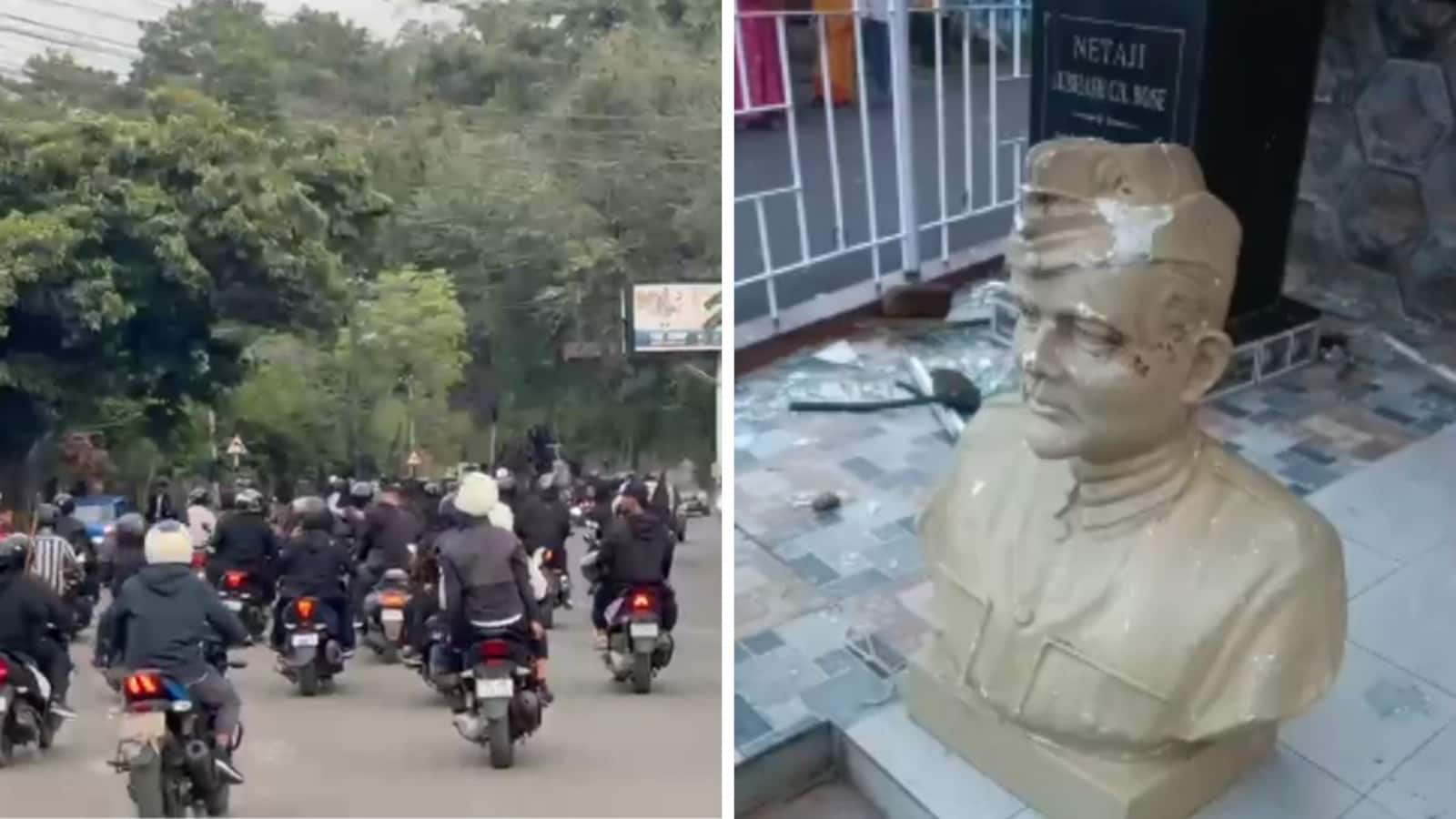
A black-flag motorcycle rally by the Khasi Students' Union (KSU) turned violent in Shillong, resulting in the burning of government vehicles and the vandalism of statues of Swami Vivekananda and Netaji Subhas Chandra Bose.
- The Khasi Students' Union (KSU) rally in Shillong escalated into widespread violence.
- Government vehicles, including an NIC vehicle and a police escort, were damaged or set on fire.
- Statues of prominent leaders Swami Vivekananda and Netaji Subhas Chandra Bose were vandalized.
The state capital of Shillong witnessed intense unrest on Wednesday as a black-flag motorcycle rally organized by the Khasi Students' Union (KSU) spiraled into violence. What began as a protest against the state government's perceived inaction turned into a scene of chaos, with protesters targeting vehicles and public property across multiple localities.
According to Meghalaya police sources, the violence was concentrated in key areas including Polo, Barik, and Mawlai. During the procession, a police escort vehicle was attacked, and a National Informatics Centre (NIC) vehicle's windshield was smashed in the Barik area. The situation reached a boiling point in Mawlai, where a government vehicle near the Food Corporation of India office was reportedly set ablaze.
Vandalism of National Icons
In a move that has sparked outrage, the protesters also targeted statues of iconic Indian leaders. In the RR Colony area, the glass enclosure protecting the statue of Swami Vivekananda was destroyed. Additionally, the statue of Netaji Subhas Chandra Bose was also vandalized, marking a significant escalation from political protest to the desecration of historical symbols.
The transition from peaceful demonstration to targeted vandalism of national icons signals a breakdown in organized protest protocols.
Why This Matters
BozokMedia analysis shows that the KSU's agitation is not merely a localized protest but a reflection of deep-seated socio-political anxieties in Meghalaya. The organization's five-point charter—which focuses on recruitment, indigenous protection, and environmental concerns—touches upon the core identity of the Khasi Hills region. Failure to address these demands through institutional channels could lead to prolonged instability in the Northeast.
Historical Background
The Khasi Students' Union (KSU) has long been a formidable force in Meghalaya's political landscape. Known for its fierce advocacy for indigenous rights and local autonomy, the KSU often acts as a pressure group that can mobilize large sections of the youth. Their current agitation follows a pattern of demanding greater representation and protection for the local populace against perceived external influences.
Frequently Asked Questions
1. What are the KSU's specific demands?
The KSU is demanding government action on a five-point charter involving recruitment, protection of indigenous residents, migration control, and environmental issues.
2. How has the administration responded?
While the district administration had initially permitted the rally under certain conditions, police have since stepped up security to prevent further law and order breakdowns.