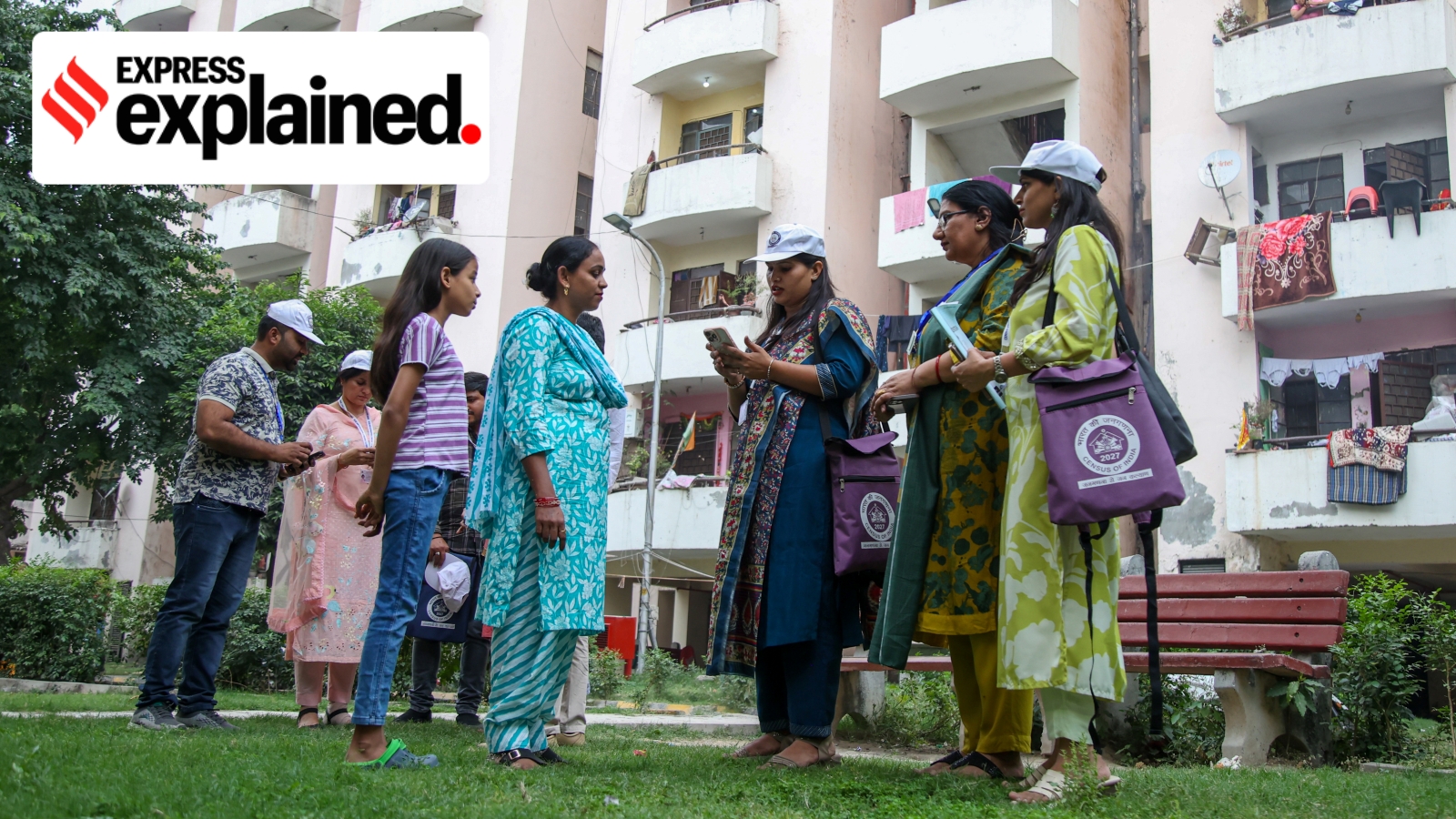
Several new questions in India's Census 2027 questionnaire, particularly those concerning parental details and identification documents, have sparked political controversy. Opposition parties allege these questions, drawing parallels with the National Population Register (NPR), could be used for surveillance and a "deeper nefarious purpose".
- The Census 2027 questionnaire includes 14 new or modified questions.
- Eight of these questions, such as parental details and ID proofs, were also part of the 2020 National Population Register (NPR).
- Opposition parties are raising concerns about privacy and surveillance.
- The government had previously stated that questions on parents' date and place of birth were optional in 2020.
- NPR is a register of residents, not a citizenship register, but is legally linked to citizenship registration.
New Delhi: A new political controversy has erupted in India concerning the questionnaire for the upcoming Census 2027. Several new and modified questions included in the questionnaire have triggered concerns from opposition parties, notably the Congress and the Left parties. They allege that the inclusion of these questions aims to facilitate surveillance and serve a "deeper nefarious purpose." The controversy is amplified by the fact that many of these questions were also part of the National Population Register (NPR) schedule prepared in 2020, which itself became highly contentious amid protests against the Citizenship Amendment Act (CAA).
New Census Questions and Link to NPR
The population enumeration questionnaire for Census 2027 comprises 40 questions, 14 of which are new or modified compared to the 2011 Census. These new questions cover details such as spouse's name, nationality as declared, father's and mother's particulars, Scheduled Caste/Scheduled Tribe/caste, literacy and digital literacy, highest educational qualification and stream, place of Covid-19 vaccination, number of bank accounts, mobile number, Aadhaar, voter ID, passport, and driving licence.
Significantly, eight of these questions – nationality as declared, father's particulars, mother's particulars, mobile number, Aadhaar, voter ID, passport, and driving licence – were also included in the NPR schedule for the 2020 exercise. The questions pertaining to parents' date and place of birth, including district and state, and country if born outside India, had been particularly at the centre of political opposition to the NPR.
Core Concerns: Privacy and Political Context
Two distinct concerns have emerged regarding this questionnaire: firstly, the privacy of personal data, and secondly, the political context in which the NPR has been revived. On privacy, the argument is that Census data has traditionally been collected for population statistics and planning. However, the new questionnaire seeks a much wider range of personal information, including details that can identify or link individuals to other government databases. Therefore, the question is not merely about how much data the government collects, but how it is stored, protected, and used.
The second concern relates to citizenship. The NPR is defined as a register of the country's "usual residents," not a citizenship register. A usual resident is someone who has lived in a local area for at least six months or intends to stay there for the next six months; this can include a foreigner meeting the residence criterion. However, the NPR is linked in law to the process for preparing the National Register of Indian Citizens. The Citizenship (Registration of Citizens and Issue of National Identity Cards) Rules, 2003, provide for the preparation of a Population Register and its verification for the preparation of the citizens' register. The rules also allow for individuals whose citizenship is considered doubtful to be marked for further inquiry.
Historical Background and Government Clarifications
The political context became explosive in 2019-20, when the CAA was passed and against the backdrop of the NRC in Assam, which had excluded around 19 lakh people. During this period, Union Home Minister Amit Shah repeatedly spoke of a nationwide NRC and asked people to understand the "chronology" in which the CAA would be followed by the NRC. This political context fundamentally changed how the exercise was perceived, associating an exercise previously conducted without comparable controversy with the possibility of citizenship being questioned.
It is important to note that the NPR itself was not new. It was first prepared in 2010 alongside the houselisting phase of the 2011 Census and updated through a door-to-door exercise in 2015, both without significant controversy.
In 2020, the government attempted to allay these concerns. Then Information and Broadcasting Minister Prakash Javadekar stated that the controversial questions on parents' date and place of birth were optional. He clarified that if a person remembered the information, they could provide it; otherwise, the columns could be left blank. Then Union Minister Ram Vilas Paswan also assured that no one could lose their citizenship merely for not knowing their parents' date or place of birth, and no documentary proof would be required for such information. The government also maintained that NPR was primarily a database of residents intended to improve policy formulation and delivery of welfare schemes.
Why This Matters
BozokMedia analysis shows that the renewed inclusion of questions similar to the NPR in the Census 2027 questionnaire has reignited the debate around data privacy, surveillance, and the potential for these exercises to be linked to citizenship determination. While the government emphasizes the utility of such data for policy-making and service delivery, civil society groups and opposition parties remain wary of the potential for misuse, especially given the historical context of the CAA and NRC discussions. The balance between data collection for public good and safeguarding individual privacy and rights is at the heart of this ongoing controversy.
“The collection of personal data in a national exercise like the Census is always a delicate balancing act, where the need for national development intersects with concerns for individual privacy and security.”
Frequently Asked Questions
- Which new questions in the Census 2027 questionnaire are controversial?
- Are NPR and NRC the same thing?