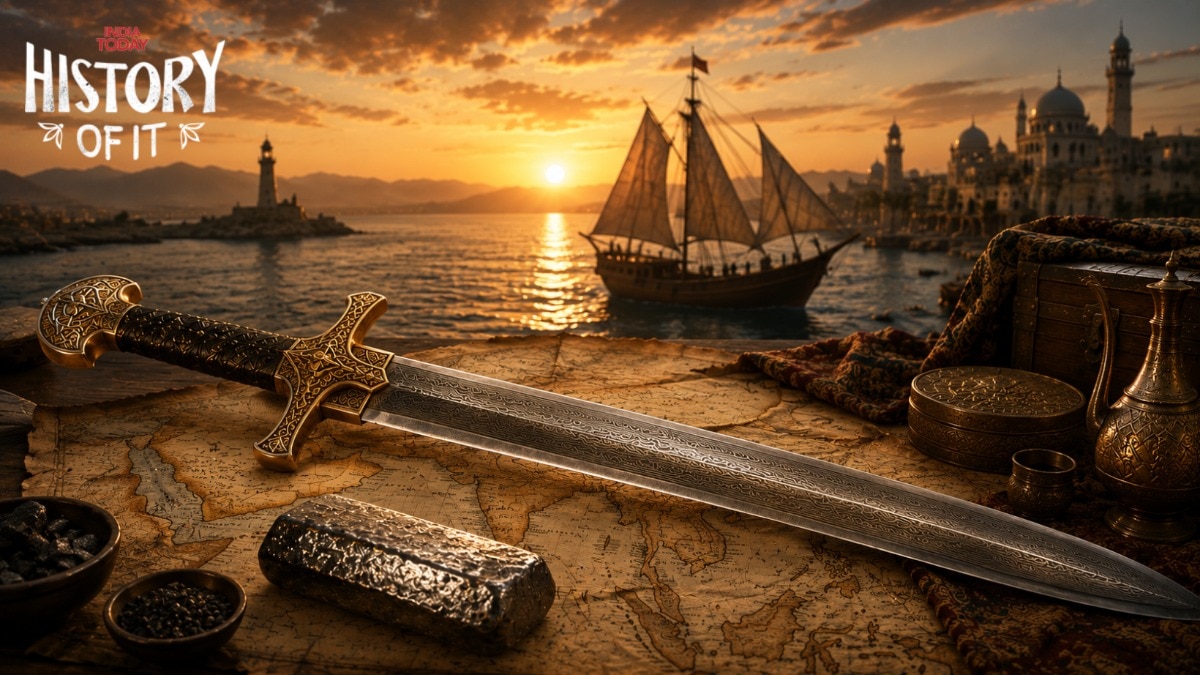
Centuries before modern geopolitics, Indian steel was the ultimate strategic resource. Discover how Indian craftsmanship became a symbol of divine strength in ancient Arabic poetry.
- Ancient Indian 'Wootz Steel' was globally renowned for its unparalleled quality.
- 7th-century poet Ka'b bin Zuhair used the metaphor of an 'Indian sword' (Muhannad) to praise Prophet Muhammad.
- India's mastery over metallurgy was a cornerstone of ancient global trade and power.
Long before 'critical minerals' became the buzzword of modern geopolitics, the mastery of materials was already the language of power. Centuries ago, Indian craftsmen perfected a substance so exceptional that it traveled across vast trade routes, influencing not just economies, but also the very fabric of literature and religion. This is the story of how Indian steel became a metaphor for greatness in the heart of Arabia.
In the 7th century, the celebrated Arabian poet Ka'b bin Zuhair composed his famous poem, Banat Su'd. In it, he invoked the image of the Prophet Muhammad as a 'Muhannad'—an Indian sword. This was not merely a poetic flourish; it was a recognition of the technological supremacy of Indian metallurgy. To the ancient world, an Indian sword represented the pinnacle of strength, sharpness, and reliability.
Why This Matters
BozokMedia analysis shows that the strategic importance of Indian steel in antiquity mirrors the current global race for semiconductors and rare earth elements. Just as nations today vie for control over critical minerals to secure their future, ancient civilizations sought Indian steel to secure their dominance. India's history proves that technological mastery over raw materials is the ultimate currency of geopolitical influence.
The journey of this steel began in the clay furnaces of the Middle Ganga Valley and the peninsular regions of South India. Archaeological evidence from sites like Malhar and Raja Nala-ka-tila points to a sophisticated ironworking tradition dating back millennia. However, the true marvel was Wootz steel—a high-carbon crucible steel that was produced with astonishing precision by craftsmen who lacked modern scientific instruments.
The mastery of Indian smiths over heat, ore, and carbon transformed simple iron into a legendary material that defined the eras of warriors and kings.
This steel, known as ukku in South India, was traded by merchants as Hinduwani and recognized by Persians as pulad. The production was an organized industry, with centers in modern-day Telangana, Karnataka, and Tamil Nadu. The discovery of crucible-steel ingots at Konasamudram serves as a testament to an industrial scale of production that predates modern manufacturing by centuries.
| Term | Region/Language | Meaning |
|---|---|---|
| Ukku | South India | Steel |
| Hinduwani | Arabia | Indian-made |
| Pulad/Faulad | Persia | Steel |
| Wootz | European/Scientific | Crucible Steel |
Frequently Asked Questions
1. What makes Wootz steel unique?
It is a high-carbon crucible steel known for its distinctive patterns and ability to hold an incredibly sharp edge.
2. How did Indian steel reach the Middle East?
It was transported through ancient maritime and land-based trade routes by merchants and envoys.