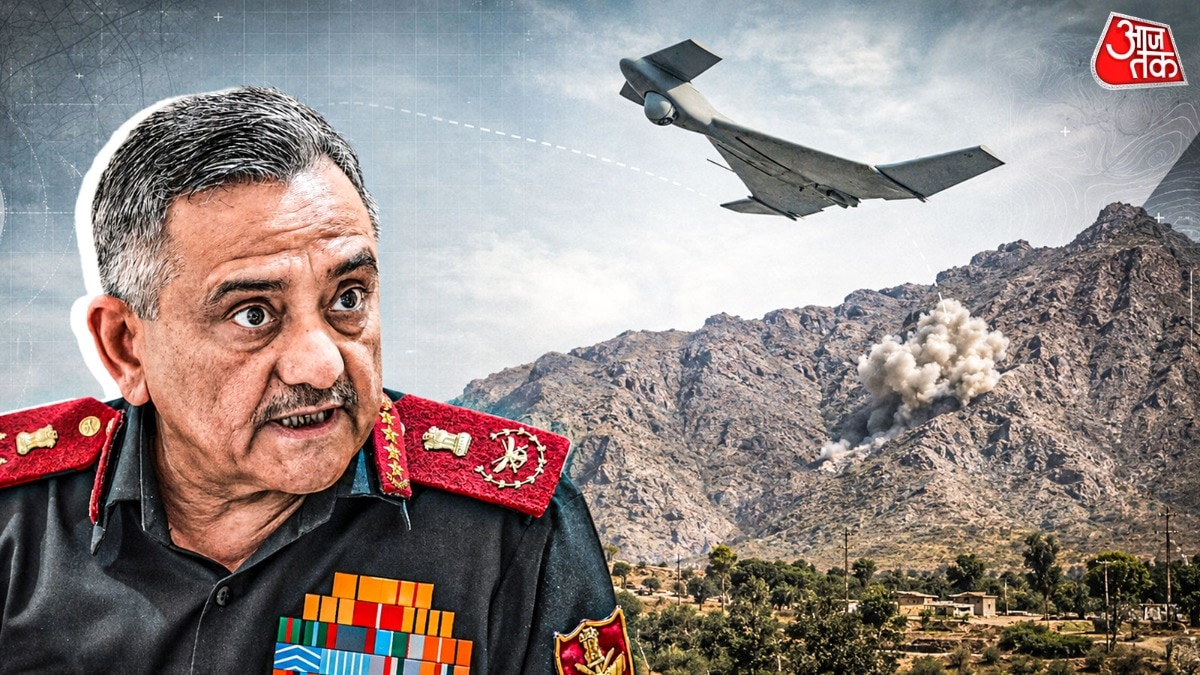
Former CDS General Anil Chauhan revealed that during Operation Sindoor, an Indian loitering munition might have landed in the Kirana Hills area, a critical site for Pakistan's nuclear facilities. He also highlighted Pakistan's severe intelligence failures.
- Ex-CDS General Anil Chauhan stated that a loitering munition sent to find radars may have landed in Pakistan's Kirana Hills.
- Kirana Hills, located near Sargodha, is a known location for Pakistan's nuclear facilities.
- The munitions were designed to loiter for two hours; if no target was found, they would eventually crash.
- Chauhan criticized Pakistan's maritime intelligence and its heavy reliance on Chinese military platforms.
Speaking at an event hosted by the Vivekananda International Foundation, former Chief of Defence Staff (CDS) General Anil Chauhan (retd) provided significant insights into the aftermath of Operation Sindoor. He noted that one of the loitering munitions deployed to locate enemy radars may have inadvertently landed in the Kirana Hills region.
The Kirana Hills Connection
General Chauhan explained that during the operation, multiple loitering munitions were dispatched toward Sargodha and the nearby Kirana Hills to identify radar installations. Kirana Hills, situated approximately 10 km north of Sargodha, is strategically sensitive as it houses Pakistan's nuclear facilities.
He clarified the technical nature of these weapons, stating they have a specific 'lifetime' or loitering duration of about two hours. "If it does not find a target, it comes down and hits somewhere," Chauhan remarked. He added that this could explain why Pakistani media had previously broadcasted images showing smoke emanating from the Kirana Hills area.
Why This Matters
BozokMedia analysis shows that these revelations underscore the precision and the inherent risks of modern autonomous warfare. While the official stance from the Air Force (via Air Marshal A K Bharti) was that India did not intentionally target nuclear sites, the accidental landing of a munition in such a sensitive zone highlights the razor-thin margin of error in high-stakes electronic warfare.
"Pakistan's understanding of the situation was quite poor, even in the maritime domain, often relying on inaccurate foreign inputs."
Intelligence Failures and Chinese Dependency
A major theme of the General's address was the systemic failure of Pakistan's intelligence apparatus. He noted that Pakistan's briefings regarding the movement of Indian carrier battle groups were frequently erroneous, often by hundreds of nautical miles. This inaccuracy suggests a heavy reliance on external intelligence sources rather than domestic surveillance.
Furthermore, Chauhan addressed the 'China-Pakistan' nexus, noting that 70% to 80% of Pakistan's military platforms are of Chinese origin. He pointed out that during conflicts, Chinese Original Equipment Manufacturers (OEMs) are often present in the country to maintain these systems. However, he also noted that Pakistan's attempts to utilize Chinese commercial satellite imagery failed to yield accurate targeting results.
Historical Background
The Sargodha-Kirana Hills corridor has long been a focal point of regional security concerns. As the heart of Pakistan's strategic deterrent, any kinetic activity in this sector—whether intentional or accidental—carries immense geopolitical weight and potential for escalation.
Frequently Asked Questions
1. Was Operation Sindoor a direct attack on Pakistan's nuclear sites?
No. According to General Chauhan, the munitions were targeting radars, and any impact on the hills was likely due to the munition's programmed flight path after failing to find a radar.
2. Why did Pakistan struggle with maritime tracking?
General Chauhan suggested that Pakistan relies too heavily on foreign intelligence, leading to significant errors in tracking Indian naval movements.