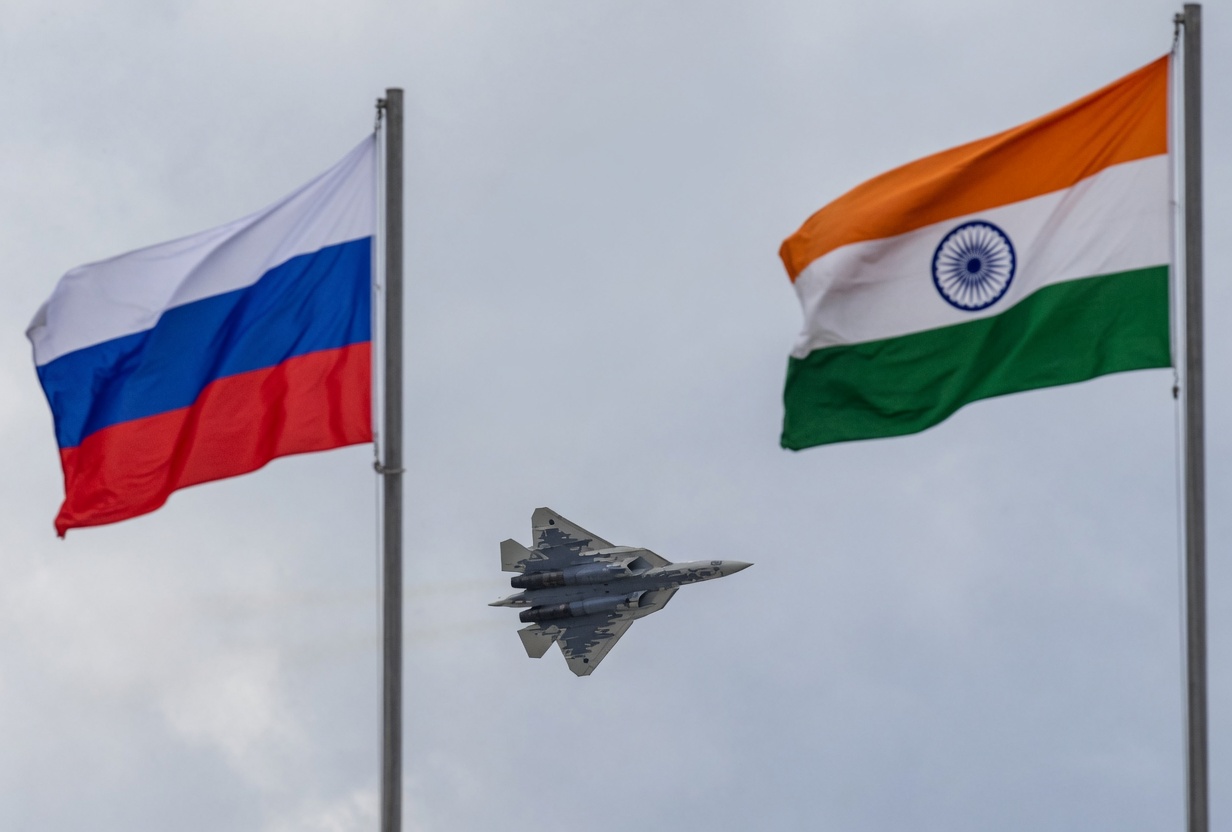
As India weighs the acquisition of the Russian Su-57 stealth fighter, a critical question emerges: Will India replicate China's success in absorbing Soviet technology, or miss a generational opportunity?
- Russia has offered India full access to Su-57 source codes, AESA radar, and local production.
- China utilized the post-Soviet collapse to acquire critical technology, fueling its modern air force.
- The IAF faces a shortage of squadrons while waiting for the indigenous AMCA.
- Acquiring Su-57 could provide a technological leap in engines and hypersonic systems.
The Indian Air Force (IAF) stands at a strategic crossroads. While the prospect of acquiring Russian 5th-generation Sukhoi Su-57 stealth fighters remains on the table, the Indian government's stance appears cautious. Defense Secretary Rajesh Kumar Singh recently hinted that India has no immediate plans for a 'new version of the Sukhois,' signaling a shift toward indigenous platforms and Western collaborations like the Future Combat Air System (FCAS).
However, military analysts argue that a limited induction of Su-57 squadrons could bridge the widening stealth gap between India and its neighbors, particularly if China deploys advanced J-35 jets in the region. The debate pits the proven reliability of the Rafale against the unproven, yet high-potential, Su-57.
Why This Matters
BozokMedia analysis shows that the real significance of the Su-57 deal lies in the historical context of technological absorption. In the 1990s, following the collapse of the USSR, China aggressively recruited Russian scientists and secured licenses for the Su-27, which evolved into the J-11 and eventually the J-20. China didn't just buy planes; they bought the intellectual capital that built them.
Strategic autonomy is not achieved by refusing technology, but by mastering it and building beyond it.
Today, Russia is in a position where it desperately needs reliable partners and hard currency due to international sanctions. This has made Moscow unprecedentedly flexible. President Vladimir Putin has reportedly offered India 'no limitations' on the Su-57, including mission software and integration of Indian-made weaponry. This could solve the critical high-thrust engine bottleneck currently facing India's Advanced Medium Combat Aircraft (AMCA) program.
Comparison: Su-57 vs. Global Peers
| Feature | Sukhoi Su-57 | Rafale | J-20 (China) |
|---|---|---|---|
| Generation | 5th Gen | 4.5 Gen | 5th Gen |
| Tech Transfer | High (Proposed) | Low | High (via Absorption) |
| Primary Advantage | Stealth/Agility | Multi-role/Reliability | Mass Production/Tech |
Beyond fighter jets, a partnership could unlock access to advanced Russian expertise in hypersonic missiles, nuclear-powered submarine designs, and next-generation propulsion systems. For a nation striving for Atmanirbharta (self-reliance), absorbing cutting-edge tech is a faster route than starting from scratch.
Frequently Asked Questions
1. Is the Su-57 a true stealth aircraft?
While critics argue its stealth capabilities are inferior to US jets, it possesses a significantly lower Radar Cross Section (RCS) than many 4th-generation fighters.
2. Why is India focusing on FCAS instead?
India is looking to diversify its technological base by engaging with European-led programs for 6th-generation capabilities.