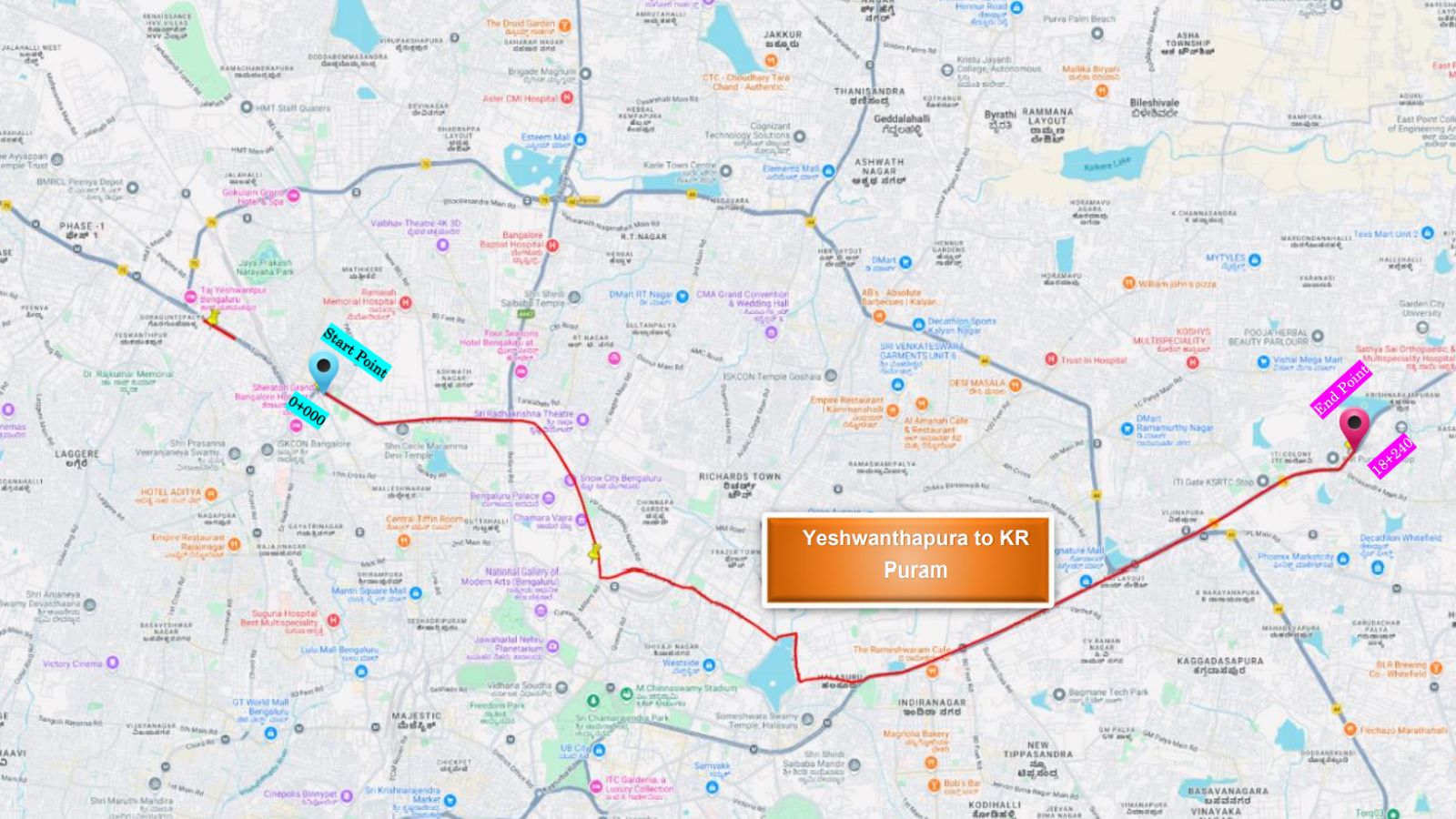
Tenders have been invited for Bengaluru's landmark 28-km Yeshwanthpur–KR Puram elevated corridor. Built under a BOOT model, the project features a strict 32.5-year cap on toll collection.
- A 28-km elevated corridor will connect Yeshwanthpur to KR Puram.
- The estimated project cost is ₹3,536 crore.
- Toll collection is strictly capped at 11,863 days (approx. 32.5 years).
- The project follows the Build-Own-Operate-Transfer (BOOT) model.
In a major push for urban mobility, tenders have been officially invited for Bengaluru's very first toll-based flyover. The proposed Yeshwanthpur–KR Puram elevated corridor aims to revolutionize connectivity across the city. Bengaluru Smart Infrastructure Ltd (BSMILE) announced that the 28-km stretch will be developed under the Build-Own-Operate-Transfer (BOOT) model, with a construction deadline set at 30 months.
A unique financial mechanism has been introduced to prevent excessive concession periods. BSMILE has explicitly stated that toll collection cannot exceed 11,863 days, which equates to roughly 32.5 years from the date the tender is awarded. Unlike traditional government-fixed contracts, bidders must now quote the specific number of days they require to recover their investment and generate returns. Any bid exceeding the 11,863-day limit will be summarily rejected.
Route and Technical Specifications
The corridor is set to traverse through critical hubs, including Mathikere Cross, IISc, Mekhri Circle, Jayamahal, St John’s Church Road, and Ulsoor Lake, before reaching KR Puram via Old Madras Road. The four-lane structure will be 19.61 metres wide, engineered for design speeds of 60-80 km/hour. The project also incorporates a split flyover at the MEI Junction and includes 10 up and 10 down ramps to ensure seamless access at major junctions like RT Nagar, Indiranagar, and Varthur Road.
Why This Matters
BozokMedia analysis shows that this corridor addresses a significant gap in Bengaluru's current transit network. While the Metro provides connectivity between Yeshwanthpur and Indiranagar, the existing route forces commuters to pass through the congested Majestic/Central Business District. By providing a direct east-west link that bypasses the city center, this elevated corridor will significantly slash travel times and reduce the carbon footprint caused by idling traffic.
This project marks a paradigm shift in how urban infrastructure is financed in India, moving toward competitive concession bidding.
Financially, the scale of the project is massive. According to the Detailed Project Report (DPR), the total estimated cost stands at ₹3,536 crore. Of this, civil works alone are pegged at ₹2,710 crore, with the superstructure accounting for more than 62% of the total civil expenditure.
Frequently Asked Questions
1. How long will it take to complete the construction?
The project is slated to be completed within a strict timeline of 30 months from the commencement of work.
2. What happens if a bidder asks for more than 32 years to collect tolls?
The tender document specifies that any bid requesting more than 11,863 days will be automatically rejected.