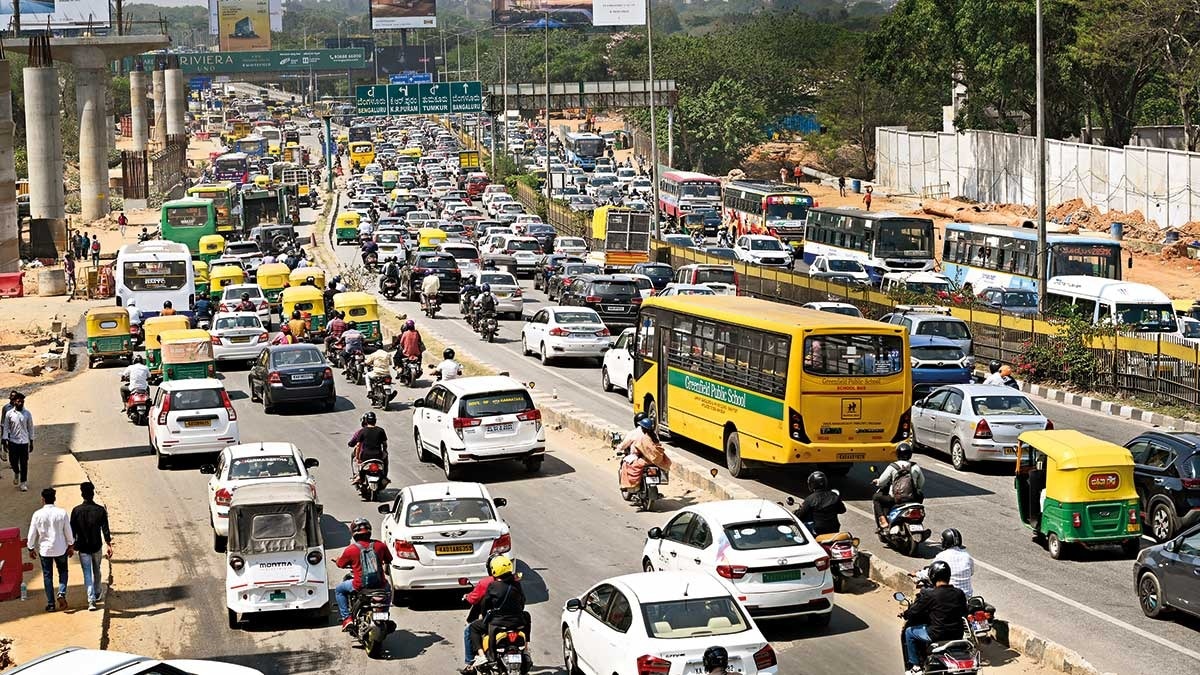
Karnataka Minister Krishna Byre Gowda has called for a dedicated regulatory body to tackle Bengaluru's traffic crisis, revealing that parked vehicles consume nearly 60% of the city's road space.
- Parked vehicles occupy approximately 60% of Bengaluru's available road space.
- Minister Krishna Byre Gowda proposes a dedicated regulatory agency for parking enforcement.
- Expansion of roads alone is deemed insufficient; public discipline and micromobility are key.
- GPS tracking is now mandatory for construction and demolition (C&D) waste vehicles.
The worsening traffic congestion in Bengaluru has reached a critical tipping point, prompting the Karnataka government to evaluate the creation of a dedicated agency to regulate and enforce parking rules. During a high-level meeting with former Mayors at Vidhana Soudha, Greater Bengaluru Development Minister Krishna Byre Gowda delivered a stark revelation: parked vehicles currently occupy nearly 60 per cent of the city's available road space, severely throttling the movement of commuters.
Minister Gowda emphasized that the solution to the city's gridlock does not lie solely in the expansion of the road network. He argued that without a fundamental shift in public behavior and the strict enforcement of existing laws, new roads would quickly succumb to the same chaos. The Minister highlighted that even narrow residential lanes are often choked by vehicles parked on both sides, effectively reducing functional road width to a fraction of its design.
Why This Matters
BozokMedia analysis shows that Bengaluru's traffic crisis is no longer just an infrastructure failure but a regulatory collapse. When 60% of road capacity is lost to static vehicles, the efficiency of the entire urban transit system drops exponentially. The shift toward a dedicated regulatory body suggests the government recognizes that the police and civic bodies currently lack the specialized manpower and mandate to manage urban parking scientifically.
"Unless people develop a sense of self-discipline, it will be impossible to find a solution to Bengaluru's traffic problem."
Beyond parking, the Minister advocated for the integration of micromobility for short-distance journeys under two kilometers. However, he noted that this transition is impossible without restored footpaths and stringent parking regulations to prevent sidewalks from becoming makeshift garages. He also expressed frustration over the blatant disregard for building regulations, specifically unauthorized sewer line alterations and the lack of mandatory parking spaces in new residential constructions.
In a bid to clean up the city's periphery, the government has now made registration and GPS tracking mandatory for vehicles transporting construction and demolition (C&D) waste. This initiative aims to stop the illegal dumping of debris on roadsides, directing waste instead to five designated disposal facilities.
The meeting also served as a platform for former Mayors to push for systemic civic reforms. Their recommendations included the establishment of a dedicated asphalt plant for the civic body to eliminate dependence on private contractors, the acceleration of the ₹2,000-crore stormwater drain project, and a total ban on single-use plastics to improve garbage management.
| Current Approach | Proposed Strategy |
|---|---|
| Road Network Expansion | Parking Regulation & Enforcement |
| General Police Monitoring | Dedicated Parking Regulatory Body |
| Private Contractor Asphalt | Government-Owned Asphalt Plant |
| Unregulated C&D Waste | GPS Tracking & Designated Facilities |
Frequently Asked Questions
1. Why is a dedicated regulatory body needed for parking?
Because current civic administrations and police lack the specialized manpower and resources to monitor and enforce parking rules across the sprawling metropolis of Bengaluru.
2. How will GPS tracking help in waste management?
It prevents the illegal dumping of construction debris on roadsides by ensuring waste vehicles travel only to designated disposal sites.