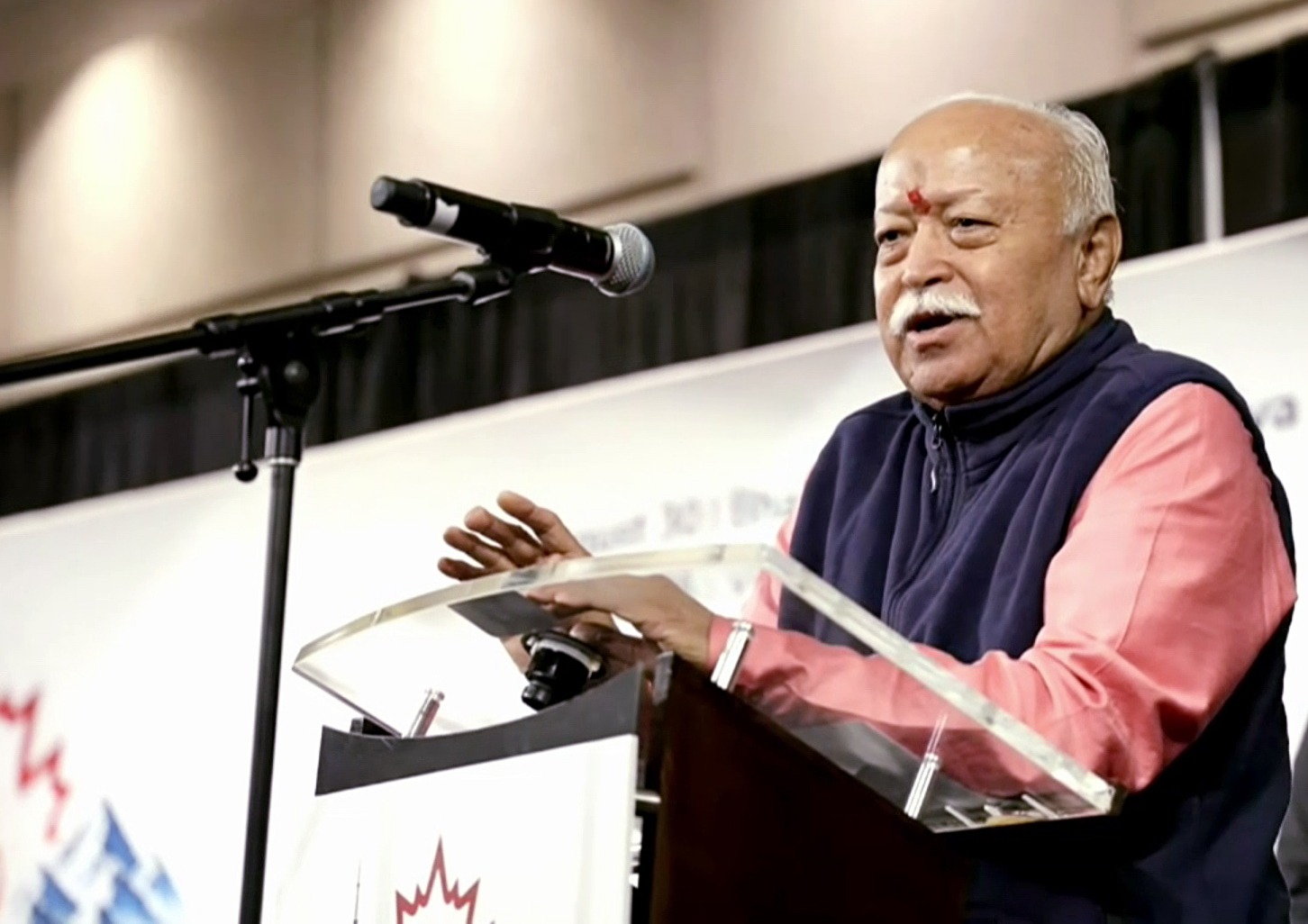
RSS Sarsanghchalak Mohan Bhagwat asserts that India's global influence stems from its civilizational character and tradition of service rather than military or economic dominance. Speaking in Canada, he highlighted the concept of 'Vasudhaiva Kutumbakam' as the blueprint for global unity.
- India's status as 'Vishwaguru' is based on character and service, not 'Mahashakti' (superpower) status.
- The RSS chief emphasized that India's history is one of sharing knowledge, not conquest or conversion.
- Bharat's 'DNA' is defined by providing refuge to persecuted communities and aid during global crises.
- Proposed a 'Third Way' of development to balance individual happiness, societal well-being, and environmental sustainability.
In a significant address to the Indian community in Canada, the chief of the Rashtriya Swayamsevak Sangh (RSS), Mohan Bhagwat, redefined India's trajectory on the global stage. He argued that Bharat has attained the status of "Vishwaguru" (the world's teacher) not by pursuing the traditional path of a "Mahashakti" or superpower, but through its enduring character and a deep-rooted tradition of serving humanity.
Bhagwat emphasized that whenever India grew in influence historically, it never sought to dominate others. Instead, it became a glorious nation that served the world. He cited the ancient journeys of Indians from Mexico to Siberia and across Southeast Asia, noting that they brought mathematics, Ayurveda, and civilizational values without ever attempting to conquer lands or forcibly convert populations.
Why This Matters
BozokMedia analysis shows that this rhetoric marks a strategic shift in how the RSS intends to project India's soft power globally. By distancing the term 'superpower'—often associated with hegemony and military coercion—from 'Vishwaguru', Bhagwat is positioning India as a moral and spiritual leader. This narrative aims to appeal to a global audience weary of geopolitical tensions, presenting India as a stabilizing force based on ethical leadership.
The RSS chief further explained that the Hindu understanding of the world is rooted in seeing unity within diversity. He pointed to India's historical role as a sanctuary for persecuted groups, specifically mentioning the Parsis and Jews, as evidence of this inclusive DNA. He argued that this openness is not just a religious trait but a civilizational identity.
"India's rise should not be measured by its GDP or military arsenal, but by its ability to make the world realize that unity can coexist with diversity through practice, not preaching."
Addressing contemporary crises, Bhagwat questioned the current global development model. He argued that the prosperity of one group often comes at the expense of another or the environment. He proposed a "Third Way"—the ancient way of Hindustan—where Dharma acts as a mechanism for sustenance and balance, ensuring that individual progress does not harm society or the planet.
His remarks in Canada follow a similar address at Madison Square Garden in New York, where he stressed that India's destiny is to lead by example. He urged Hindus worldwide to embrace this worldview and contribute to their respective countries while sharing the values of Vasudhaiva Kutumbakam (the world is one family).
Frequently Asked Questions
Q1: What is the difference between a 'Superpower' and a 'Vishwaguru' according to Mohan Bhagwat?
A superpower (Mahashakti) is typically associated with dominance, military might, and economic control, whereas a Vishwaguru is a leader that guides the world through moral character, knowledge, and service.
Q2: How did Mohan Bhagwat define the 'Hindu' identity in his speech?
He defined it in civilizational terms rather than religious ones, stating that being Hindu means accepting and respecting all, regardless of language, worship style, or living standards.