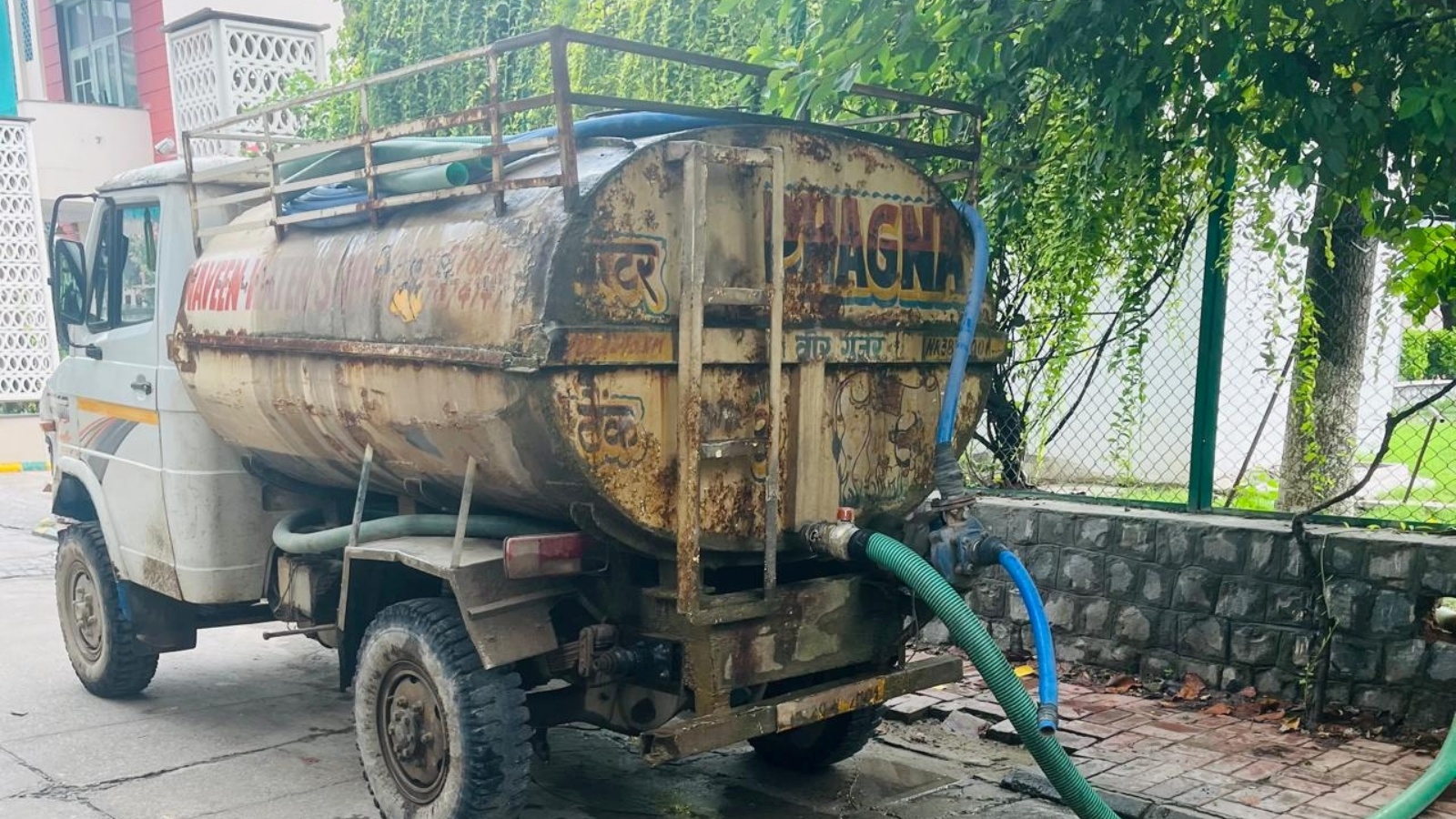
Despite owning luxury villas worth up to ₹4 crore, residents of Faridabad's Achievers Society have been forced to rely on private water tankers for two decades. The Haryana Human Rights Commission has now intervened, ordering immediate free water supply.
- Residents of Achievers Society, Faridabad, have lacked a municipal water connection since 2005.
- The colony features luxury villas valued between ₹2 crore and ₹4 crore.
- The Haryana Human Rights Commission (HHRC) has ordered free government tanker supply.
- Groundwater depletion and failed borewells have left 500 families dependent on private vendors.
In a stark contrast between urban aspiration and ground reality, the Achievers Society in Sector 49, Kalindi Hill, Faridabad, presents a grim picture of systemic failure. While the colony boasts wide cemented roads, underground cabling, and manicured parks, its nearly 500 families have been fighting a desperate battle for a basic human necessity: running water. For over 20 years, these residents—many of whom own properties valued at ₹2 crore to ₹4 crore—have been forced to rely entirely on private water tankers.
Developed under the Town Planning Scheme in 2004, the colony was never integrated into the municipal water network. Initially, residents relied on borewells, but as the groundwater levels plummeted, these sources dried up. This has left the community in a perpetual state of water insecurity, with approximately 90 to 100 private tankers entering the society daily during peak summer months to meet the demand.
Why This Matters
BozokMedia analysis shows that this crisis highlights a massive gap in urban governance and infrastructure planning. When high-value real estate developments are completed without ensuring sustainable utility networks, it creates a legal and humanitarian vacuum that places an undue financial and physical burden on citizens.
'The prolonged lack of safe and adequate drinking water raises serious human rights and constitutional concerns under Article 21.'
The legal battle reached the Haryana Human Rights Commission (HHRC) after residents failed to get relief from local MLAs and grievance committees. The HHRC took a stern view of the situation, citing Section 267 of the Haryana Municipal Corporation Act, 1994, which mandates civic bodies to provide adequate water supply within five years of a scheme's sanction.
The commission has directed the Municipal Corporation of Faridabad (MCF) and the Faridabad Metropolitan Development Authority (FMDA) to ensure an uninterrupted supply of free water via government tankers until a permanent solution is implemented. A status report regarding water quality and a roadmap for permanent infrastructure is expected by November 12.
The quality of available water is also a major concern. Residents report that the remaining groundwater is muddy with a TDS (Total Dissolved Solids) level of around 2,000 ppm, far exceeding the healthy limit of 50-300 ppm. This has not only increased costs but has also prompted several families to sell their homes and relocate.
Frequently Asked Questions
Question 1: Why is there no municipal water in Achievers Society?
Answer: The colony was developed under a scheme that never included a municipal water network, and local borewells have since run dry.
Question 2: What action has the HHRC taken?
Answer: The HHRC has ordered the MCF and FMDA to provide free water through government tankers until a permanent connection is established.