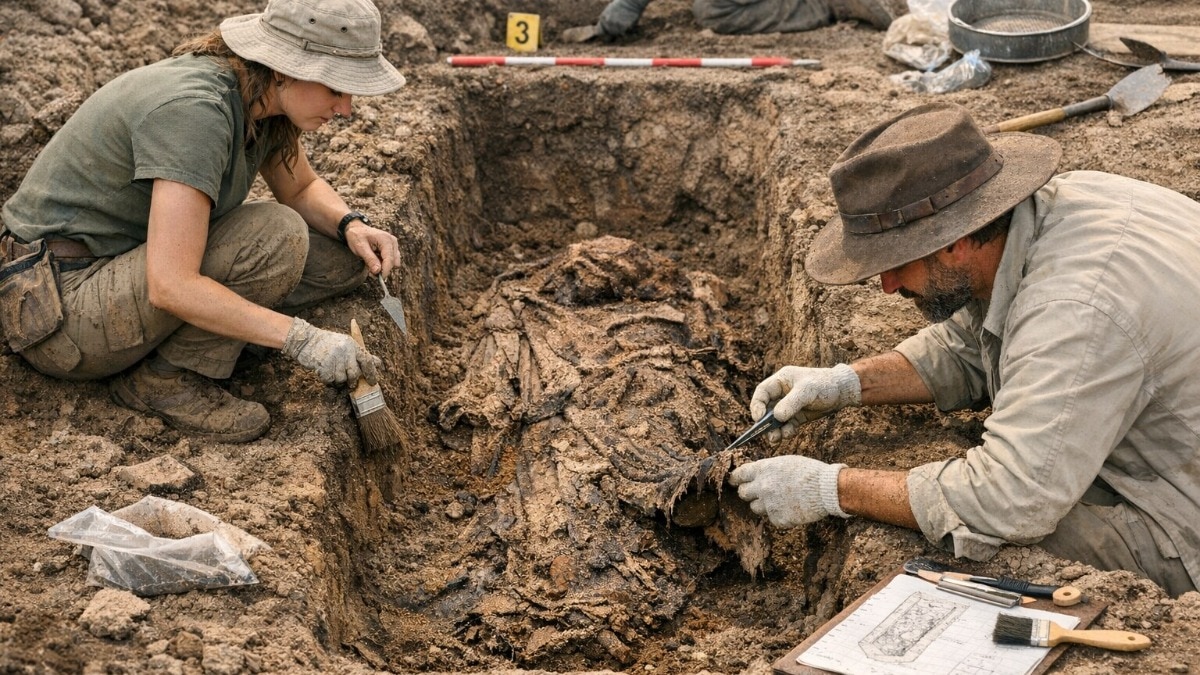
Archaeologists in Poland have unearthed a 400-year-old grave of a girl named 'Zosia,' who was buried with a padlock on her foot and a sickle on her neck to prevent her from rising as a vampire.
- A 400-year-old skeleton of a girl named 'Zosia' was found in Poland with a padlock on her toe.
- A sharp iron sickle was placed across her neck to decapitate her should she attempt to rise from the grave.
- Despite her noble background, physical abnormalities likely led the community to label her a 'vampire'.
In the annals of history, there are discoveries that blur the line between archaeology and horror. A recent find in Poland has shed light on the profound fear of the 'undead' that gripped European society during the 17th century. Archaeologists discovered the remains of a young woman, aged between 17 and 19, whom they affectionately named 'Zosia'. However, the manner of her burial was anything but affectionate.
Zosia was found in a coffin with a heavy iron padlock fastened to her big toe. In a further attempt to secure the grave, the site had been reopened post-burial to place a sharp iron sickle across her neck. This macabre arrangement served a singular purpose: if Zosia attempted to rise as a 'vampire' and climb out of her grave, the sickle would effectively decapitate her, ensuring she remained dead.
Why This Matters
BozokMedia analysis shows that this case is a stark manifestation of the intersection between medical ignorance and social hysteria. In 17th-century Eastern Europe, any physical deformity or sudden epidemic was often attributed to supernatural causes. Zosia's skeleton revealed an unusual chest structure that likely caused her significant pain in life. Without modern medical knowledge, the community likely misinterpreted this deformity as a mark of the occult or a sign of vampirism.
"The practice of 'anti-vampire' burials reflects a collective psychological trauma where the living projected their fears of disease and death onto the deceased."
Interestingly, Zosia was not from a marginalized background. She was buried wearing a luxurious silk cap adorned with genuine gold and silver threads, indicating she belonged to a wealthy or noble family. This proves that in the face of deep-seated superstition, neither wealth nor social status could provide immunity from the community's fear.
Historical records indicate that since the 11th century, beliefs about the 'returning dead' were prevalent across Eastern Europe. This led to various abnormal burial practices, including burying bodies face-down, placing stones in mouths, or using chains and locks to anchor the corpse to the earth.
Frequently Asked Questions
1. Why was Zosia specifically targeted as a vampire?
Researchers believe her unusual chest anatomy and the possibility of her being blamed for a local famine or virus led the villagers to perceive her as a supernatural threat.
2. Was the padlock a common practice?
Yes, in regions where vampire myths were strong, locking the feet or binding the body was a known method to prevent the 'undead' from escaping the coffin.