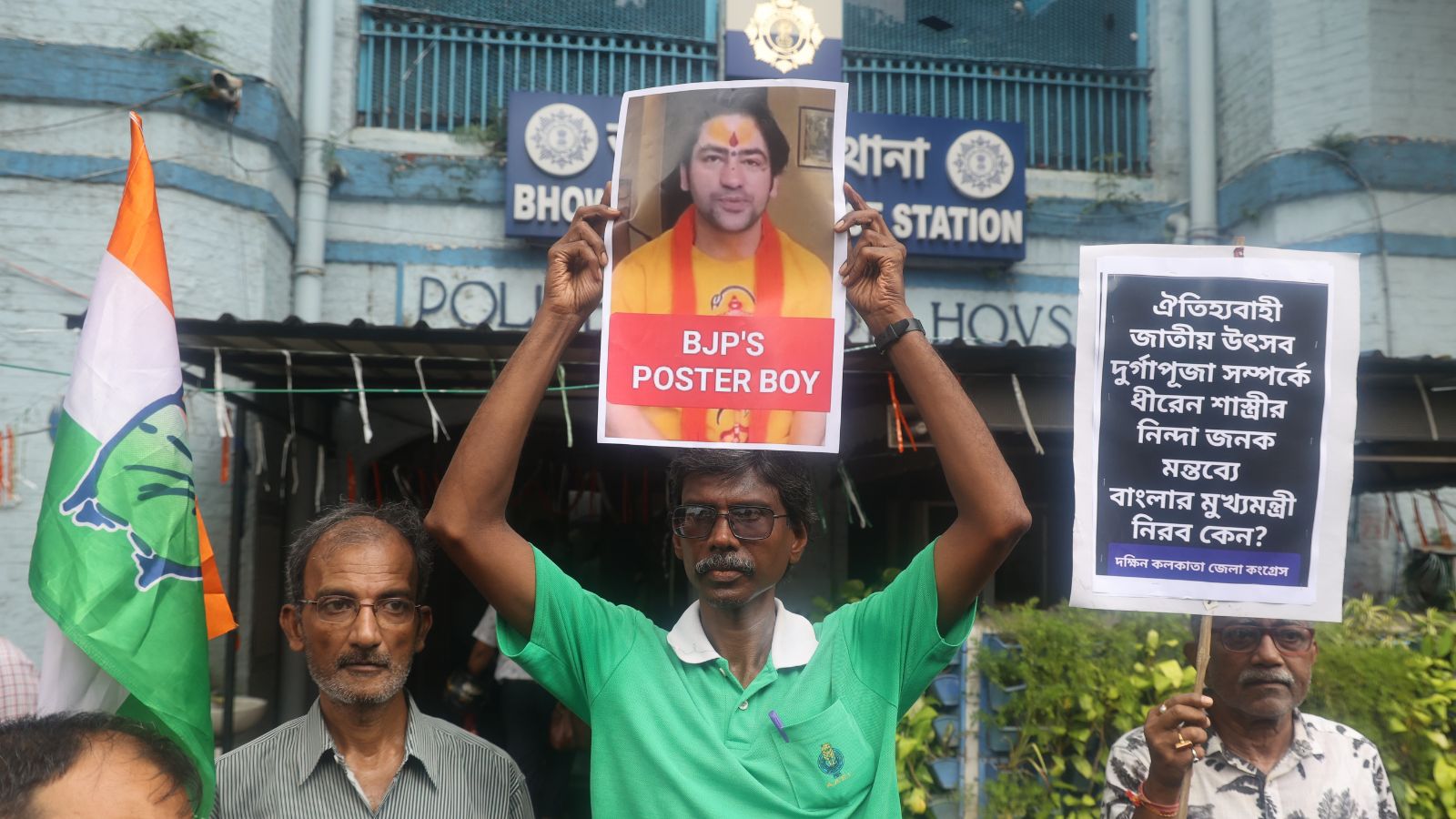
The Congress party has moved the police against Bageshwar Dham chief Dhirendra Shastri after he labeled those eating fish and meat during Durga Puja as 'frauds'. The controversy has ignited a fierce debate over cultural identity and culinary traditions in West Bengal.
- Congress filed police complaints in Bhabanipur and via email to Kolkata Police against Dhirendra Shastri.
- Shastri called those eating fish/meat during Durga Puja 'pakhandi' (frauds) and used the term 'ganda cooking'.
- The BJP state chief distanced the party from the comments, while local leaders highlighted the tradition of animal sacrifice.
In a significant escalation of cultural tension just weeks before the grand Durga Puja celebrations, the Congress party has filed formal police complaints against Dhirendra Shastri, the chief priest of Bageshwar Dham. The legal action follows a series of controversial remarks made by Shastri during an event in Liluah, where he urged devotees to abstain from consuming fish and meat during the festival, labeling those who do so as "pakhandi" (frauds).
Pradeep Prasad, the South Kolkata District Congress president, filed a complaint at the Bhabanipur Police Station, demanding an immediate FIR. The Congress alleges that Shastri's comments were not merely religious advice but a direct attack on the Bengali cultural identity. By referring to traditional culinary practices as "ganda ganda cooking," the party claims Shastri has insulted the sentiments of millions of Bengalis who view fish and meat as integral parts of their social and religious fabric during the Puja.
Why This Matters
BozokMedia analysis shows that this incident transcends a simple debate over diet; it is a clash between a centralized, orthodox interpretation of Hinduism and the deeply rooted, localized traditions of Bengal. In West Bengal, the intersection of faith and food is complex, where fish and meat are often offered as prasad. When an influential figure from outside the region attempts to redefine these norms, it is perceived as cultural imperialism, making it a volatile political issue ahead of major festivals.
The political fallout has been swift. While the BJP state chief Samik Bhattacharya attempted to distance the party from the remarks, other leaders like Dilip Ghosh defended the regional context. Ghosh pointed out that the tradition of animal sacrifice to Goddess Kali and Goddess Durga is an age-old practice in Bengal, emphasizing that the meat consumed is viewed as sacred offerings.
"The attempt to homogenize diverse regional religious practices under a single moral lens often leads to social friction and political polarization in multi-cultural states like West Bengal."
Adding to the complexity, the Trinamool Congress (TMC) has criticized the BJP and the state government for the "grand welcome" extended to Shastri, including a dinner hosted by the Cabinet. The TMC argues that honoring a figure who insults the people's traditions is a contradiction and an affront to the state's heritage.
Historically, Durga Puja in Bengal is not just a religious event but a socio-cultural phenomenon. The culinary traditions associated with it, including the preparation of specific fish and meat dishes, are passed down through generations. Any external interference in these habits is often met with strong resistance, as seen in previous instances where regional identity was pitted against external narratives.
Frequently Asked Questions
Q1: Why did the Congress file a complaint against Bageshwar Baba?
The complaint was filed because Shastri allegedly insulted Bengali culture by calling people who eat fish and meat during Durga Puja 'frauds' and describing their cooking as 'dirty'.
Q2: What is the BJP's stance on this issue?
The BJP state chief distanced the party from the comments, but other leaders like Dilip Ghosh highlighted that meat and fish offerings are a long-standing tradition in Bengal.