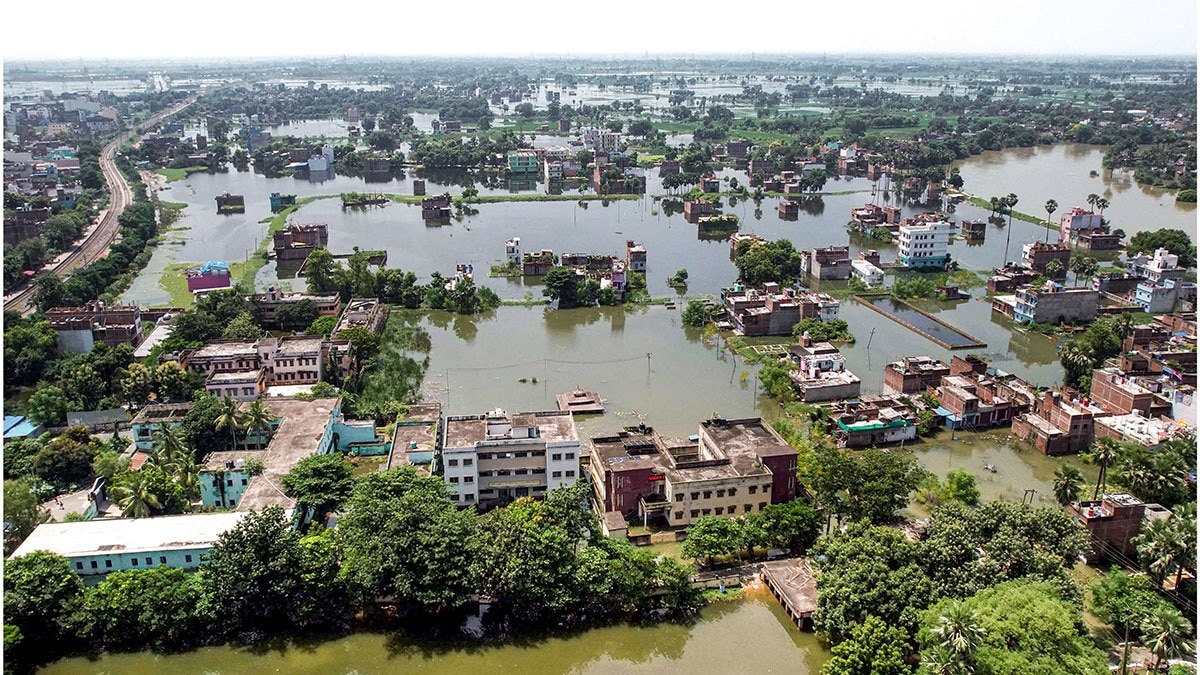
Despite below-normal monsoon rainfall, Patna faced a critical rise in Ganga water levels. Experts reveal this was a 'junction flood' caused by the simultaneous surge of multiple tributaries into an already saturated main channel.
- Patna's geography makes it a critical junction for the Sone, Gandak, and Punpun rivers.
- A 'Junction Flood' occurs when tributaries peak while the main river is already running high.
- Downstream bottlenecks at Munger and Bhagalpur prevented water from exiting the Patna stretch quickly.
- The Sone river was the primary contributor to the recent water surge.
The city of Patna does not simply sit on a single river; it is positioned at a complex hydrological crossroads. Within a few kilometers of the capital, the Ganga receives three massive tributaries: the Sone from the southwest, the Gandak from the north (via Nepal), and the Punpun from the southeast. This unique geography means that the water level at Patna is not just a reflection of local rain, but a culmination of water from thousands of square kilometers across multiple states.
The recent surge in water levels, despite below-normal rainfall, is a phenomenon known as a 'Junction Flood'. This occurs when several rivers rise simultaneously while the main artery—the Ganga—is already running high. Because the terrain in Bihar is exceptionally flat, the river's hydraulic head is reduced, meaning it cannot move water downstream fast enough to accommodate new inflows. Consequently, water 'backs up' at the confluences, pushing the gauges at Patna to dangerous heights.
Why This Matters
BozokMedia analysis shows that this event highlights a critical vulnerability in urban planning and disaster management. When the 'exit route' (the downstream stretch toward Munger and Bhagalpur) is already saturated or above the danger mark, the river essentially acts as a stagnant lake rather than a flowing stream. This 'stacking' effect means that even a moderate release from a barrage can cause catastrophic flooding in a specific reach, such as from Danapur to Fatuha.
"A river doesn't need to overflow everywhere for a specific gauge to jump; it only needs more water entering a stretch than that stretch can carry away at that moment."
The primary driver this season was the Sone River. Originating near Amarkantak, the Sone is a plateau-fed river. On September 2, the Indrapuri Barrage recorded a peak discharge of 563,654 cusecs. This massive volume of water collided with a Ganga that was already struggling to push water toward the Bay of Bengal. While the Gandak and Punpun also contributed, the Sone's peak was the catalyst for the broken records at Gandhi Ghat.
Furthermore, the 'road out' was blocked. At the same time Patna was peaking, gauges at Hathidah, Munger, and Bhagalpur were already at or above their own flood records. This created a hydraulic bottleneck. The water from Patna had nowhere to go, leading to the 'bulge' effect that threatened the city's low-lying areas.
| River | Source/Region | Role in Recent Surge |
|---|---|---|
| Sone | Plateau (MP/CG) | Primary contributor; peak discharge at Indrapuri Barrage. |
| Gandak | Himalayan (Nepal) | Secondary pressure; above danger at Hajipur. |
| Punpun | Rain-fed (Jharkhand) | Added pressure on south Patna lowlands. |
Frequently Asked Questions
Q1: Why did the water rise if it didn't rain much in Patna?
The rise was caused by water arriving from distant catchment areas in Nepal, Madhya Pradesh, and Jharkhand through tributaries, not local rainfall.
Q2: What is a 'Junction Flood'?
It is a situation where multiple tributaries peak at the same time that the main river is already high, causing water to back up at the meeting points.