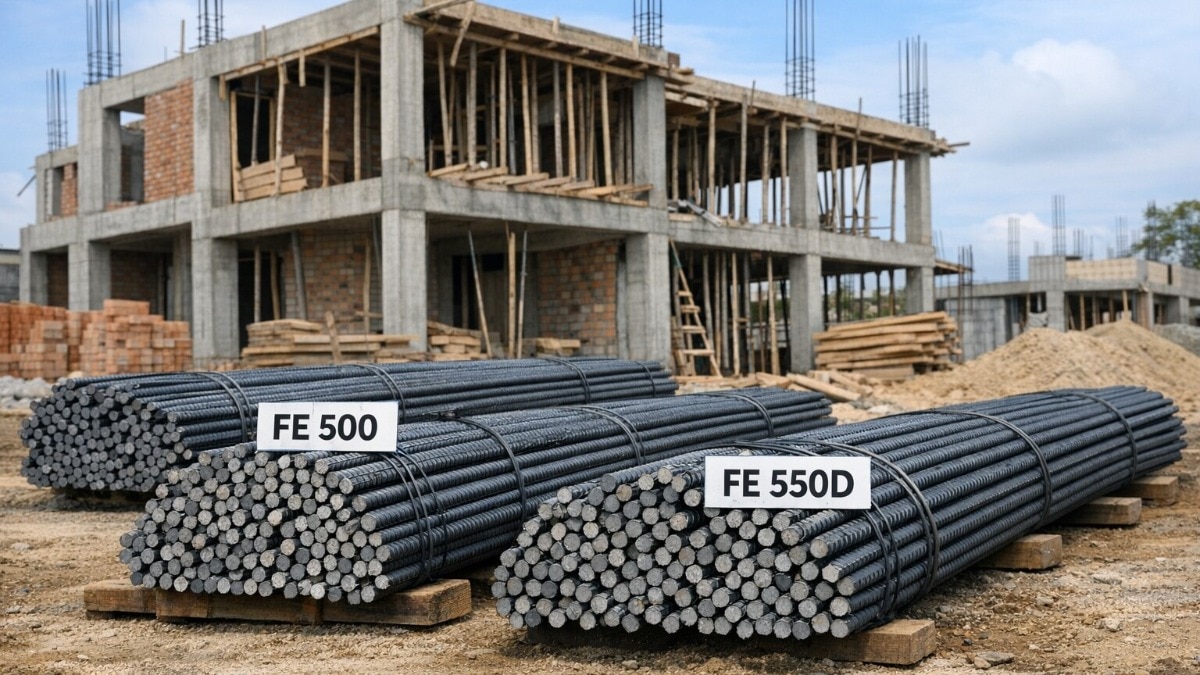
Selecting the correct grade of TMT steel is critical for structural integrity. Learn the technical differences between Fe 500 and Fe 550D to ensure your home is safe and durable.
- 'Fe' stands for Iron, and the number indicates the minimum yield strength in MPa.
- The 'D' suffix denotes 'Ductility', essential for earthquake-prone regions.
- Fe 500 is ideal for standard residential homes, while Fe 550D is superior for heavy infrastructure.
When planning the construction of a home, the quality of reinforcement steel (TMT bars) is the most critical factor determining the building's longevity. Many homeowners mistakenly focus only on the thickness or the brand, ignoring the grade of the steel. Understanding the difference between Fe 500 and Fe 550D is essential to prevent structural failure.
What is Fe 500 Steel and Where to Use It?
In TMT bars, 'Fe' represents the chemical symbol for iron, and '500' refers to the minimum yield strength of 500 MPa (N/mm²). This grade provides a balanced combination of strength and flexibility, making it the industry standard for general construction.
Typically, for single or double-story residential buildings, Fe 500 is used in pillars, plinth beams, and RCC slabs. In regions with low seismic activity, this grade offers the most cost-effective and reliable solution for home stability.
Why This Matters
BozokMedia analysis shows that contractors often substitute higher-grade steel with lower-grade alternatives to save costs, which can lead to catastrophic cracks during environmental stress. Choosing the right grade ensures the structural safety of the occupants.
"In seismic zones, strength alone is a liability; ductility is the real savior that allows a building to sway without collapsing."
Fe 500D and Fe 550D: The Power of Ductility
The addition of the letter 'D' signifies a Ductile grade of steel. Ductility is the ability of the steel to undergo significant plastic deformation before rupture. This is a life-saving feature in earthquake-prone areas, as it allows the structure to absorb energy by bending rather than snapping.
Fe 550D possesses a higher minimum yield strength of 550 MPa, making it stronger than Fe 500. It is primarily utilized in high-rise buildings, bridges, dams, and heavy-duty industrial projects where extreme load-bearing capacity and seismic resistance are required.
| Feature | Fe 500 | Fe 550D |
|---|---|---|
| Yield Strength | 500 MPa | 550 MPa |
| Ductility | Standard | Very High |
| Application | Small Residential Homes | High-rises, Bridges, Seismic Zones |
| Earthquake Resistance | Average | Excellent |
Historical Background and Evolution
Historically, construction relied on Mild Steel, which lacked the necessary strength for modern urban densities. The advent of Thermo-Mechanically Treated (TMT) technology revolutionized the industry by creating a hard outer layer (martensite) and a soft inner core (ferrite-pearlite). This duality led to the creation of specialized grades like Fe 500 and Fe 550D to meet diverse global architectural needs.
Frequently Asked Questions
Q1: Can I use Fe 550D for my entire small house?
Yes, you can, but it may be an unnecessary expense as the strength of Fe 500 is usually sufficient for small homes.
Q2: How is 'D' grade steel different from regular steel?
D grade steel has higher elongation properties, meaning it can stretch more before breaking, providing a critical safety margin during earthquakes.