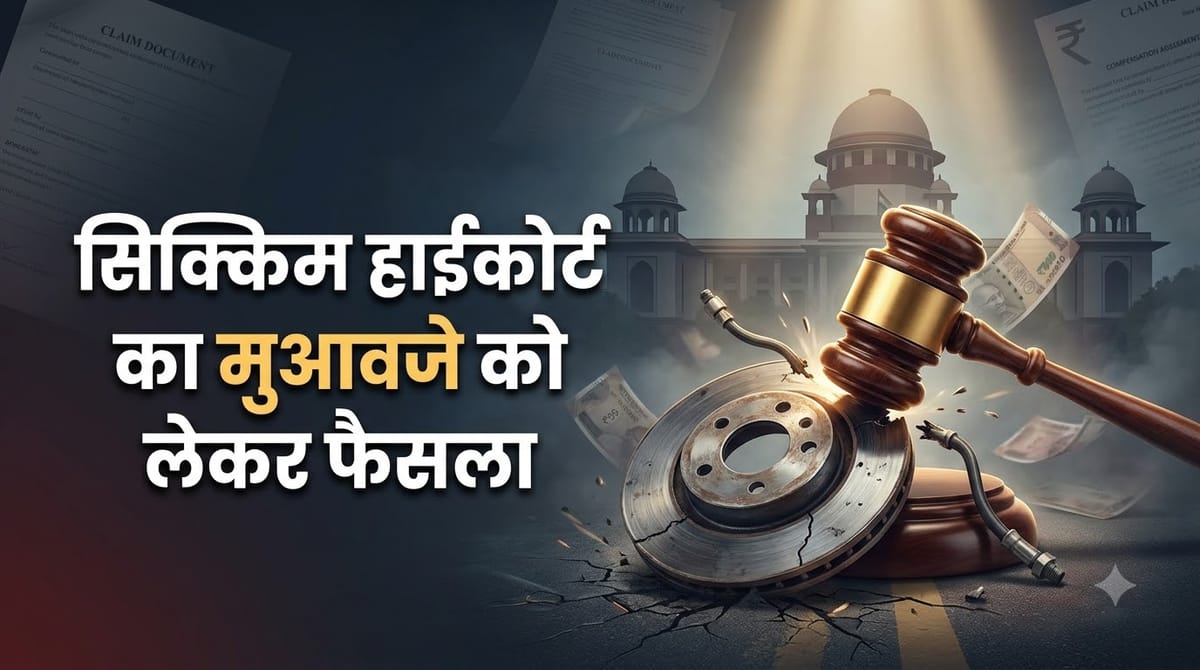
The Sikkim High Court has overturned a tribunal's decision, awarding ₹5 lakh to the family of a accident victim. The court emphasized the principle of 'No-Fault Liability' regardless of whether driver negligence was proven.
- Sikkim High Court awarded ₹5 lakh compensation for a 2019 fatal accident.
- The ruling is based on the 'No-Fault Liability' principle under the Motor Vehicles Act.
- The court criticized insurance companies for using complex and ambiguous policy language.
- An annual interest of 7% is mandated from February 14, 2023, until final payment.
The Sikkim High Court has provided significant relief to the family of a person who lost their life in a tragic road accident in 2019. Justice Bhaskar Raj Pradhan overturned a previous ruling by the Motor Accident Claims Tribunal (MACT), which had rejected the compensation claim on the grounds that the accident was caused by brake failure rather than negligence or reckless driving.
The incident dates back to November 12, 2019. Following the death, the victim's wife, son, and parents filed a claim for ₹19,07,560 at the Gangtok-based MACT. The tribunal initially dismissed the plea, stating that no negligence was proven. This led the aggrieved family to approach the High Court, arguing that while Section 166 might not apply, they were entitled to compensation under the 'No-Fault' provisions of Section 140.
Why This Matters
BozokMedia analysis shows that this judgment serves as a critical check on insurance companies that often use technical loopholes to deny claims. By upholding the 'No-Fault Liability' principle, the court has reinforced the social security aspect of the Motor Vehicles Act, ensuring that the bereaved families are not left stranded due to the lack of a 'negligent party'.
During the proceedings, the court expressed severe concern over the ambiguity of insurance certificates. Justice Pradhan remarked that insurance companies should provide policies in a language that is easily understandable to the average consumer, rather than forcing them to navigate a 'maze' of pages on a company website.
"Understanding the terms and conditions of insurance policies has always been a daunting task; the language must be clear so the insured knows their rights immediately."
The court rejected the insurance company's argument that the deceased was responsible for the accident. It ruled that the insurance company is fully liable to indemnify the vehicle owner and provide the statutory compensation of ₹5 lakh for death under current legal provisions.
Frequently Asked Questions
Q1: What is 'No-Fault Liability' in motor accidents?
It is a legal provision where compensation is awarded to the victim or their heirs regardless of whether any negligence or fault is proven on the part of the driver.
Q2: What did the court say about insurance policies?
The court stated that according to IRDA guidelines, every certificate must clearly mention the limit of insurance coverage to ensure transparency for the policyholder.