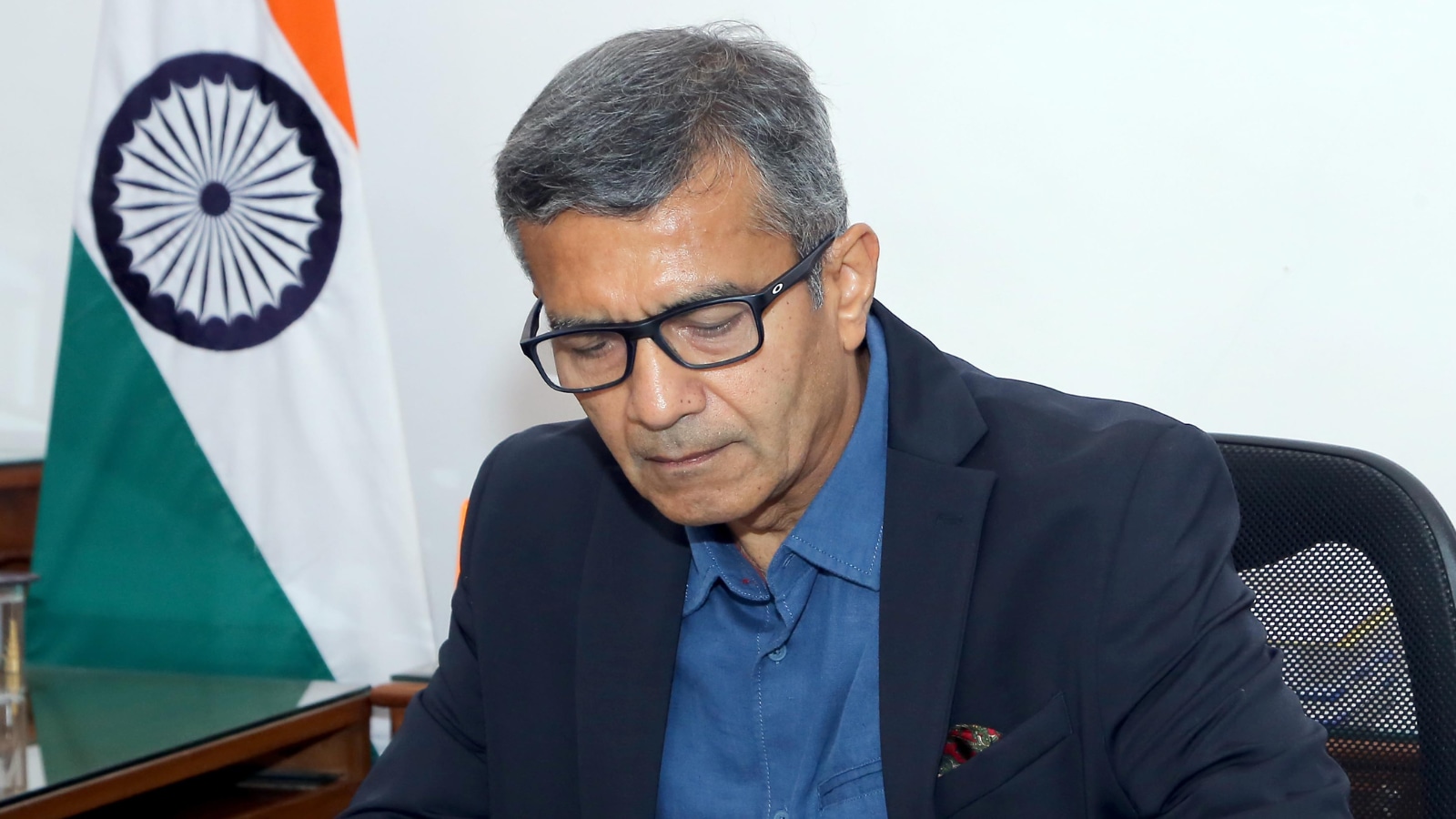
Union Home Minister Amit Shah emphasized that decolonisation is about presenting historical truths through an Indian lens rather than erasing the past. He called for the preservation of Indian knowledge traditions to combat colonial-era inferiority complexes.
- Decolonisation involves presenting history authentically from an Indian perspective, not erasing it.
- Colonial interpretations have historically fostered an inferiority complex among Indians.
- Protecting memory, traditions, and languages is essential for national survival.
- Digitization and a common platform for manuscripts are crucial for future research.
Union Home Minister Amit Shah, while inaugurating a manuscript exhibition at the Asiatic Society of Mumbai on Sunday, delivered a powerful message regarding the decolonisation of India's history and knowledge systems. He asserted that decolonisation does not imply the erasure of the past, but rather the necessity of presenting the "historical truth to the world in an authentic manner from an Indian perspective."
Addressing the gathering, Shah noted that for decades, Indian history, languages, and traditions have been interpreted through a colonial lens. This skewed perspective was designed not for the welfare of the world, but to understand Indian systems to facilitate long-term British rule. He remarked that this approach had successfully instilled a sense of inferiority complex among Indians, weakening their national confidence.
Why This Matters
BozokMedia analysis shows that the movement toward decolonisation is a critical step in reclaiming India's intellectual sovereignty. By decoupling knowledge from the colonial framework of power, India aims to restore its rightful place in global discourse. Shah emphasized that a nation's survival is tied to its ability to protect its memory, culture, and archives. He poignantly noted that while invaders could burn libraries like Nalanda, they could never destroy the knowledge embedded in the minds and oral traditions of the people.
Decolonisation is the process of freeing knowledge from colonial frameworks to allow India to speak in its own voice.
The Minister highlighted the role of institutions like the Asiatic Society of Mumbai, established in 1804, in preserving vital manuscripts, including Buddhist texts and illustrated copies of the Mahabharata. He urged the newly elected committee, led by Vinay Sahasrabuddhe, to expand access to these collections. Furthermore, Shah called for a massive digitization drive to connect these historical assets with libraries nationwide.
Historical Context: The Colonial Impact on Indology
Historically, the discipline of Indology was often used by colonial powers to categorize and control Indian society. Shah argued that Indian knowledge was rarely written in India's own voice. To rectify this, he proposed the creation of a common platform connecting heritage institutions, with the Asiatic Society playing a lead role. He also encouraged the identification of ancestral documents in rural Maharashtra to be integrated into the Gyan Bharatam National Manuscript Mission.
Frequently Asked Questions
1. What is the difference between erasing history and decolonising it?
Erasing history involves removing facts, whereas decolonising involves re-evaluating and presenting those facts from an indigenous, authentic perspective.
2. How will the Gyan Bharatam Mission help?
It aims to identify and preserve manuscripts and ancestral documents lying in homes and villages, bringing them into the scholarly fold for research.