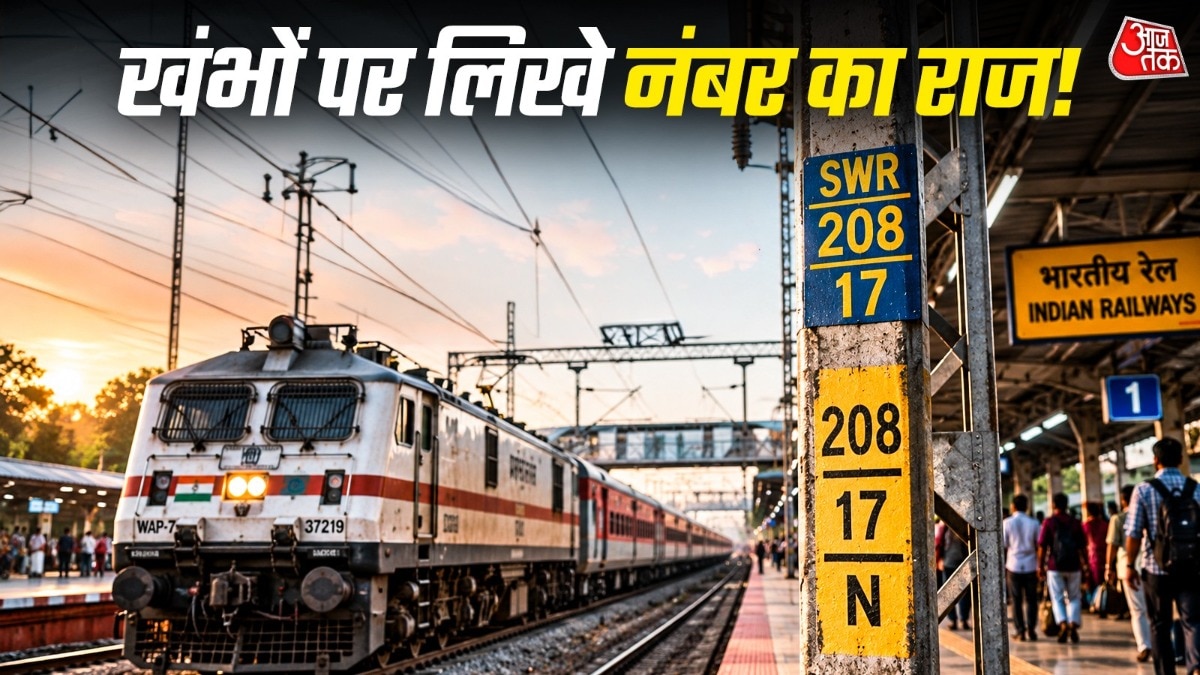
The numbers painted on railway trackside poles are far more than mere identifiers; they are critical tools for navigation and emergency response. Discover how these numbers keep the Indian Railways running safely.
- Trackside poles are technically referred to as 'Masts'.
- The numbers (e.g., 56/8) indicate exact kilometer locations and pole sequences.
- These numbers are vital for locating broken engines, track faults, or accidents.
- The average distance between two masts is approximately 60 meters.
During a train journey, passengers often notice peculiar numbers like 56/8 or 90/10 painted on the poles lining the railway tracks. While most travelers view them as mere decorations or random markings, these numbers serve as a critical lifeline for the Indian Railways infrastructure and safety protocols.
Understanding the 'Mast': More Than Just a Pole
In railway terminology, these poles are known as 'Masts'. Constructed from iron, cement, or concrete, they primarily support overhead electrical equipment (OHE) and other essential signaling systems. However, their secondary function—providing precise geographic markers—is what makes them indispensable for operational efficiency.
The Logic of the Numbers: Decoding the Location
The numbering system is a precise mathematical tool. For instance, a number like 56/8 indicates that the pole is located at the 56th kilometer mark, specifically being the 8th pole within that kilometer segment. This allows Loco Pilots and track maintainers to pinpoint their exact position on an expansive network of thousands of kilometers.
These numerical codes act as a physical GPS for railway workers, ensuring that precision meets safety in every kilometer of the journey.
Why This Matters
BozokMedia analysis shows that in a massive logistics network like Indian Railways, time is the most critical factor during an emergency. Without these specific markers, locating a stalled train or a localized track defect would lead to massive delays and increased risks of secondary accidents.
A Lifeline During Emergencies
Whether it is a mechanical failure of a locomotive or a track obstruction, the ability to communicate a precise location is vital. If an engine fails, the train manager can instantly relay the mast number to the control room, allowing technical teams to be dispatched to the exact spot without confusion. Furthermore, during track maintenance, these numbers inform pilots exactly where they need to reduce speed.
Frequently Asked Questions
1. Can passengers use these numbers?
Yes, if you spot a suspicious object or an accident near the track, providing these pole numbers to railway authorities can significantly speed up the rescue response.
2. What are these poles called officially?
They are officially termed as 'Masts' within the railway engineering department.