Archaeologists in North Kashmir's Baramulla have uncovered a 2,000-year-old Buddhist stupa complex at Zehanpora. The site may hold the secrets to the lost township of King Jushka or the monastery of Chinese scholar Hiuen Tsang.
- Discovery of a 2,000-year-old Buddhist apsidal stupa complex in Zehanpora, Baramulla.
- Architectural features, including pebble stone walls, confirm Kushan-era origins (1st Century AD).
- Potential connection to the 7th-century Chinese traveler Hiuen Tsang's monastery.
- The site served as a strategic gateway on the ancient Jhelum Valley route.
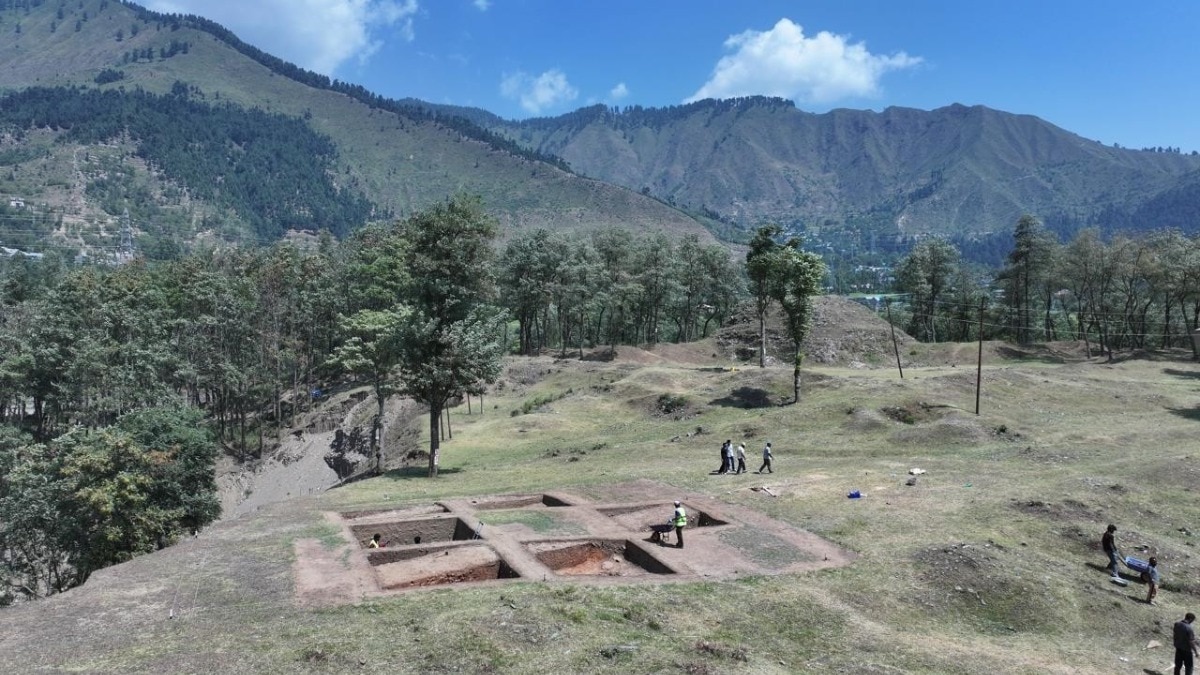
In a landmark archaeological development, excavations in the village of Zehanpora, located in the Baramulla district of North Kashmir, are shedding light on a civilization that flourished two millennia ago. For the second consecutive year, researchers are digging into what is believed to be a massive Buddhist stupa complex situated on the banks of the Jhelum River.
The excavation, led by a team from the University of Kashmir and the Department of Archives, Archaeology, and Museums, has identified a stupa foundation measuring approximately 20 by 20 meters. Experts suggest the site dates back to the Kushan period, a time when Kashmir was a central hub of Buddhist culture and trade.
The Kushan Connection and Historical Clues
Dr. Mohammad Ajmal Shah, the lead archaeologist, noted that the intact walls constructed of pebble stone are a signature characteristic of Kushan architecture. The Kushans ruled the region for over three centuries between the 1st and 4th centuries AD, leaving a profound Buddhist legacy. The recovery of ancient pottery and artifacts further solidifies this temporal link.
Zehanpora is significant because it allows us to move beyond textual references to ancient Kashmir and recover the material history of the region through scientific archaeology.
The breakthrough was catalyzed by an archival photograph found at the Guimet Museum in Paris. The image, labeled 'Stupa Dunes, Baramulla,' provided the crucial link that allowed researchers to connect modern Zehanpora to its ancient historical identity. This discovery was also highlighted by Prime Minister Narendra Modi in his 'Mann Ki Baat' address, noting how such scientific studies open windows into Kashmir's glorious past.
Why This Matters
BozokMedia analysis shows that the Zehanpora site is not just a local discovery but a piece of a much larger geopolitical puzzle. Located on the old Jhelum Valley route, the site acted as a vital northwestern gateway into the Kashmir Valley, linking the region to Gandhara and Central Asia. This makes it a crucial site for understanding ancient Silk Road communication networks.
Furthermore, the site holds immense potential regarding the travels of Hiuen Tsang (Xuanzang). The 7th-century Chinese scholar described a 'stone gate' and a large stupa near the entrance to the kingdom. The proximity of Zehanpora to these historical descriptions suggests it may indeed be the site of the monastery he visited during his journey.
Frequently Asked Questions
1. What makes the Zehanpora site unique?
It is a rare site that potentially links the 1st-century Kushan era with the 7th-century travels of Hiuen Tsang, offering a continuous look at ancient Buddhist history.
2. How did researchers identify the age of the site?
Through scientific excavation, the analysis of pebble stone architecture, and the study of recovered pottery artifacts.