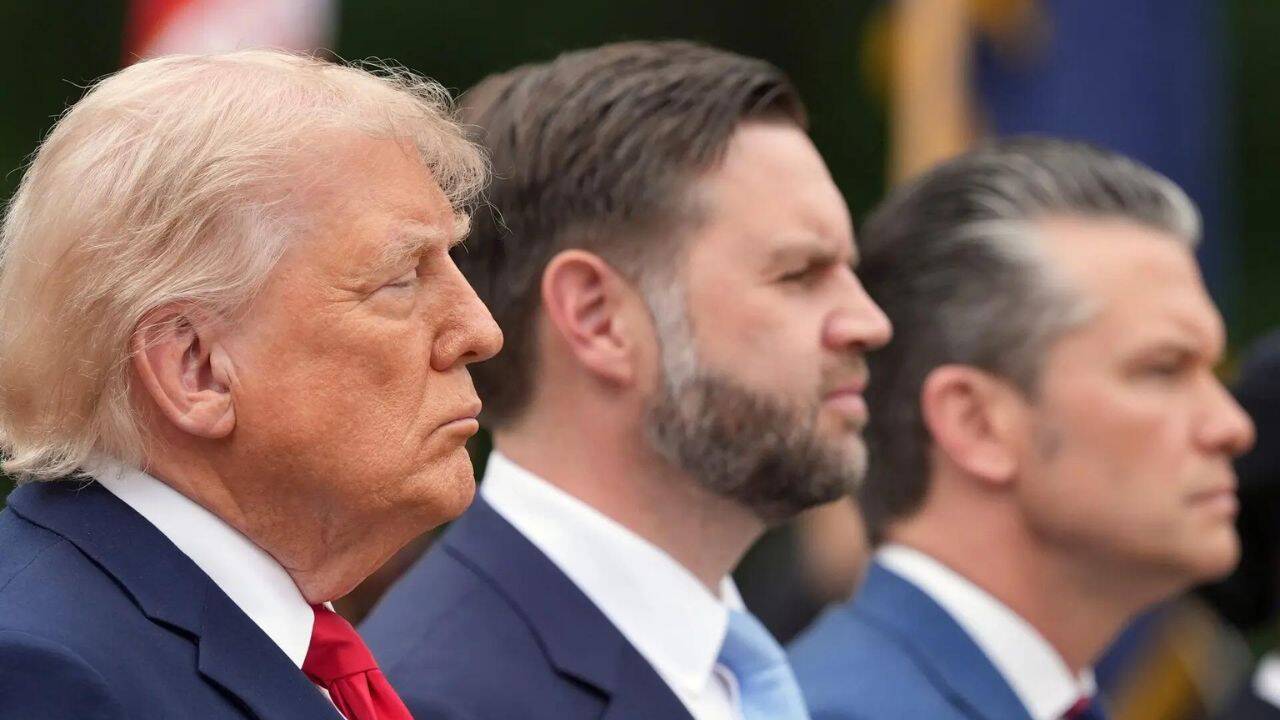
Former President Donald Trump warned that he has pre‑issued orders for a massive U.S. strike on Iran if the regime attempts his assassination, but U.S. law contains no automatic "dead‑man's switch" to activate such a plan. In the event of his death, authority would instantly pass to Vice President JD Vance under the 25th Amendment and the Presidential Succession Act of 1947.
Key Takeaways (मुख्य बिंदु)
- U.S. law does not provide an automatic military trigger upon a president’s death.
- Presidential authority would transfer to Vice President JD Vance under the 25th Amendment and the 1947 Succession Act.
- Trump’s public threat and Iran’s retaliatory rhetoric raise the risk of rapid escalation.
Former President Donald Trump posted on his own social‑media platform that he has “locked and loaded” a thousand missiles aimed at Iran, ready to unleash a massive retaliation if Tehran attempts to assassinate him. While the rhetoric is chilling, the U.S. legal framework contains no pre‑authorised “dead‑man's switch” that would automatically launch a strike upon a president’s demise.
Constitutional Mechanism and Succession
Under the 25th Amendment and the Presidential Succession Act of 1947, death or incapacitation of the president transfers executive power instantly to Vice President JD Vance. As commander‑in‑chief, Vance would decide whether to honor Trump’s alleged orders, modify them, or reject them entirely. This process is not a technical trigger; it is a constitutional hand‑off that requires a conscious decision by the new commander.
Trump’s Threat and Iran’s Response
Trump’s claim of “1,000 missiles locked and loaded” was followed by a stark response from Iran’s Supreme Leader Mojtaba Khamenei, who vowed vengeance for the death of his father, Ayatollah Ali Khamenei, during the initial U.S.–Israeli strikes that sparked the February war. Khamenei declared on state television that the “pure blood” of the Iranian martyrs would be avenged, signaling a willingness to escalate further.
Potential Scenarios After a Hypothetical Assassination
If Trump were assassinated, the decision‑making dynamics would hinge on Vance’s policy stance, congressional support, and international pressure. Recent Iranian missile tests and the renewed exchange of strikes between the U.S. and Iran have already destabilised the fragile cease‑fire. Any move toward a pre‑planned strike could trigger a cascade of regional conflicts, drawing NATO allies and Gulf states into a broader confrontation.
Strategic Analysis
Security analysts warn that publicly announcing a “dead‑man's switch” is a strategic misstep, as it may embolden adversaries and limit diplomatic flexibility. While U.S. intelligence agencies treat all threats against senior officials as credible, they are bound by constitutional processes that prevent automatic military retaliation. The real lever of power lies in the orderly succession and the subsequent policy choices made by the new commander‑in‑chief.