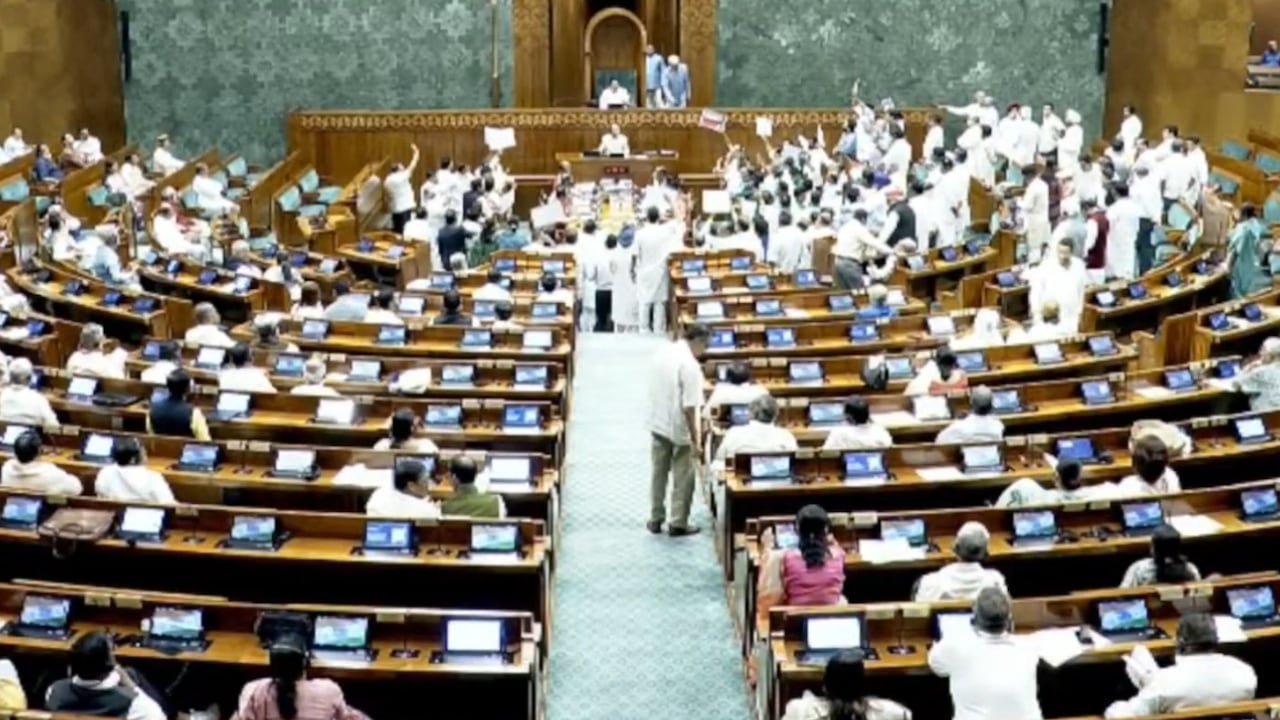
The opening day of the Monsoon Session witnessed intense sloganeering and disruption, forcing the adjournment of both Houses of Parliament.
Key Takeaways
- The Monsoon Session commenced with heavy disruptions in both Houses.
- Intense sloganeering led to the early adjournment of Lok Sabha and Rajya Sabha.
- Prime Minister Modi's call for inclusive dialogue was overshadowed by political friction.
The opening day of the Monsoon Session of Parliament was marked by intense political turbulence and chaos. Despite Prime Minister Narendra Modi's stated vision that 'every voice should find an opportunity to be heard,' the sanctity of the House was compromised by heavy disruptions. Both the Lok Sabha and Rajya Sabha were forced to adjourn shortly after reconvening due to aggressive sloganeering and protests from the opposition.
As the session began, the atmosphere inside the chambers turned volatile. Members of the opposition raised various grievances, leading to a standoff with the treasury benches. This inability to reach a consensus prevented the scheduled legislative business from proceeding, resulting in a significant loss of parliamentary time.
Why This Matters (इसके मायने क्या हैं)
BozokMedia analysis shows that frequent disruptions in Parliament do more than just delay laws; they erode the fundamental essence of representative democracy. When the floor of the House is dominated by noise rather than debate, the ability to scrutinize critical policies and budgets is severely diminished, ultimately affecting the welfare of the citizenry.
From a governance perspective, a dysfunctional Parliament creates policy uncertainty. For the economy and international stakeholders, parliamentary stability is a key indicator of a country's legislative health. Continuous adjournments signal a breakdown in political consensus, which can impact long-term legislative predictability.
The transition from constructive debate to disruptive sloganeering marks a concerning trend in modern parliamentary proceedings.
Historical Background
The Monsoon Session is one of the three annual sessions of the Indian Parliament, typically held during the July-August period. Historically, parliamentary sessions have been the arena for intense debate on nation-building. However, in recent decades, the frequency of 'adjournments' due to political protests has increased, reflecting a growing polarization in the legislative environment.
| Aspect | Ideal Parliamentary Function | Current Session Reality |
|---|---|---|
| Primary Goal | Legislative Deliberation | Political Confrontation |
| PM's Vision | Inclusive Dialogue | Polarized Environment |
| Outcome | Effective Lawmaking | Frequent Adjournments |
Frequently Asked Questions (अक्सर पूछे जाने वाले प्रश्न)
Question 1: What does it mean when Parliament is adjourned?
Answer: Adjournment means the suspension of the proceedings of the House for a specific period or until a later time.
Question 2: Why is the Monsoon Session important?
Answer: It is a vital period for the government to introduce and pass legislation and for the opposition to hold the executive accountable.