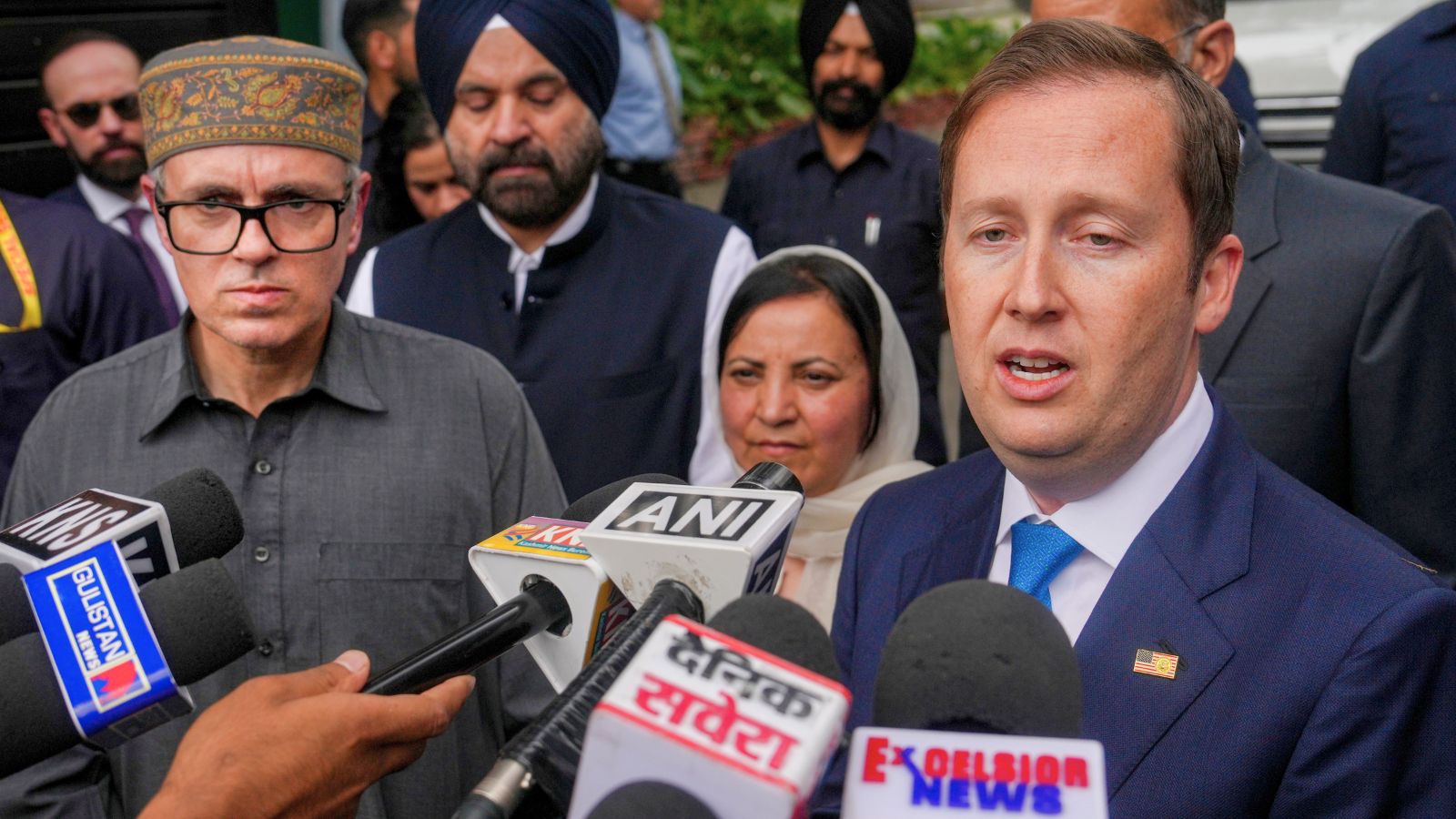
US Ambassador Sergio Gor's recent remarks in Srinagar, calling Jammu and Kashmir an 'important part of India,' signal a historic departure from decades of American diplomatic ambiguity regarding the region.
- US Ambassador Sergio Gor declared Kashmir an "important part of India" during his Srinagar visit.
- This marks a significant end to the era of US viewing J&K as a "disputed territory."
- Gor suggested a review of US travel advisories due to improved security in the Valley.
- The statement follows a meeting with Chief Minister Omar Abdullah.
History rarely hinges on a few words, but when US Ambassador Sergio Gor visited Srinagar earlier this week and declared, "This is an important part of India," he signaled the definitive end of an era. His first visit to the Valley, following a meeting with Chief Minister Omar Abdullah, has sent shockwaves through the diplomatic landscape of South Asia.
Gor's statement is not merely a casual observation; it is a profound shift in vocabulary. For nearly five decades, Washington has often avoided qualifying its discussion of Jammu and Kashmir, frequently leaning towards a more ambiguous or even "disputed" stance. By explicitly acknowledging India's sovereignty in the heart of the Valley, Gor has effectively neutralized a long-standing point of diplomatic friction.
Why This Matters
BozokMedia analysis shows that this linguistic shift is a cornerstone of modern US-India strategic partnership. For decades, the "disputed" label served as a diplomatic scaffolding for Pakistan to internationalize the issue. Gor's direct recognition of the Indian position dismantles this narrative, signaling that the US now views the stability and territorial integrity of India through a much clearer lens.
The evolution of US diplomatic vocabulary regarding Kashmir represents one of the most significant shifts in Indo-US relations in the 21st century.
To understand the magnitude of this moment, one must look back at the 1950s. During that era, American emissaries like Loy Henderson and Adlai Stevenson engaged with Sheikh Abdullah in ways that fueled deep suspicions in New Delhi. At the time, the very idea of an "independent Kashmir" was a legitimate part of American diplomatic parlance, causing significant anxiety for Prime Minister Jawaharlal Nehru.
Even as recently as 1993, the Clinton administration's Assistant Secretary of State, Robin Raphel, referred to Kashmir as a "disputed territory," a move that drew sharp condemnation from the Indian government under PM P.V. Narasimha Rao. The transition from Raphel's rhetoric to Gor's declaration in 2026 illustrates a complete reversal of the American diplomatic compass.
Historical Comparison of US Stance
| Era | US Diplomatic Stance | Key Figures/Context |
|---|---|---|
| 1950s | Exploration of Independence/Ambiguity | Loy Henderson, Adlai Stevenson |
| 1993 | Labelled as "Disputed Territory" | Robin Raphel (Clinton Admin) |
| 2026 (Current) | Recognized as part of India | Sergio Gor |
While Pakistan has responded by lodging a formal demarche, the geopolitical reality seems to have moved past the era of ambiguity. The suggestion by Gor to review US travel advisories further underscores a growing American confidence in the security situation managed by the Indian administration.
Frequently Asked Questions
1. How does Sergio Gor's statement differ from previous US stances?
Unlike previous decades where the US used terms like "disputed territory," Gor explicitly called Kashmir an "important part of India."
2. What was the reaction from Pakistan?
Pakistan has officially protested the statement by lodging a formal diplomatic demarche.