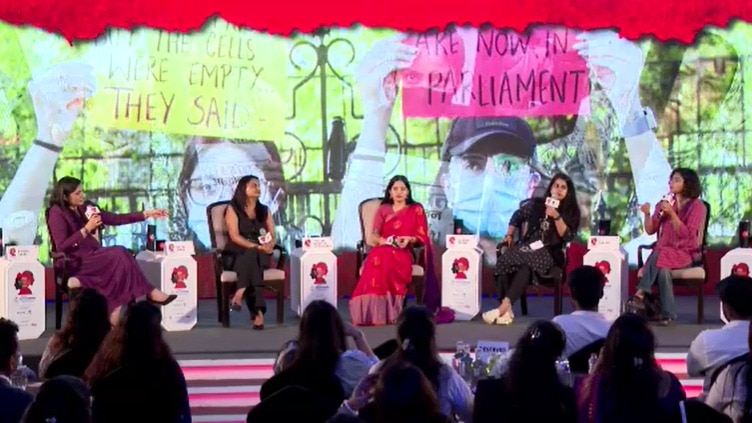
At the India Today Women's Summit, prominent student leaders engaged in a heated debate regarding the nature of recent Gen Z protests and the representation of India's disillusioned youth. The discussion followed the high-profile resignation of Union Education Minister Dharmendra Pradhan.
- Union Education Minister Dharmendra Pradhan resigned following massive student protests over paper leaks.
- Student leaders presented conflicting views on whether movements are 'leaderless' or 'organized'.
- The debate highlighted deep-seated disillusionment with the current examination and recruitment systems.
The India Today Women's Summit became a battleground for ideas as four prominent female student leaders debated a defining question of the current era: Who truly represents the voice of India's angry youth? The discussion unfolded against the backdrop of intense social unrest caused by alleged irregularities in national-level examinations.
The political climate was charged following the resignation of Dharmendra Pradhan, the Union Education Minister. His departure, cited as an act of 'moral responsibility,' came after weeks of unrelenting protests at Jantar Mantar. Students had demanded accountability for systemic failures, including widespread paper leaks that have jeopardized the futures of millions of aspirants.
Why This Matters
BozokMedia analysis shows that the shift from campus-centric politics to national-scale accountability movements marks a significant evolution in Indian democracy. The 'Gen Z' demographic is no longer just a consumer of content but a potent political force capable of driving executive changes.
Ratna Singh, spokesperson for the Cockroach Janata Party (CJP), characterized the recent agitations as a 'leaderless, issue-based movement.' She emphasized that the struggle was not about individual heroism but about collective accountability, noting that the movement had even begun to politically awaken 'Gen Alpha.'
The resignation of a Union Minister marks a historic moment where student-led pressure directly impacted the highest levels of government.
Contrasting this view, Joslyn Nandita Choudhary of the NSUI highlighted the role of organized political campaigns, specifically citing Rahul Gandhi's 'Chhatron Ki Goonj' initiative. Meanwhile, Anjali from AISA argued that a united front of student organizations was the true catalyst in challenging the government's perceived arrogance regarding the National Testing Agency (NTA).
The debate took a sharp turn when Shalini Verma of the ABVP accused the CJP of conducting 'politically selective' campaigns. She argued that these protests were often targeted specifically at BJP-ruled states and claimed that Gen Z remains fundamentally committed to nationalist values rather than anti-establishment sentiments.
Historical Background
Student activism in India has historically been a cornerstone of democratic dissent. From the anti-Emergency movements to the recent protests against the New Education Policy and examination malpractices, students have consistently acted as the conscience of the nation, often bridging the gap between policy failure and public awareness.
Frequently Asked Questions
Question 1: What triggered the recent student protests in India?
Answer: The protests were primarily driven by allegations of paper leaks and irregularities in various recruitment and entrance examinations.
Question 2: How did the government respond to the demands?
Answer: Following intense pressure and sustained protests, Union Education Minister Dharmendra Pradhan resigned from his post.


