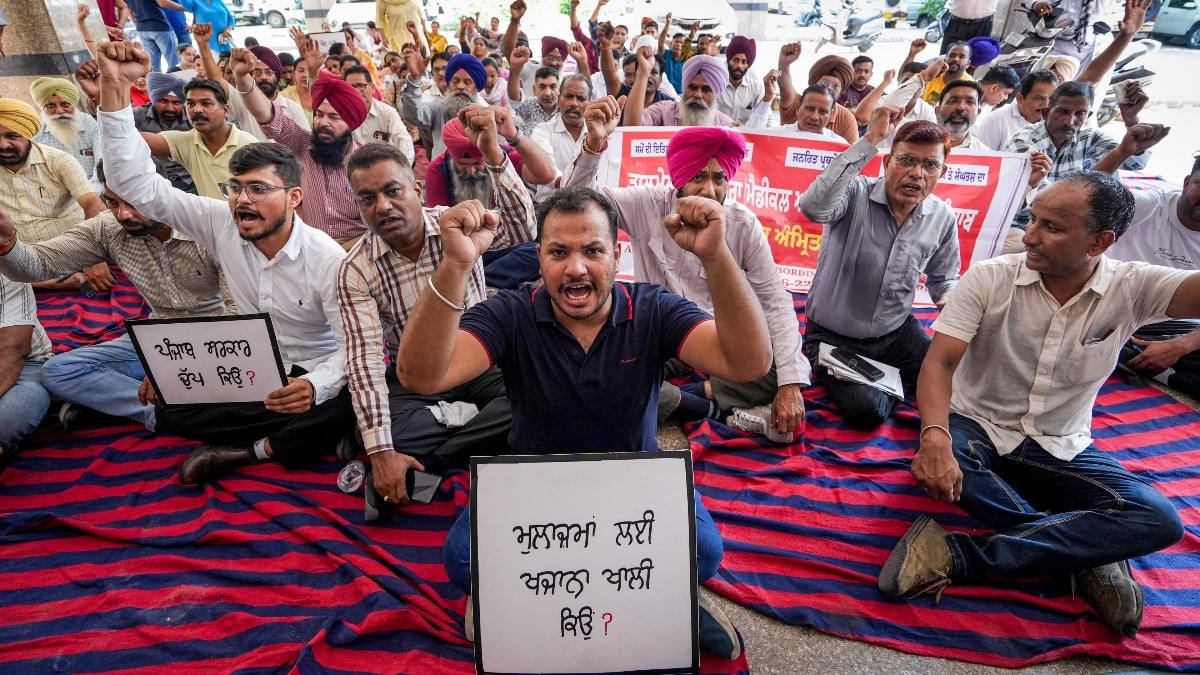
The Punjab government has moved to take strict action against 2,500 employees who were absent during the massive August 27 strike. Department heads have been ordered to issue show-cause notices.
- Nearly 2,500 employees identified as unauthorized absentees during the August 27 strike.
- Key demands: Old Pension Scheme (OPS), 18% DA arrears, and regularization of contractual staff.
- Massive disruption in health and education services across Punjab.
In a decisive move, the Punjab government has initiated disciplinary proceedings against approximately 2,500 government employees who were allegedly absent without authorization during the statewide strike on August 27. Following widespread public complaints regarding the disruption of essential services, department heads have been directed to issue show-cause notices and strictly enforce service rules.
The protest, organized under the banner of the Punjab Sanjha Mulazam Manch, saw participation from over 150 employee bodies and more than three lakh government workers. The 'maha hartal' (grand strike) caused significant paralysis in various administrative sectors, including irrigation, agriculture, and public works, across major cities like Ludhiana, Amritsar, and Jalandhar.
Why This Matters
BozokMedia analysis shows that this standoff represents a critical juncture for the Bhagwant Mann administration. The conflict is not merely about a single day of absence but reflects a deep-seated discontent regarding long-standing financial grievances. The government's decision to punish absentees is an attempt to assert administrative authority, yet it risks further alienating a massive workforce that holds significant political leverage.
The tension between administrative discipline and employee welfare demands a strategic middle ground to prevent a total collapse of public service delivery.
The impact of the strike was most visible in the healthcare sector, where outpatient (OPD) services were suspended in several government hospitals. While emergency, maternity, and medico-legal services remained operational, elective surgeries were postponed, causing significant distress to patients. Similarly, educational institutions in regions like Hoshiarpur reported disruptions due to mass casual leaves taken by teaching and clerical staff.
Core Demands of the Employees
| Demand Category | Specific Requirements |
|---|---|
| Financial Benefits | 18% pending Dearness Allowance (DA) and minimum wages for ASHA/Anganwadi workers |
| Pension & Security | Implementation of the Old Pension Scheme (OPS) |
| Employment Status | Regularization of contractual workers |
Chief Minister Bhagwant Mann has maintained a firm stance, stating that while the government is open to dialogue, negotiations cannot take place while a strike is in progress. He emphasized that Punjab government employees are among the highest-paid in the nation. However, opposition parties, including the Congress, BJP, and Shiromani Akali Dal, have slammed the AAP government for failing to address these legitimate grievances.
Historical Background
The demand for the Old Pension Scheme (OPS) has been a recurring theme in Punjab's political landscape. As the state seeks to balance its fiscal health with the welfare of its massive civil service workforce, the transition from the New Pension Scheme to the OPS remains one of the most contentious issues in recent state history.
Frequently Asked Questions
Question 1: What are the specific reasons for the disciplinary action?
Answer: Employees are being targeted for being absent from their duties without prior official authorization during the state-wide strike.
Question 2: What are the main grievances of the Punjab employees?
Answer: Their primary demands include the Old Pension Scheme, 18% DA arrears, and the regularization of contractual staff.