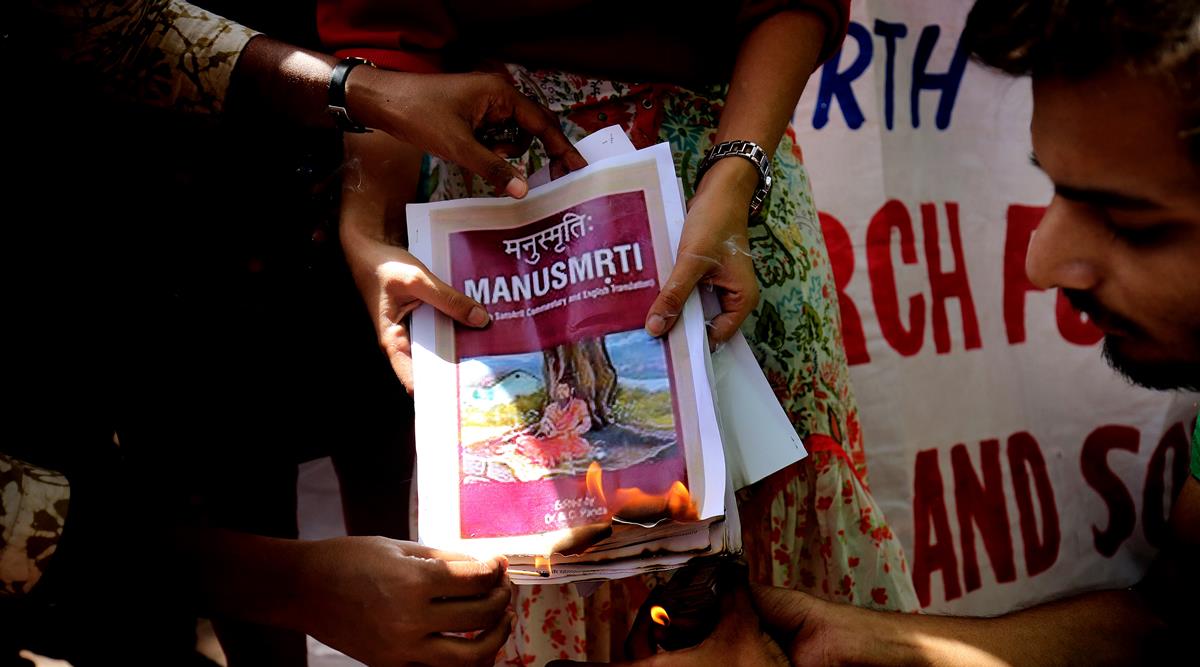
Former Law Commission member Tahir Mahmood argues that the perceived derogatory nature of Manusmriti regarding women is a result of flawed colonial translations rather than original intent.
- Current perceptions of Manusmriti are heavily influenced by William Jones' 1794 English translation.
- The controversial verse on women's independence actually emphasizes the duty of protection and maintenance.
- Ancient legal texts must be interpreted through the lens of their contemporary societal stage.
A recent political reference to a verse from the Manusmriti (Manava Dharmashastra) in Pune has reignited the debate over the social status of women in ancient Indian law. Tahir Mahmood, a seasoned law professor and former member of the Law Commission of India, contends that for over half a century, the 'verdicts' of classical Hindu law have been misunderstood due to a reliance on foreign translations.
Mahmood points out a critical historical nuance: the branding of ancient Indian traditional law as "Hindu law" was a construct of British colonial rulers. He argues that just as Roman law is not termed "Christian law," the traditional legal framework of ancient India should be viewed as a shared cultural legacy rather than a narrow religious code.
Why This Matters
BozokMedia analysis shows that the linguistic gap between Sanskrit and English often leads to systemic misinterpretation. The verse in question repeatedly uses the word 'raksha', which translates to protection and safety. The obligation placed upon the father, husband, and son was not one of ownership, but a sacred duty to ensure the woman's safety throughout her life.
"Sanskrit is an incredibly rich language; translating 'swatantrayamarhati' as 'undeserving' of independence is a mechanical error—it actually implies 'never left unprotected'."
The author emphasizes that any dharmashastra must be understood within the context of the civilization's stage at the time of writing. The authors could not have intended these guidelines to be literally applied across all future eras. Interestingly, the core concept—that daughters, wives, and mothers are entitled to maintenance and protection—remains a cornerstone of modern family law today.
Historically, the legal framework was guided by four sources: shruti (divine revelation), smriti (transmitted memory), sadachara (practices of seers), and atmanastushti (good conscience). Manusmriti was simply the foremost among the smritis.
| Perspective | Colonial Interpretation | Contextual Interpretation |
|---|---|---|
| Status of Women | Lifelong Subjugation | Sacred Protection & Maintenance |
| Translation Method | Mechanical/Literal | Nuanced/Cultural |
| Application | Universal/Eternal Law | Contemporary Social Guideline |
Frequently Asked Questions
Q1: Does Manusmriti claim women are unfit for independence?
A: According to the author, this is a translation error. The original text suggests women should not be left without protection, not that they lack the capacity for independence.
Q2: Why is the term 'Hindu Law' considered a colonial construct?
A: Because the texts were written long before the modern identity of 'Hinduism' was formalized; the British categorized these traditional laws for administrative convenience.