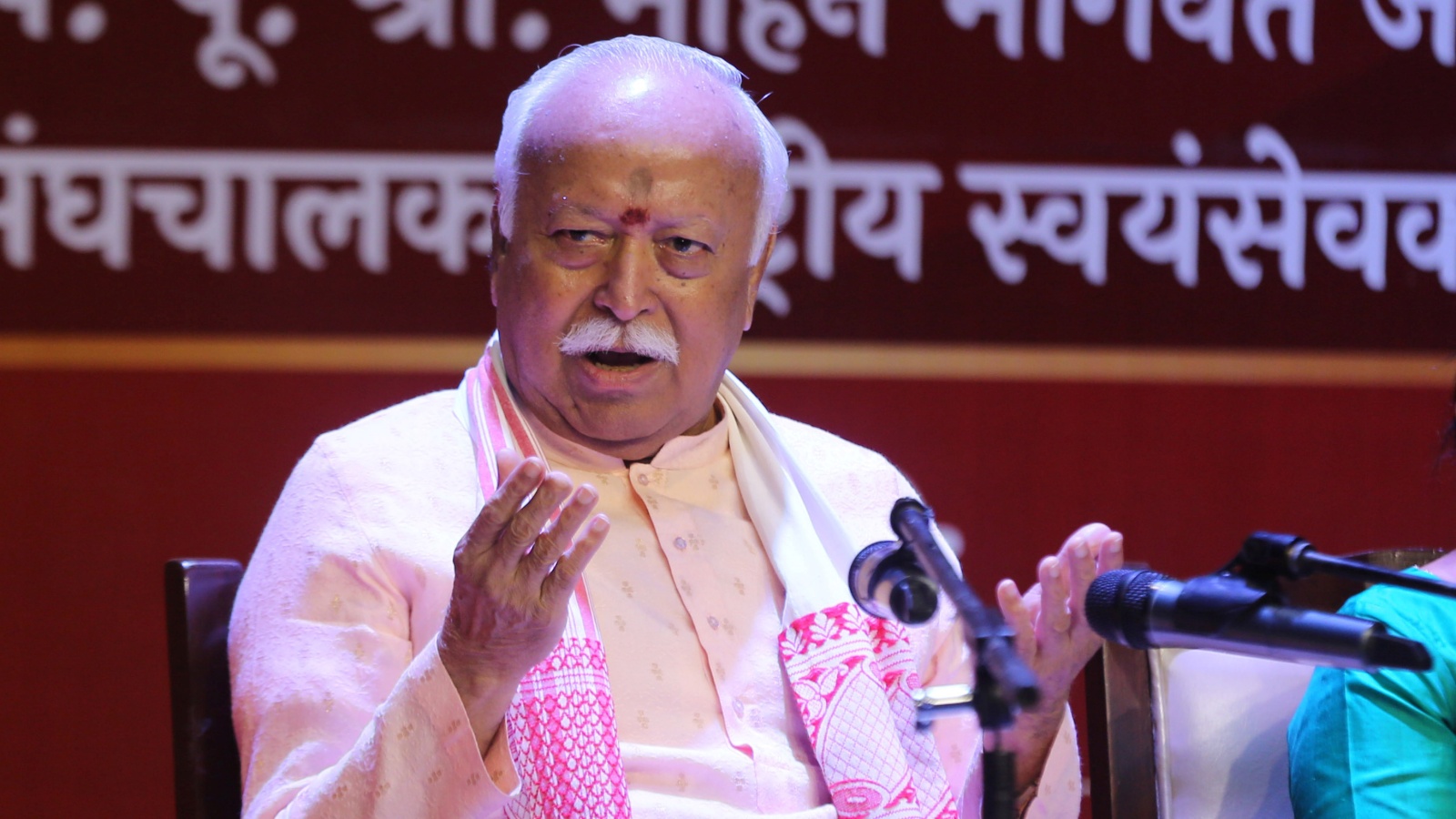
Addressing the Indian diaspora in London, RSS chief Mohan Bhagwat redefined 'Hindu Rashtra,' stating it is rooted in accepting diversity rather than religious uniformity.
- Mohan Bhagwat redefined Hindu Rashtra as an acceptance of diversity.
- He emphasized that 'uniformity is not necessary for unity.'
- The speech is part of RSS's centenary-year global outreach program.
- Bhagwat distinguished between the concepts of 'Nation' and 'Rashtra.'
In a significant address to the Indian diaspora in London, Rashtriya Swayamsevak Sangh (RSS) chief Mohan Bhagwat provided a profound perspective on the concept of 'Hindu Rashtra.' He argued that the essence of a Hindu Rashtra is not predicated on specific religious practices, worship, or a singular lifestyle, but rather on the fundamental acceptance of diversity.
Bhagwat’s remarks, delivered during his London engagement, highlight a strategic shift in the RSS's global outreach as it approaches its centenary year. By engaging with international audiences in cities like New York, Toronto, and now London, the Sangh aims to present a nuanced view of its ideology to the world.
Why This Matters
BozokMedia analysis shows that Bhagwat is attempting to decouple 'Hindutva' from narrow religious connotations, repositioning it as a cultural and civilizational framework that can coexist with global pluralism. This is a crucial move for the RSS as it seeks to build rapport with the global Indian diaspora and international observers.
"The attitude that says 'we are right, and you are also right' is the true essence of being Hindu."
During a detailed Q&A session, Bhagwat explained that the term 'Hindu' refers to a nature of respect for all diversities. He noted that India has been a cradle for various ideologies, including atheism, proving that the land has always embraced a spectrum of thought. He stated that the purpose of a Hindu Rashtra is to demonstrate to the world that "diversity is natural and unity is truth."
Furthermore, Bhagwat drew a sophisticated distinction between a 'nation-state' and a 'Rashtra.' While a nation is often organized around shared governance or language, a Rashtra is defined by a common purpose. He noted that India remained a Rashtra throughout centuries of invasion and enslavement because the people's underlying purpose remained intact.
Addressing the younger generation, Bhagwat expressed optimism, noting their drive to improve the world by shedding petty differences. He advised that leaders should "set the goal, not the method," allowing the youth the autonomy to find efficient paths toward progress.
Frequently Asked Questions
1. What did Mohan Bhagwat say about unity and uniformity?
He stated that while unity is essential, it does not require everyone to follow the same lifestyle or religious practices; diversity is a natural part of unity.
2. How does Bhagwat define 'Rashtra' differently from a 'Nation'?
He defines a nation as a state based on similarities like language or rules, whereas a Rashtra is driven by a shared, overarching purpose.