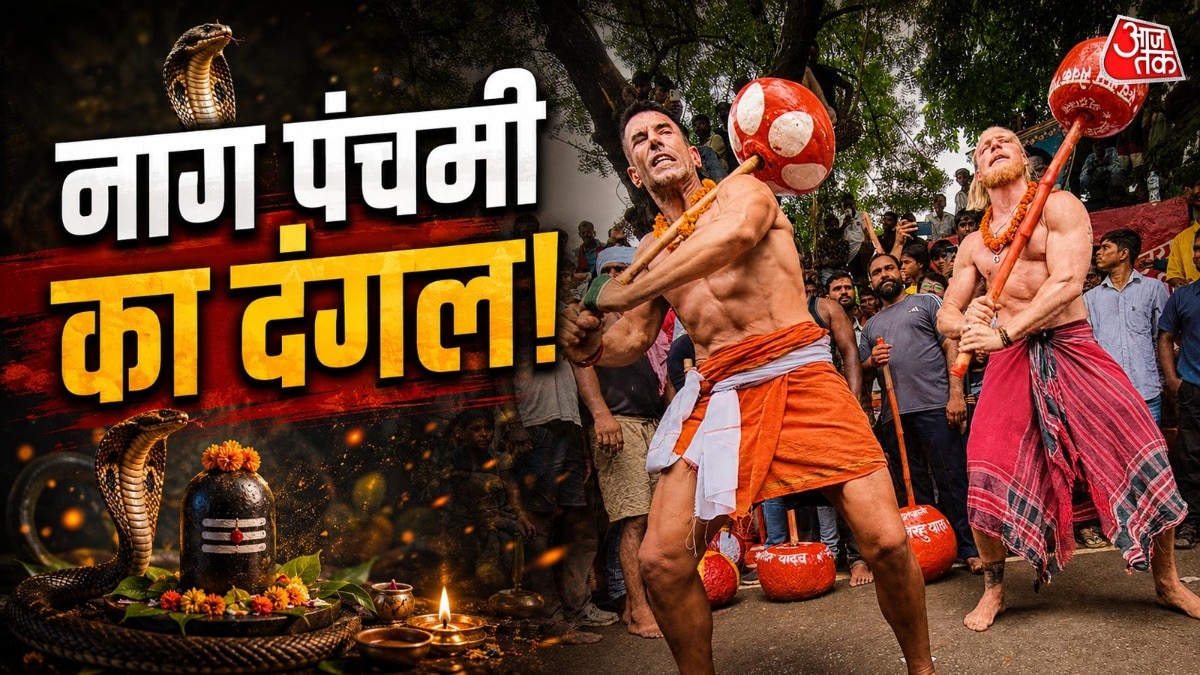
In a stunning blend of culture and athleticism, wrestlers from Spain and the Netherlands visited the traditional mud pits of Varanasi during Nag Panchami to test their strength using ancient Indian equipment.
- International athletes from Spain and the Netherlands participated in traditional Indian wrestling exercises in Varanasi.
- The event highlighted the use of 'Gada' (mace) and 'Jodi' (clubs) as tools for physical excellence.
- Reports indicate a decline in traditional akhadas in Kashi, dropping from 105 to just 29.
The holy city of Varanasi (Kashi), known globally for its spiritual depth, witnessed a unique spectacle this Nag Panchami. While the festival is traditionally associated with the worship of serpents, in Kashi, it also marks a celebration of physical prowess. This year, the traditional mud arenas, known as Akhadas, welcomed foreign athletes who traveled thousands of miles to test their strength against centuries-old Indian traditions.
Among the participants were Santiago, a 'Mesflow' practitioner and trainer from Spain, and Herbert Egbert from the Netherlands. The crowd watched in awe as these international guests skillfully maneuvered the 'Gada' (mace), 'Jodi' (clubs), and heavy dumbbells. Their presence in the mud pits served as a bridge between Western athletic training and Eastern traditional wisdom.
Why This Matters
BozokMedia analysis suggests that this trend indicates a growing global disillusionment with sterile, machine-based fitness centers. The preference for the organic environment of an Akhada—characterized by natural shade and a deep sense of brotherhood—highlights a shift toward 'holistic strength.' This cultural exchange reinforces India's soft power by positioning its traditional physical culture as a viable alternative to modern gym culture.
"The joy and sense of camaraderie found in traditional Akhadas are things that cannot be replicated in the sterile environment of Western gyms." - Santiago, Mesflow Trainer.
Santiago explained that his discipline, Mesflow, shares striking similarities with the Indian practice of using the Gada and Jodi. He visits Kashi annually to refine his skills and draw inspiration from the local wrestlers. Similarly, Herbert Egbert has been visiting Kashi every Nag Panchami since 2017, treating the city as a living classroom for strength and discipline.
However, the festivities were tempered by a sobering reality shared by Gyan Shankul Singh, a promoter of traditional Indian sports. He revealed that Kashi once boasted 105 active Akhadas, but that number has dwindled to just 29. Despite this decline, the tradition persists, with wrestling competitions (Dangals) continuing for two to three months following Nag Panchami.
Traditional Akhada vs. Modern Gym
| Feature | Traditional Akhada | Modern Gym |
|---|---|---|
| Environment | Natural mud and open air | Enclosed space with AC |
| Equipment | Gada, Jodi, Mudgars | Machines, Treadmills, Weights |
| Primary Goal | Overall power and mental discipline | Specific muscle hypertrophy |
| Social Aspect | Guru-Shishya bond and brotherhood | Individualistic and professional |
Frequently Asked Questions
Q1: Why do foreign wrestlers visit Kashi specifically during Nag Panchami?
A: Nag Panchami is the traditional day for strength displays in Kashi's Akhadas. Foreigners visit to participate in this cultural ritual and learn indigenous training methods.
Q2: What is Mesflow?
A: Mesflow is a foreign athletic discipline that focuses on fluid movement and strength, bearing a strong resemblance to the Indian practice of Gada and Jodi exercises.