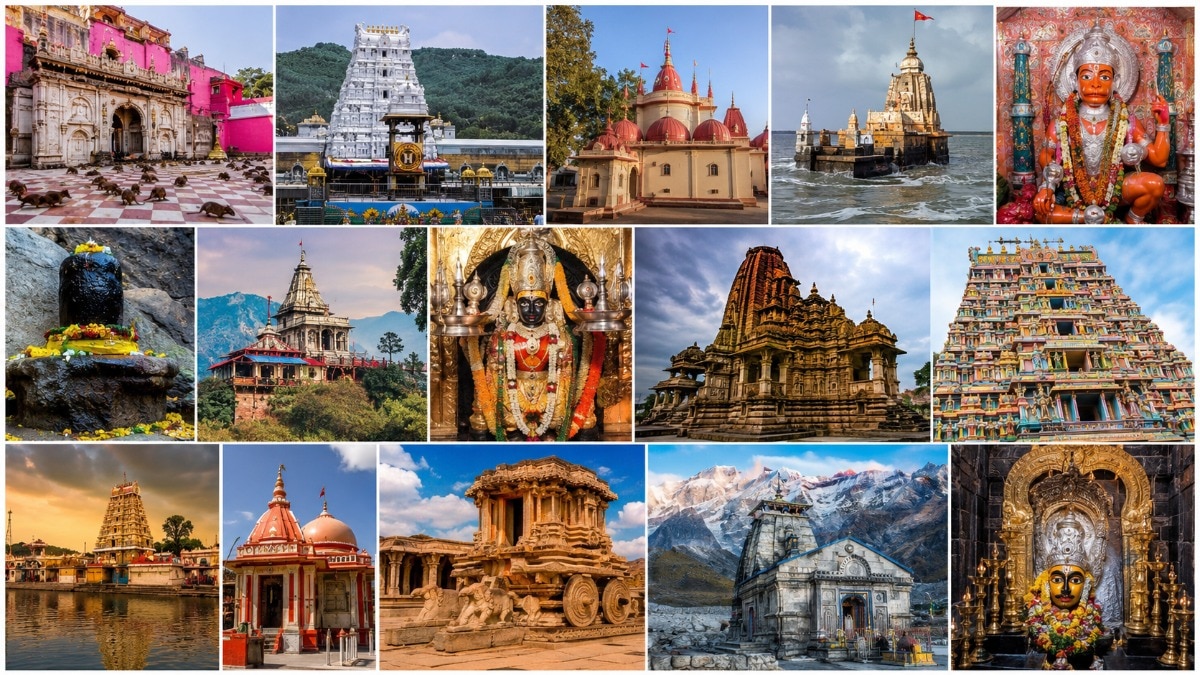
From temples that vanish under the ocean to idols that change color, India is home to spiritual sites that challenge the laws of physics. Discover the divine enigmas that continue to baffle modern science.
- India hosts several temples with phenomena that remain unexplained by modern science.
- Key sites include the Karni Mata temple (rats), Tirupati (hair/sound), and Stambheshwar Mahadev (disappearing act).
- These sites blend deep spiritual faith with geological and architectural anomalies.
India's cultural landscape is defined by its ancient and magnificent temples. Beyond their architectural brilliance, many of these shrines are centers of profound mystery, where traditional beliefs intersect with phenomena that leave modern scientists searching for answers. From the deserts of Rajasthan to the coasts of Gujarat, these temples serve as beacons of faith and curiosity.
The Divine Anomalies of the North and West
In Bikaner, Rajasthan, the Karni Mata Temple presents a sight unlike any other. Dedicated to an incarnation of Goddess Durga, the temple is home to over 25,000 rats. While rodents are typically avoided in sanitary environments, here they are revered. Devotees offer them milk and sweets, believing that white rats are reincarnations of the Goddess's family.
Further into Rajasthan, the Achleshwar Mahadev Temple in Dholpur is renowned for a शिवलिंग (Shivling) that allegedly changes color three times a day—turning red in the morning, saffron at noon, and dark by evening. Similarly, the Mehandipur Balaji Temple remains a focal point for those seeking liberation from negative energies, blending spiritual healing with rigid traditional rituals.
Why This Matters
BozokMedia analysis shows that these temples are not merely religious sites but are critical nodes of cultural heritage that preserve ancient knowledge. The persistence of these 'mysteries' highlights the gap between empirical scientific measurement and the subjective experience of faith, suggesting that some aspects of ancient Indian engineering or natural phenomena are yet to be fully understood.
"The intersection of faith and physics in Indian temples often reveals a sophisticated understanding of acoustics and geology that predates modern science."
Coastal Wonders and Southern Secrets
The coastlines of Gujarat offer the Stambheshwar Mahadev Temple and the Nishkalank Mahadev Temple. Both share a surreal characteristic: they disappear entirely under the Arabian Sea during high tide and reappear as the waters recede. This natural cycle creates a rhythmic pattern of worship dictated by the moon and tides.
In the south, the Tirupati Venkateswara Temple in Andhra Pradesh is world-famous. Legends suggest that the hair on the idol of Lord Venkateswara is real and never tangles. Furthermore, devotees claim that placing one's ear near the idol allows them to hear the distant sound of ocean waves, despite the temple being inland.
| Temple Name | Location | Primary Mystery |
|---|---|---|
| Karni Mata | Rajasthan | 25,000+ Sacred Rats |
| Stambheshwar Mahadev | Gujarat | Disappears during High Tide |
| Tirupati Venkateswara | Andhra Pradesh | Real hair & Ocean sounds |
| Achleshwar Mahadev | Rajasthan | Color-changing Shivling |
The Mystical East and Central India
Assam's Kamakhya Devi Temple is one of the most powerful Shakti Peeths, marking the spot where the yoni of Goddess Sati fell. Its rituals and the energy of the site attract seekers from across the globe. Meanwhile, in Chhattisgarh, the Lakshmaneshwar Temple (the Kashi of Chhattisgarh) features a Shivling with an estimated one lakh holes, one of which is said to connect directly to the underworld (Patala Loka).
Frequently Asked Questions
Q1: Why do the temples in Gujarat disappear?
This is due to the geographical location on the coast where the high tide of the Arabian Sea completely submerges the structure.
Q2: Is the color change at Achleshwar Mahadev scientifically proven?
While devotees witness it daily, scientific documentation remains anecdotal, making it a subject of ongoing faith-based curiosity.