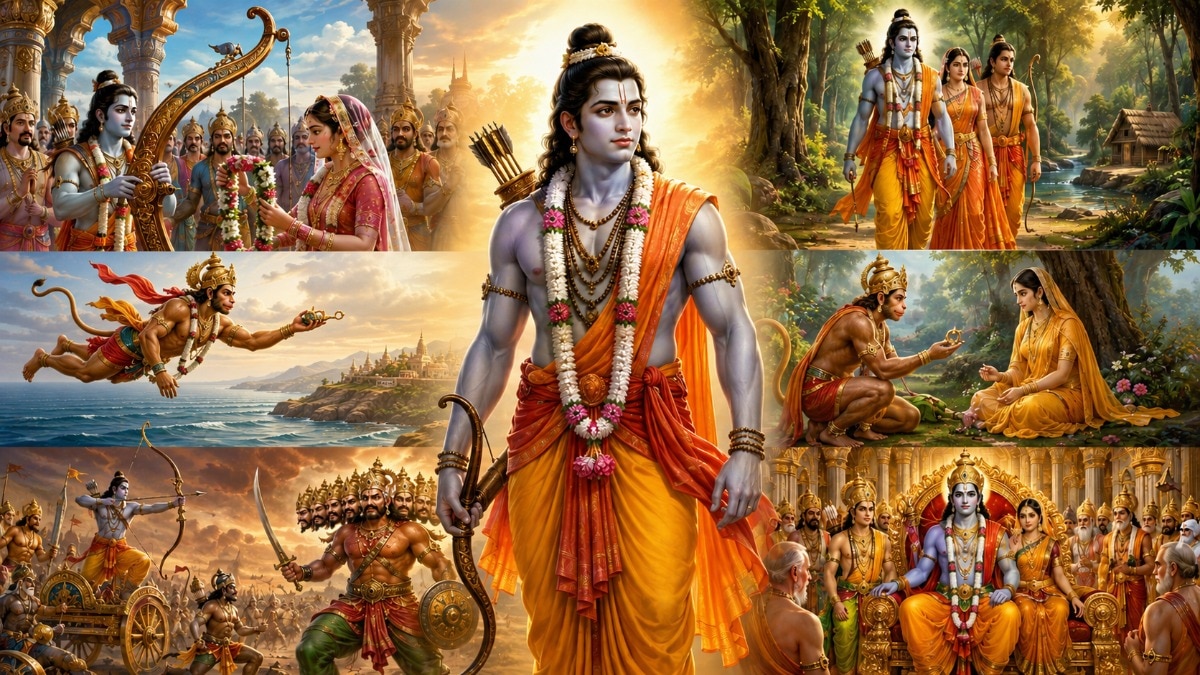
The Ramayana is more than an epic; it is a blueprint for righteous living. Discover the five pivotal moments that shaped the life of Lord Rama and defined the victory of truth.
- Lord Rama's life serves as the ultimate archetype of sacrifice and duty.
- The defeat of Ravana symbolizes the inevitable end of ego and injustice.
- Ram Rajya remains the global benchmark for ideal governance.
In an era when unrighteousness (Adharma) had surged and the peace of sages was constantly threatened, Lord Shri Ram descended to earth. The Ramayana is not merely a mythological text; it is a profound treatise on ethics, sacrifice, duty, and the preservation of humanity. It teaches us that no matter how daunting the circumstances, one must never abandon the path of truth.
1. Breaking the Shiva Dhanush: Strength Meets Humility
During the Swayamvar of Sita in Mithila, King Janaka set a formidable challenge: only the one who could lift and string the massive bow of Lord Shiva would win Sita's hand. While mighty kings failed, Shri Ram, under the guidance of Sage Vishwamitra, not only lifted the bow but broke it while attempting to string it. This moment signifies that true power lies not just in physical might, but in spiritual discipline and humility.
2. Acceptance of Exile: Unwavering Commitment to Duty
When Queen Kaikeyi demanded 14 years of exile for Rama to fulfill her boons, Shri Ram did not react with anger or resentment. Instead, he embraced the exile to uphold his father's word and the sanctity of Dharma. This profound act teaches us that prioritizing duty over personal comfort is the hallmark of a true leader.
True leadership is defined by the ability to remain steadfast in one's moral principles even during the most turbulent times.
Why This Matters
BozokMedia analysis shows that the principles of the Ramayana are highly applicable to modern-day leadership and crisis management. Rama's decision-making process and his equanimity during hardship serve as timeless lessons for navigating professional and personal challenges.
3. Hanuman's Journey to Lanka: Devotion and Courage
The quest to find Mata Sita led to Hanuman's legendary leap across the ocean to Lanka. His journey, filled with obstacles, showcases the perfect synergy of intellect, strength, and absolute devotion. His success proves that when courage is guided by purpose, no barrier is insurmountable.
4. The Battle of Rama vs. Ravana: Ego vs. Righteousness
The war between Rama and Ravana was not just a conflict between two kings; it was a cosmic struggle between 'Dharma' and 'Adharma.' Ravana's immense power and vast empire ultimately fell before his overwhelming ego. Even after defeating Ravana, Shri Ram showed immense respect for his knowledge, demonstrating that one can remain righteous while facing a formidable enemy.
5. The Establishment of Ram Rajya: The Ideal State
Upon his return to Ayodhya, Shri Ram established 'Ram Rajya'—a reign characterized by justice, equality, and the welfare of all citizens. This era of governance is still cited globally as the gold standard for an ideal society where the ruler and the ruled exist in harmony.
Frequently Asked Questions
Q1: What is the core lesson of the Ramayana?
Answer: The core lesson is the victory of truth over falsehood and the importance of adhering to one's moral duties (Dharma).
Q2: What defines 'Ram Rajya'?
Answer: Ram Rajya is an ideal form of governance where justice, peace, and the well-being of every citizen are the highest priorities.
