Discover the fascinating tale of the divine pact between Sage Ved Vyas and Lord Ganesha that led to the creation of the world's longest epic, the Mahabharata.
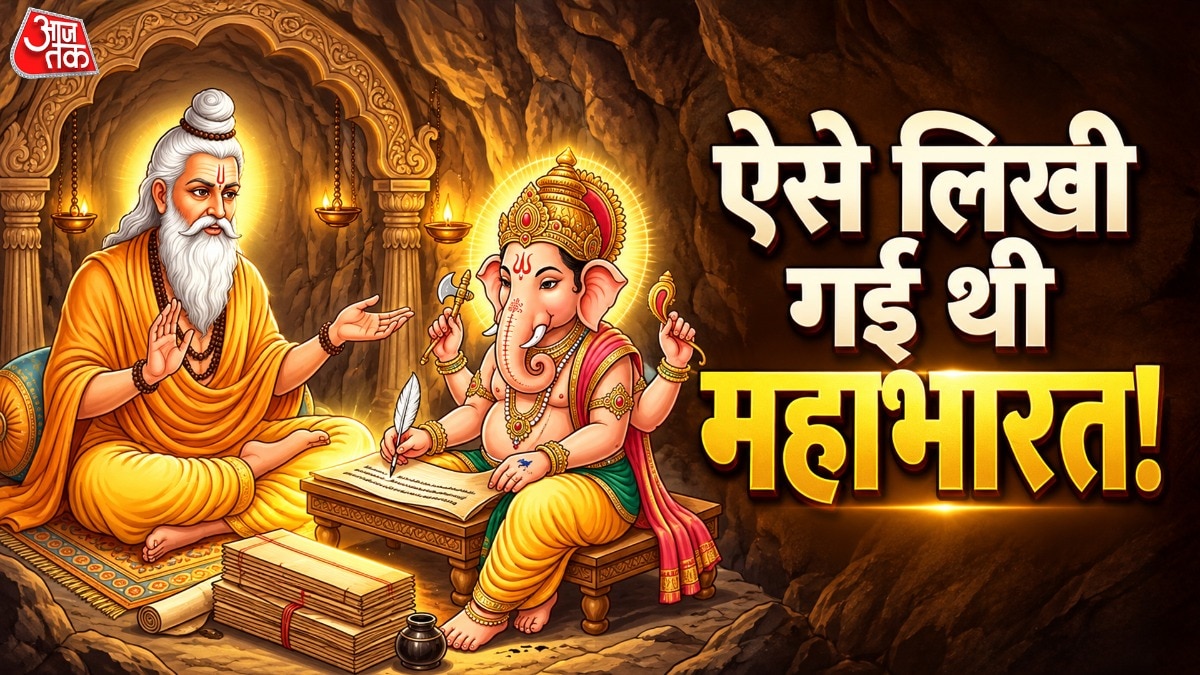
- Sage Ved Vyas conceptualized the Mahabharata, while Lord Ganesha served as the divine scribe.
- A strict agreement was made to ensure the writing process remained uninterrupted.
- Lord Ganesha broke his own tusk to replace a broken pen, earning him the name 'Ekdant'.
The Mahabharata is not merely a chronicle of a great war but a profound treatise on duty, ethics, and spirituality. The creation of this monumental work is a testament to the union of divine wisdom and intellectual discipline. It involves the collaboration between Sage Ved Vyas, the visionary author, and Lord Ganesha, the deity of intellect and the scribe of the epic.
The Divine Pact and Strategic Conditions
According to religious scriptures, when Ved Vyas approached Lord Ganesha for assistance, Ganesha agreed on one stringent condition: his pen must not stop for a single moment. If Vyas paused in his narration, Ganesha would cease writing immediately. In response, Ved Vyas imposed his own condition—Ganesha must fully comprehend the meaning of every verse before inscribing it.
This arrangement created a unique intellectual rhythm. Whenever Ved Vyas needed time to compose the next sequence of verses, he would dictate complex and cryptic shlokas. While Ganesha used his immense intellect to decode the meaning, Vyas would mentally prepare the subsequent parts of the narrative.
The Crisis of the Broken Pen
As the narrative progressed toward the Kurukshetra war and the divine discourse of the Bhagavad Gita, the intensity of the writing increased. During this peak of creation, an unexpected crisis occurred—Lord Ganesha's writing instrument broke. Ganesha faced a dilemma: stopping to find a new pen would violate his own vow and halt the divine work.
"The act of Lord Ganesha breaking his tusk symbolizes that the pursuit of knowledge and the preservation of truth supersede any physical sacrifice."
Without hesitation, Ganesha broke off one of his own tusks and used it as a stylus to continue writing. For him, the commitment to the task and the sanctity of his word were far more valuable than his physical form. This act of sacrifice is why he is revered as 'Ekdant' (The One-Tusked God).
Why This Matters
BozokMedia analysis shows that this narrative transcends mythology, serving as a metaphor for discipline and unwavering commitment. It highlights the importance of adaptability and the idea that when faced with an obstacle, one must find an innovative solution to fulfill their purpose.
Frequently Asked Questions
Q1: What were the conditions agreed upon by Vyas and Ganesha?
A: Ganesha stipulated that the writing must be continuous, while Vyas required that every verse be understood before being written.
Q2: Why is Lord Ganesha referred to as 'Ekdant'?
A: He is called Ekdant because he broke his own tusk to use as a pen when his original writing tool broke during the transcription of the Mahabharata.