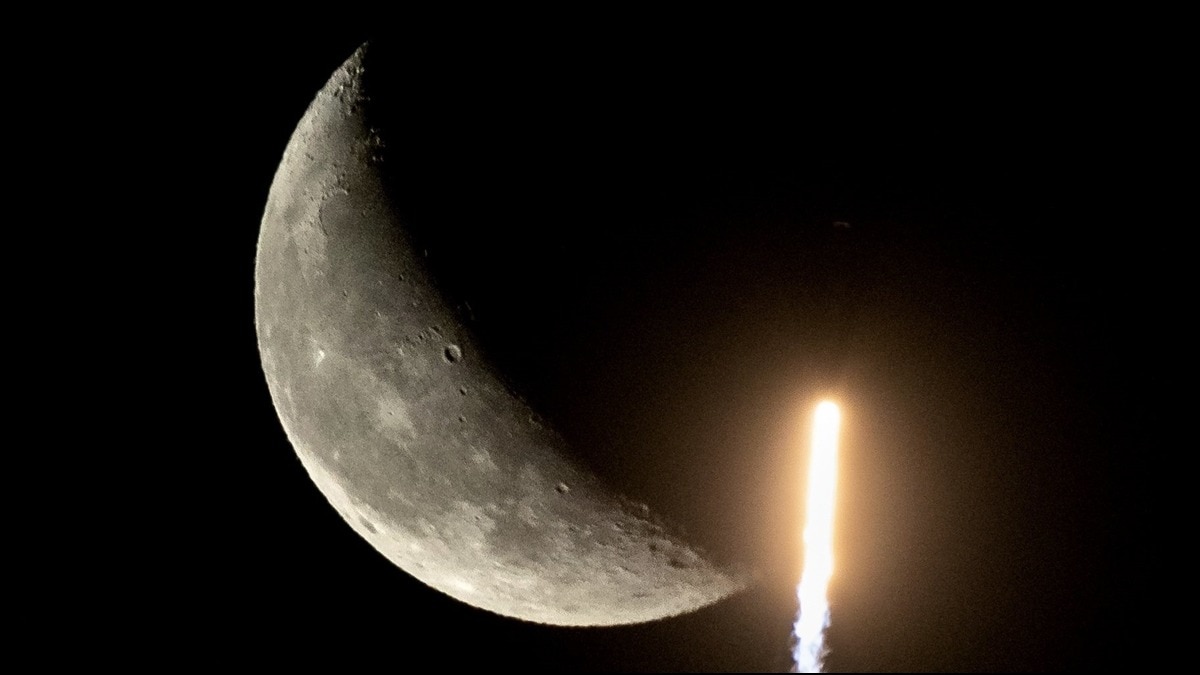
A piece of SpaceX's Falcon 9 rocket, identified as 2025-010D, is scheduled to strike the lunar surface on August 5 at a staggering speed of 8,700 kmph.
Key Takeaways
- SpaceX Falcon 9 debris will impact the Moon on August 5.
- The impact speed is estimated at 8,700 kmph (2.43 km/s).
- A dust plume (ejecta) might be visible through high-powered telescopes.
- The collision will occur on the Moon's near side.
Space enthusiasts and astronomers are bracing for a celestial event as a piece of SpaceX's Falcon 9 rocket is poised to slam into the Moon on August 5. The object, designated 2025-010D, is traveling at a violent velocity of approximately 8,700 kmph, making it a significant kinetic event on the lunar surface.
While the Moon lacks an atmosphere to create sound or aerodynamic drag, the sheer energy released during this collision will be immense. Astronomers have meticulously tracked the trajectory, noting that the object will strike the near side of the Moon—the hemisphere that remains permanently facing Earth.
Why This Matters
BozokMedia analysis shows that such impacts are critical scientific windows. By observing the energy distribution and the resulting debris, researchers can gain unprecedented insights into lunar geology and the physics of impacts in a vacuum environment. It also highlights the growing issue of orbital debris interacting with celestial bodies.
This impact provides a unique laboratory to study how kinetic energy transforms into light and dust in an airless environment.
Whether the event will be visible to the naked eye remains a subject of debate. While the impact itself won't be seen, experts suggest that an ejecta plume—a cloud of dust kicked up by the collision—could potentially be captured by advanced telescopes, depending on the impact angle and surface composition.
Historical Background
Over the years, lunar impact studies have transitioned from observing natural asteroids to monitoring human-made debris. These events are vital for understanding cratering processes and the long-term reshaping of the Moon by both natural and anthropogenic objects.
Frequently Asked Questions
Question 1: Will I see a flash in the sky?
Answer: It is unlikely to be visible to the naked eye, but a dust plume might be detectable via telescopes.
Question 2: When exactly will it happen?
Answer: The impact is scheduled for August 5, with precise timing being refined by tracking data.