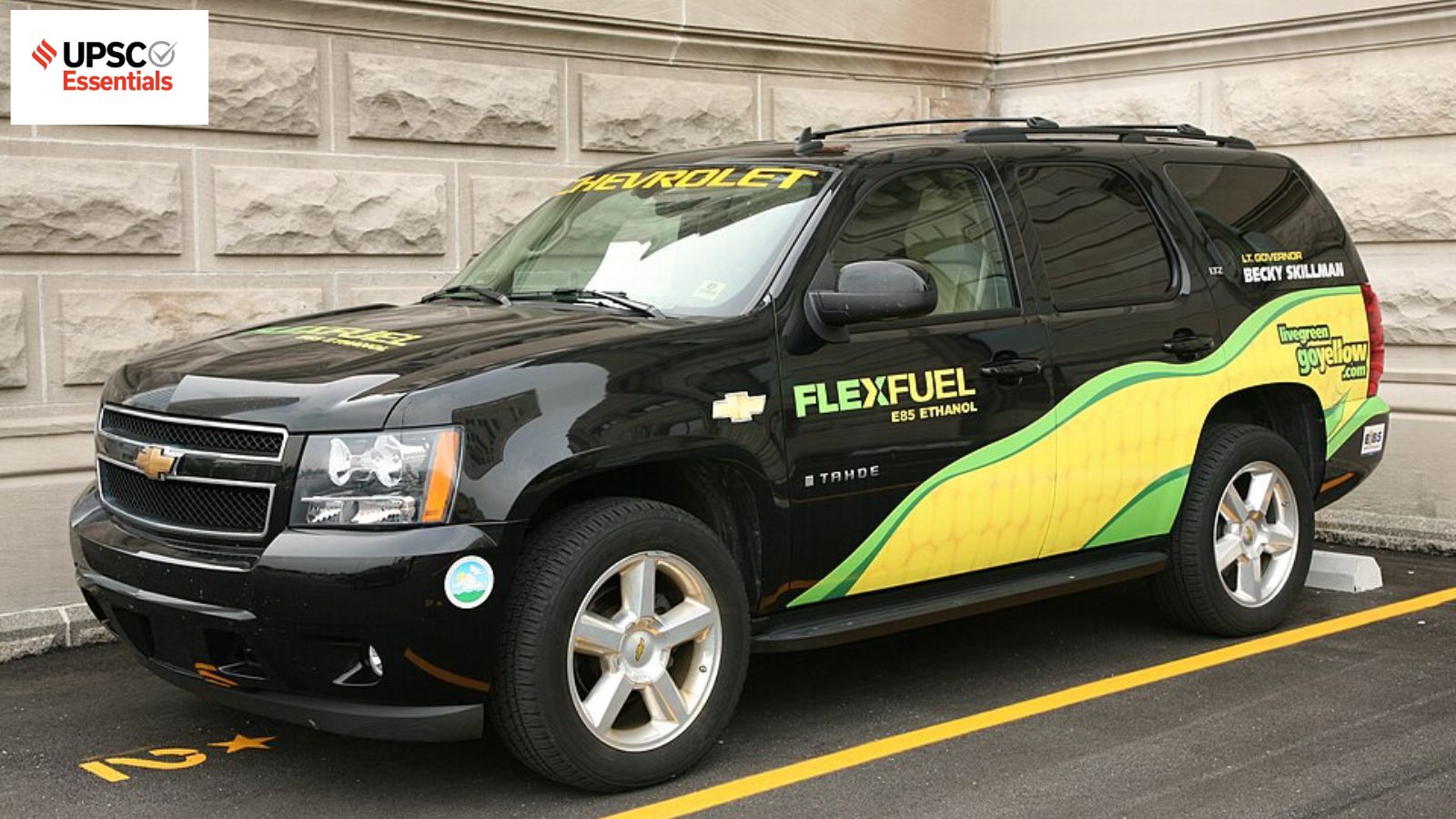
UPSC Essentials released a subject‑wise quiz on Science & Technology, featuring questions on flex‑fuel cars, Alzheimer’s disease and the Swift Observatory. The test reinforces candidates' grasp of India’s ethanol‑blended fuel policy and contemporary space‑mission challenges.
Purpose of the UPSC Quiz
UPSC Essentials’ subject‑wise quizzes are designed to help civil‑service aspirants consolidate the static portion of the syllabus. The Science & Technology segment focuses on concepts that frequently appear in the prelims, while simultaneously exposing candidates to current government initiatives and global technological trends.
Flex‑Fuel Vehicles and India’s Ethanol Programme
The first question examines flex‑fuel vehicles (FFVs), which are essentially internal‑combustion engines capable of running on more than one fuel – typically petrol blended with ethanol or methanol. Under the Ethanol‑Blended Petrol (EBP) programme, India moved from a target of 20 % ethanol (E20) by 2030 to making E20 the nationwide standard, with a gradual shift toward E25 and specialised E85‑E100 blends for FFVs. These vehicles employ fuel‑composition sensors to automatically adjust injection timing, allowing seamless switching between petrol and ethanol. While statement 1 in the quiz is correct, statements 2 (zero greenhouse‑gas emissions) and 3 (compression ignition like diesel) are inaccurate; FFVs still emit CO₂ during combustion. Historically, Fiat introduced the world’s first ethanol‑only car (the Fiat 147) in Brazil in 1979, not India, rendering statement 4 false.
Alzheimer’s Disease Question
The second question tests knowledge of Alzheimer’s pathology. It correctly identifies the disease as a progressive dementia that erodes memory and cognition, and notes that the hippocampus is one of the earliest brain regions affected. A recent Harvard‑led study published in the BMJ found that professionals who constantly navigate (taxi, ambulance drivers) exhibit a lower mortality risk from Alzheimer’s, likely because routine spatial planning strengthens hippocampal networks. This link underscores the importance of correlating clinical facts with occupational epidemiology.
Neil Gehrels Swift Observatory and Space Weather
The third question centers on NASA’s Swift Observatory, built to monitor gamma‑ray bursts and other high‑energy cosmic phenomena. Increased solar activity has heightened atmospheric drag in low‑Earth orbit, causing Swift’s orbit to decay gradually. To extend its operational life, NASA launched a privately built rescue spacecraft that successfully rendezvoused with Swift, demonstrating a novel approach to satellite servicing in an era of congested LEO.
Preparation Strategies for Aspirants
To tackle such questions, candidates should adopt three core strategies: (i) stay updated on policy changes – especially India’s ethanol‑blend targets and alternative‑fuel incentives; (ii) integrate scientific concepts with real‑world case studies, such as linking hippocampal function to navigation‑heavy professions; and (iii) understand the interplay between space weather and satellite dynamics, which frequently appears in UPSC’s astronomy and technology sections. By doing so, aspirants not only answer factual queries but also develop the analytical depth required for the evolving UPSC syllabus.