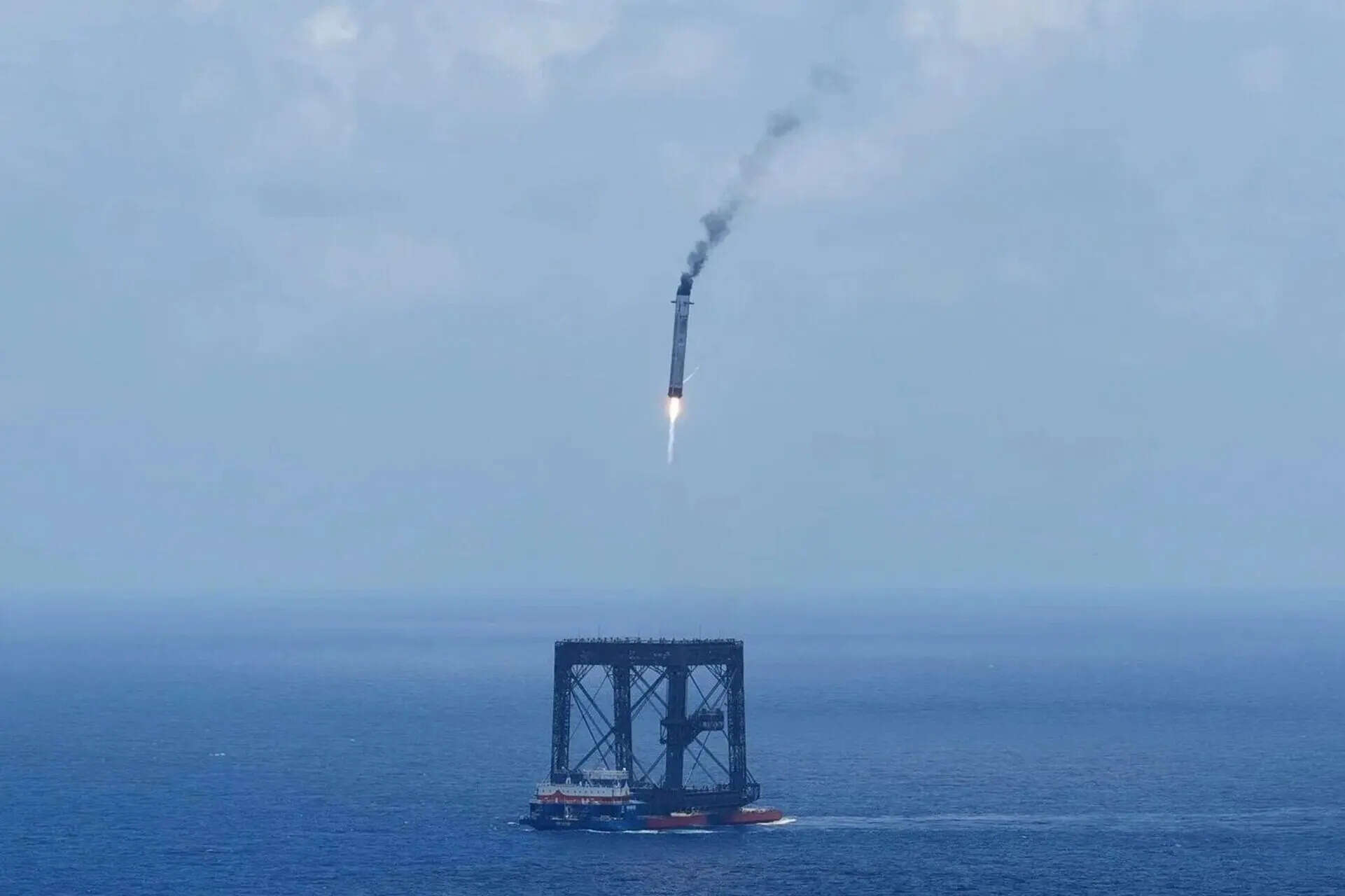
China successfully retrieved the first stage of its Long March‑10B rocket, joining the elite club of reusable launch providers, while India’s Next Generation Launch Vehicle remains several years away from a test flight. The milestone underscores the growing importance of reusable technology for cutting launch costs and expanding flight cadence.
मुख्य बिंदु (Key Takeaways)
- China recovered the Long March‑10B first‑stage booster using a sea‑based net capture.
- India’s NGLV program is still in early development and years from a demonstration launch.
- Reusable launch systems are reshaping global launch economics and competition.
In a dramatic demonstration off the coast of Hainan, China retrieved the first‑stage booster of its Long March‑10B orbital rocket via a maritime net‑capture system. The successful vertical descent and recovery places Beijing among a select group of space powers actively pursuing reusable launch technology, a field once dominated by the United States.
Global Landscape of Reusable Launchers
SpaceX has set the benchmark for the past decade, routinely landing and reflighting Falcon‑9 boosters, slashing launch costs by up to 40 %. Blue Origin is pursuing a similar path with the heavy‑lift New Glenn first stage. China’s latest achievement demonstrates that reusable orbital launch capability is no longer an exclusive US monopoly but an emerging standard for major space‑faring nations seeking commercial, lunar and deep‑space ambitions.
India’s Next Generation Launch Vehicle (NGLV) Progress
The Indian Space Research Organisation (ISRO) describes the NGLV as a “partially reusable, human‑rated and commercially viable” three‑stage launch vehicle capable of delivering up to 30 tonnes to low‑Earth orbit. Two variants—a version with solid strap‑on boosters and a booster‑less version—are under design. The first stage is being engineered for vertical landing and reuse, mirroring the Falcon‑9 approach that China has now emulated.
According to ISRO, the program has moved beyond conceptual studies: vehicle specifications, stage configurations, mission trajectories, wind‑tunnel models, preliminary 3‑D designs, and the LOX‑methane LME‑1100 engine are all defined. An expression of interest (EoI) has been issued for industry partners to fabricate the methane engines, while avionics design reviews and infrastructure planning are underway.
Economic and Strategic Implications
The first stage constitutes the most expensive portion of a launch vehicle. Recovering and refurbishing it can dramatically lower launch prices, increase launch cadence, and enable a broader range of missions—from commercial satellite constellations to crewed lunar exploration. While SpaceX proved the commercial viability of this model, other nations now strive to replicate its success.
Path Forward for India
India faces the dual challenge of accelerating NGLV’s design‑to‑flight timeline and ensuring that the system can compete in a cost‑sensitive global market. Leveraging private‑sector partnerships, fostering international collaboration, and mastering rapid turnaround for booster refurbishment will be critical. The Chinese breakthrough underscores how quickly reusable launch systems are becoming the norm rather than the exception, and India’s commitment to NGLV signals its intent to stay in the race.