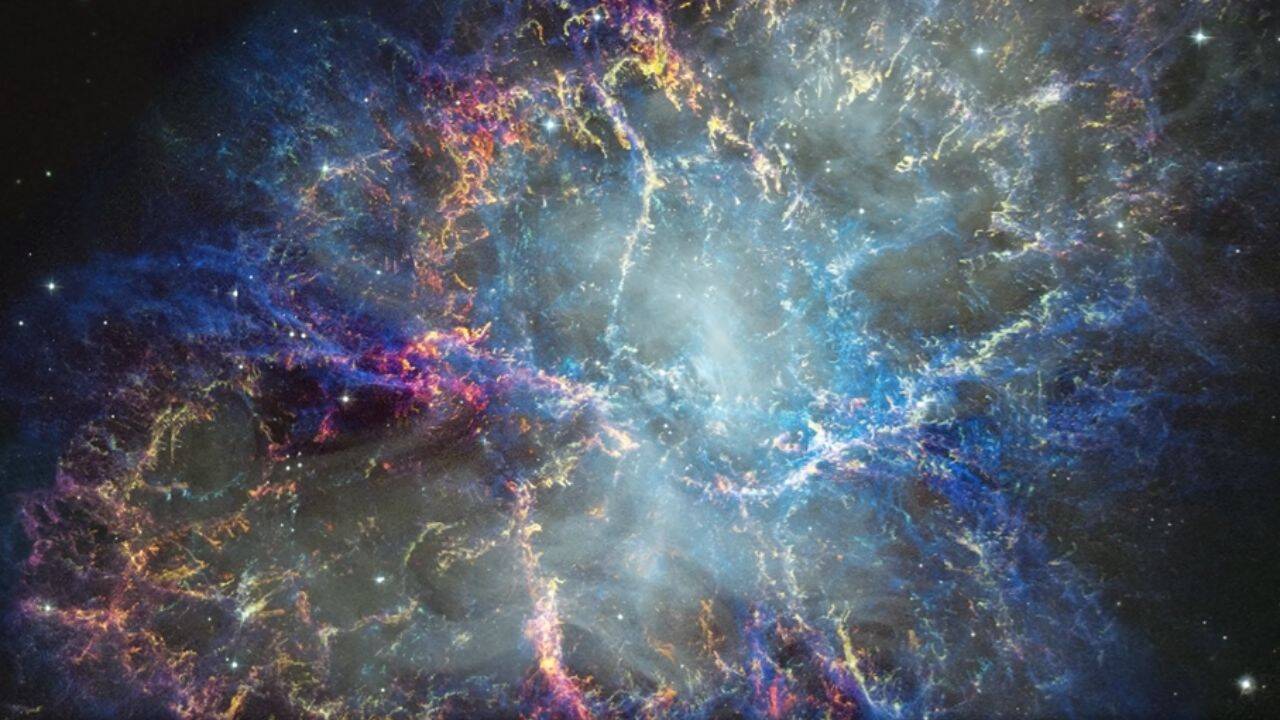
The Hubble Space Telescope has re‑measured the expansion of the Crab Nebula, showing gas filaments pushing outward even after a millennium. The ancient 1054 supernova remnant remains dynamically active, powered by the central Crab Pulsar, with newly identified filament structures adding fresh intrigue.
Key Takeaways
- Hubble validates that the Crab Nebula continues to expand 1,000 years after the 1054 supernova.
- Comparative imaging reveals outward motion of gas filaments at ~0.014 ly/yr.
- The Crab Pulsar still energises the nebula and new filamentary features have been discovered.
The Hubble Space Telescope has delivered another milestone for astrophysics by precisely tracking the growth of the Crab Nebula, the luminous remnant of the 1054 supernova. Situated roughly 6,500 light‑years from Earth, this nebula spans about 11 light‑years and has long served as a natural laboratory for studying the life cycle of massive stars, shock physics, and cosmic dust formation.
Historical Context and Scientific Significance
Recorded by Chinese, Arab, and Babylonian astronomers in 1054 CE, the supernova was one of the brightest celestial events of the Middle Ages. Its brilliant flash left behind a rapidly expanding shell of ionised gas, later named “Crab Nebula” by Sir John Herschel in the 18th century. Over the centuries, the nebula has been observed across the electromagnetic spectrum, providing key insights into how stellar explosions seed the interstellar medium with heavy elements.
New Hubble Imaging and Measurement Techniques
By juxtaposing high‑resolution images taken in 1999 with those captured in 2023, researchers measured filament motions with unprecedented precision. The filaments now appear to be moving outward at an average rate of 0.014 light‑years per year, confirming a steady expansion that adds roughly 0.2% to the nebula’s radius each decade. Advanced image registration, photometric calibration, and three‑dimensional modeling reduced uncertainties by nearly a third compared with earlier estimates.
The Role of the Central Crab Pulsar
At the heart of the nebula lies the Crab Pulsar, a rapidly rotating neutron star that powers the nebular glow through a wind of relativistic electrons and positrons. The pulsar’s 33‑millisecond spin period continues to inject energy into the surrounding gas, sustaining synchrotron emission across radio to X‑ray bands. Hubble’s latest observations have uncovered previously unseen fine‑scale structures near the pulsar, hinting at complex magnetic reconnection events that may shape filament formation.
Implications for Future Research
These findings reaffirm that supernova remnants are far from static relics; they remain dynamic agents influencing galactic ecosystems. With the James Webb Space Telescope (JWST) slated to peer deeper into the infrared, astronomers anticipate a clearer view of dust grain composition and shock‑driven chemistry within the Crab Nebula. Such data could refine models of how supernovae enrich galaxies and inform predictions about the remnants of future nearby explosions.
In sum, Hubble’s renewed imaging showcases that a cosmic blast witnessed a millennium ago continues to evolve, underscoring the importance of revisiting archival data with cutting‑edge instruments to unlock fresh scientific breakthroughs.