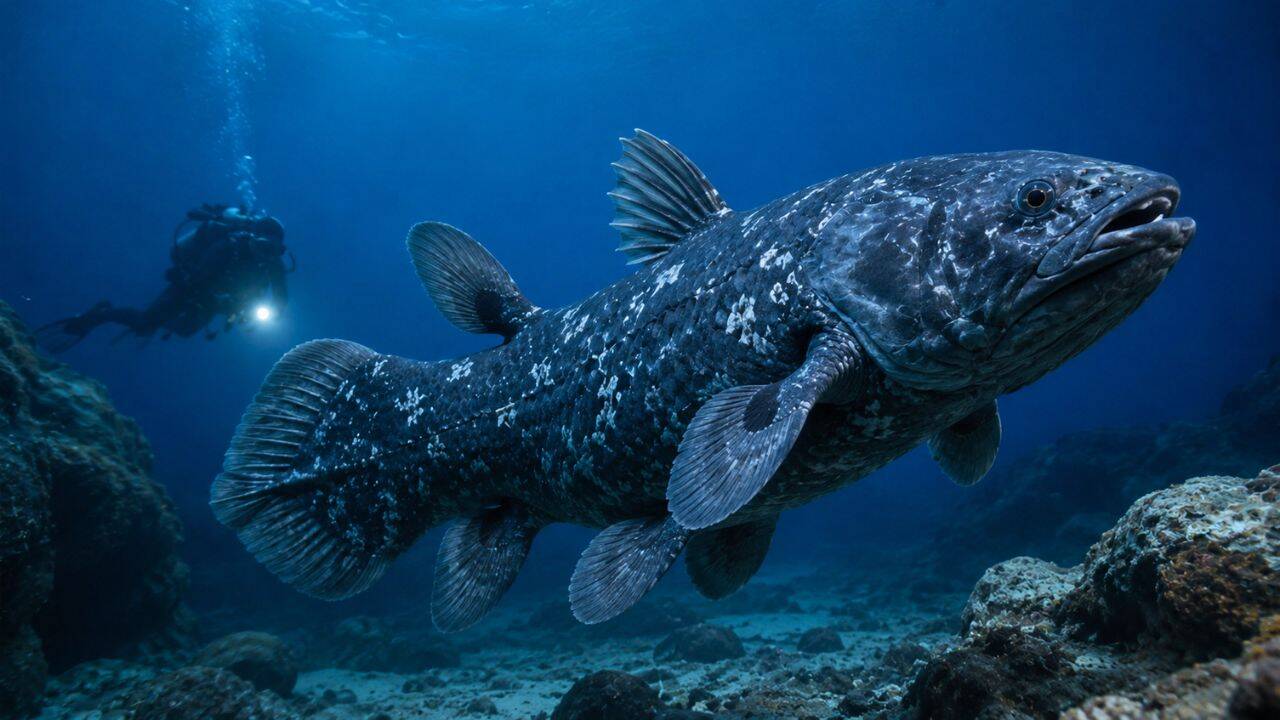
The remarkable rediscovery of the coelacanth, a prehistoric fish believed to have gone extinct alongside the dinosaurs 66 million years ago, continues to challenge our understanding of evolutionary history and deep-sea marine biology.
Key Takeaways
- The coelacanth was widely believed to have gone extinct 66 million years ago during the Cretaceous-Paleogene extinction event.
- In 1938, a living specimen was discovered off the coast of South Africa, shocking the global scientific community.
- Known as a 'living fossil', this deep-sea fish provides invaluable insights into the evolutionary transition from water to land.
In the annals of scientific discoveries, few events have caused as much astonishment as the reappearance of the coelacanth. For decades, paleontologists and evolutionary biologists were certain that this ancient, lobe-finned fish had vanished from the face of the Earth approximately 66 million years ago, wiped out by the same cataclysmic asteroid impact that decimated the dinosaurs. However, nature had preserved a secret in the depths of the ocean, waiting to rewrite the history books.
The Shocking Rediscovery of 1938
The scientific consensus was shattered on December 22, 1938, when Marjorie Courtenay-Latimer, a museum curator in East London, South Africa, received a call from a local trawler captain, Hendrik Goosen. Among the catch of the day was a bizarre, iridescent blue fish with limb-like fins. Recognizing its uniqueness, Courtenay-Latimer sought the expertise of chemist and ichthyologist J.L.B. Smith. Smith identified the creature as a living coelacanth, a find so monumental that it was described as the zoological equivalent of finding a living dinosaur walking in a forest.
An Evolutionary Time Capsule
The coelacanth is often referred to as a "living fossil" because its physical structure has remained largely unchanged for millions of years. Belonging to an ancient lineage of lobe-finned fish (Sarcopterygii), the coelacanth possesses lobed fins that move in an alternating diagonal pattern, much like the walking gait of a four-legged land animal (tetrapod). This unique anatomical feature suggests that the coelacanth shares a close evolutionary link with the prehistoric creatures that first transitioned from aquatic environments to terrestrial life.
Deep-Sea Mysteries and Modern Conservation
Subsequent expeditions revealed that the coelacanth was not entirely extinct but survived in the deep, volcanic waters of the Western Indian Ocean and near Indonesia. These elusive creatures live at depths of 100 to 500 meters, inhabiting steep underwater caves. Despite surviving for millions of years, the coelacanth now faces modern threats, including commercial deep-sea trawling, climate change, and accidental capture in gillnets. Marine biologists emphasize that protecting these ancient survivors is crucial to understanding our own evolutionary origins.