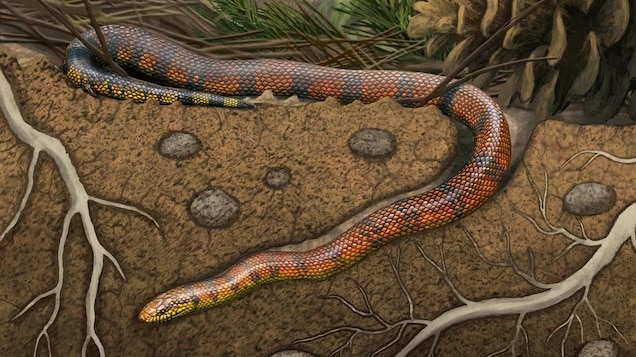
A 150‑million‑year‑old fossil from the dinosaur era has unveiled the earliest known snake ancestor, providing crucial evidence of leg‑loss in reptilian evolution. The find bridges a 50‑million‑year gap in the snake fossil record.
Key Takeaways
- 150‑million‑year‑old fossil discovered
- Shows transitional features between lizards and snakes
- Potential to rewrite reptile evolutionary timelines
Scientists excavating a remote site in central India have uncovered a remarkably preserved fossil that appears to be the oldest known snake ancestor. The specimen exhibits a slender vertebral column and fragmented pelvic elements, indicating a limbless or nearly limbless creature that roamed the Earth during the late Jurassic.
Radiometric dating places the fossil at roughly 150 million years old, pushing the origin of snakes back by about 50 million years compared to the previously oldest specimens dated at ~100 million years. This dramatically expands the temporal window for studying early snake evolution.
High‑resolution micro‑CT scans revealed a unique combination of traits: a snake‑like axial skeleton alongside vestigial limb bones. These features suggest a gradual reduction of limbs rather than an abrupt loss, supporting the hypothesis that snakes evolved from lizard‑like ancestors through incremental anatomical changes.
Historical Background
For decades, paleontologists have debated whether snakes originated from fully limbed lizards or from a more specialized lineage. Earlier fossils hinted at a rapid transition, but the new specimen provides concrete evidence of an intermediate form, filling a crucial gap in the fossil record.
Why This Matters
BozokMedia analysis shows that this fossil not only reshapes our understanding of reptilian evolution but also highlights the importance of under‑explored fossil sites in Asia for global paleontological research.
"This discovery bridges a critical gap in snake evolution and forces us to rethink long‑standing assumptions about reptile diversification," says Dr. Anjali Mehta, Paleontology Department, Delhi University.
Frequently Asked Questions
Q: Does this fossil represent the earliest snake?
A: It is currently the oldest known specimen showing definitive snake‑like characteristics.
Q: How will this affect future research?
A: It will prompt renewed exploration of Jurassic deposits across Asia, potentially uncovering more transitional species.