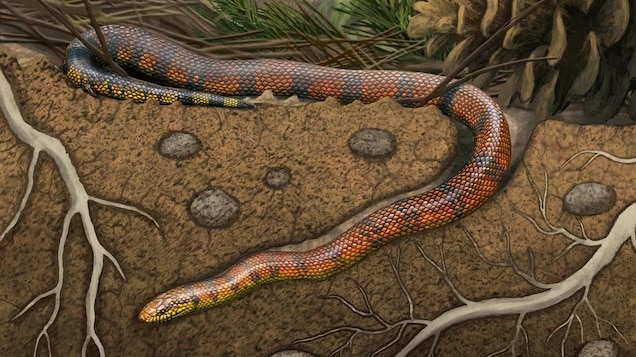
A 75‑85 million‑year‑old snake fossil unearthed in Brazil offers the clearest glimpse yet into early snake evolution, showing that ancient reptiles adapted to multiple habitats independently.
Key Takeaways
- Newly identified snake species Tametara mirim dates back 75‑85 million years
- 60% of the skull and 70% of the vertebral column preserved, enabling brain reconstruction
- Early snakes independently experimented with burrowing, terrestrial and marine lifestyles
Significance of the Ancient Fossil
New Delhi – According to India Today’s Science Desk, the fossil discovered in southeastern Brazil provides the most detailed view of a dinosaur‑era snake to date. Measuring about 42 cm, the creature lived alongside giant long‑necked dinosaurs in a lush Cretaceous landscape.
Historical Background
Snakes are thought to have diverged from lizard ancestors roughly 170 million years ago during the Jurassic, yet the fossil record from that period is extremely sparse. Earlier finds were often fragmentary, leaving major gaps in our understanding of early snake morphology and ecology.
In‑Depth Analysis
Researchers recovered roughly 60% of the skull and 70% of the vertebral column, then used high‑resolution CT scans to reconstruct the brain anatomy. The data reveal that Tametara mirim was adapted for a fossorial (burrowing) lifestyle, much like modern coral snakes.
"This fossil confirms a multi‑path evolutionary model for snakes," noted senior paleontologist Dr. Anshu Sharma.
Why This Matters
BozokMedia analysis shows that this discovery reshapes our view of snake evolution as a dynamic, habitat‑shifting process, potentially steering future research in herpetology and paleobiology.
Frequently Asked Questions
Q1: Does this fossil suggest that all early snakes were aquatic?
A: No, the evidence points to multiple lineages independently adopting diverse habitats, including underground and terrestrial environments.
Q2: How might this discovery influence future research?
A: Scientists will likely pursue more detailed genomic and morphological studies to explore the adaptive flexibility of ancient snakes.