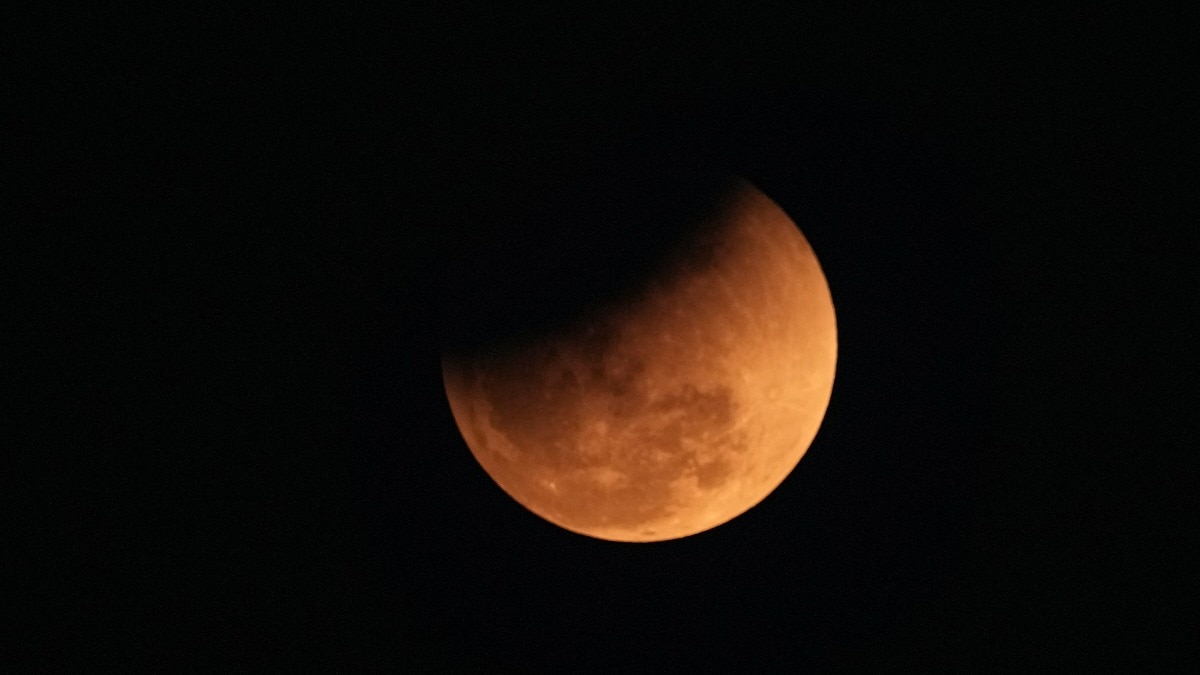
The celestial show continues this August. Just two weeks after the total solar eclipse, a significant partial lunar eclipse is approaching on August 28.
Key Takeaways
- A deep partial lunar eclipse will occur on August 28.
- Approximately 93% of the Moon will enter Earth's darkest shadow (Umbra).
- It will not be visible from India but will be seen in the Americas, Europe, and Africa.
The August skies are proving to be exceptionally active for astronomy enthusiasts. Following the rare total solar eclipse that swept across parts of the Northern Hemisphere on August 12, the Moon is preparing for its own celestial rendezvous. On August 28, a deep partial lunar eclipse will take place, marking a significant astronomical event.
This eclipse is expected to be quite peculiar. Unlike a standard partial eclipse, nearly 93% of the lunar disc will be submerged within Earth's darkest central shadow, known as the umbra. This will leave only a thin, luminous sliver of the Moon untouched. As the shadow progresses, observers may witness the Moon taking on a deep orange or reddish hue—a phenomenon caused by Earth's atmosphere scattering blue light and allowing longer red wavelengths to reach the lunar surface.
Why This Matters
BozokMedia analysis shows that August 2026 is shaping up to be an unusually busy month for skywatchers. The sequence of a total solar eclipse followed closely by a deep partial lunar eclipse provides a rare opportunity to study the mechanics of shadows in our solar system. While a solar eclipse occurs when the Moon obstructs the Sun, a lunar eclipse happens when the Earth positions itself between the Sun and the Moon.
The reddish tint during a lunar eclipse is essentially the reflection of all the world's sunrises and sunsets onto the Moon.
For observers in India, there is a significant caveat: the eclipse will not be visible from the Indian subcontinent. The peak stages are scheduled to occur around 8:00 am to 11:22 am IST, a time when the Moon will have already set across India. However, those in the Americas, Europe, Africa, and parts of Western Asia will have a front-row seat to this cosmic event.
Solar vs. Lunar Eclipse Comparison
| Feature | Solar Eclipse | Lunar Eclipse |
|---|---|---|
| Alignment | Moon is between Sun and Earth | Earth is between Sun and Moon |
| Visibility Area | Narrow path of totality | Large portion of the nighttime hemisphere |
| Eye Safety | Requires special solar filters | Safe to view with the naked eye |
Frequently Asked Questions
1. Why will the Moon look red during the eclipse?
This is due to Rayleigh scattering, where Earth's atmosphere filters out blue light and bends red light toward the Moon.
2. Can I see this eclipse from India?
No, the timing of the eclipse coincides with the Moon setting in India, making it invisible to local observers.