Long before the advent of modern neonatal pain scales, the ancient Indian physician Vriddha Kashyapa developed a systematic method to diagnose infants by interpreting their non-verbal behavioral cues.
- Sage Vriddha Kashyapa authored the 'Kashyapa Samhita', a pioneering text in pediatric care.
- He identified specific bodily signs (like knee-tucking) as indicators of internal pain.
- His diagnostic approach mirrors modern tools like the Neonatal Infant Pain Scale (NIPS).
Long before modern hospitals developed standardized pain assessment charts for newborns, an ancient Indian physician may have laid the foundations of pediatric diagnosis by decoding what many believed was impossible: the language of infants. The sage Vriddha Kashyapa, author of the revered Kashyapa Samhita, is a pioneering figure in child healthcare whose observations bear striking similarities to techniques used in modern neonatal medicine.
One of the greatest challenges in ancient medicine was diagnosing patients who could not describe their symptoms. While medical traditions in Greece, Rome, and Mesopotamia relied heavily on verbal questioning, infants remained a mystery. Their cries often left physicians guessing about the source of distress, leading to imprecise treatments.
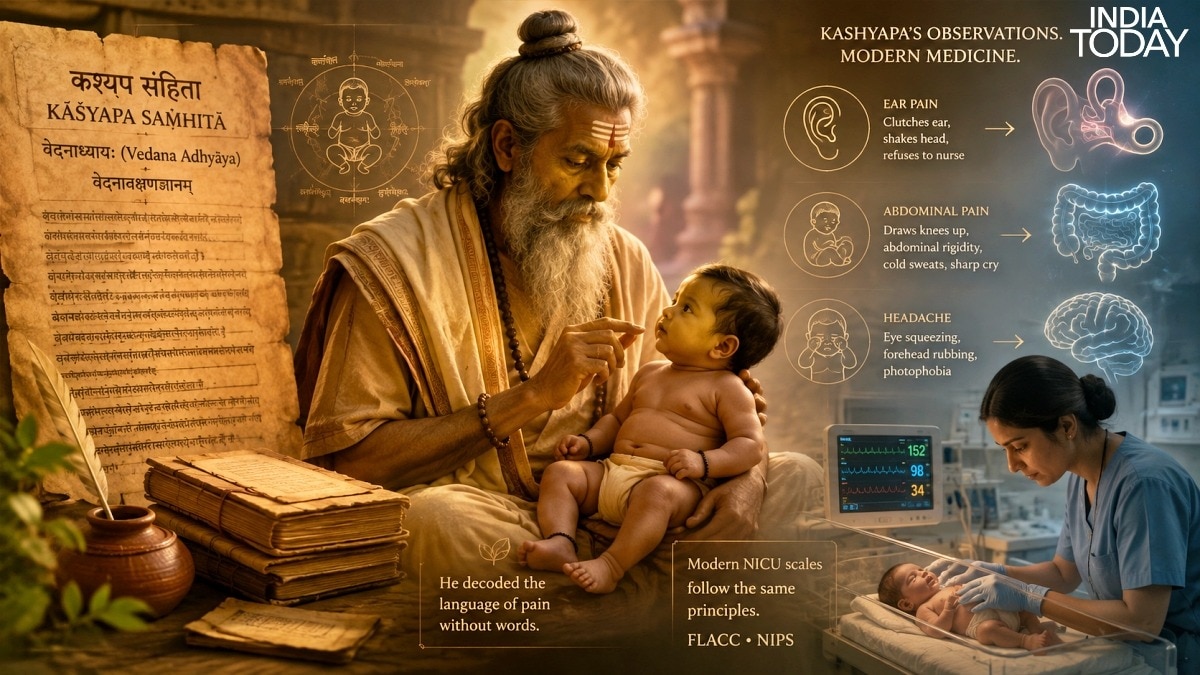
Kashyapa approached the problem through a lens of systematic observation. In a section of the Kashyapa Samhita known as the Vedana Adhyaya, or "Chapter on Knowledge of Pain Signs," he proposed that although infants cannot speak, their bodies communicate through involuntary actions and behavioral responses. By carefully observing these patterns, physicians could identify the location and nature of pain.
BozokMedia analysis shows that Kashyapa's contribution was not merely anecdotal but structural. By organizing infant behaviors into a diagnostic framework, he effectively created a non-verbal medical language. This transition from 'guessing' to 'interpreting' marks the birth of clinical pediatrics, predating similar Western advancements by centuries.
For example, Kashyapa noted that infants suffering from ear pain repeatedly pull at their ears, shake their heads, and refuse to breastfeed. Modern medicine recognizes that swallowing can increase pressure in an inflamed middle ear, making feeding painful. He also documented signs of abdominal pain, observing that affected infants pull their knees toward their chest and emit sharp, high-pitched cries—a position modern doctors know reduces abdominal pressure.
"Vriddha Kashyapa's ability to link physiological distress to behavioral output represents an early mastery of what we now call neonatal neurology."
Modern Neonatal Intensive Care Units (NICUs) use structured tools such as the FLACC Scale and the Neonatal Infant Pain Scale (NIPS) to assess pain in non-verbal patients. While developed through modern clinical research, the underlying principle—that pain can be decoded through behavior—echoes the ideas described by Kashyapa centuries ago.
| Symptom | Kashyapa's Observation | Modern Medical Interpretation |
|---|---|---|
| Ear Pain | Ear pulling, refusal to nurse | Increased middle ear pressure during swallowing |
| Abdominal Pain | Knees pulled toward chest | Natural reflex to reduce intra-abdominal pressure |
| Headache | Eye-squeezing, light sensitivity | Activation of the trigeminal nerve pathways |
Q1: Who was Vriddha Kashyapa?
A: He was an ancient Indian sage and physician who specialized in pediatric care and authored the Kashyapa Samhita.
Q2: How does his work relate to modern NICUs?
A: Both rely on the principle of behavioral observation to diagnose pain in patients who cannot communicate verbally.