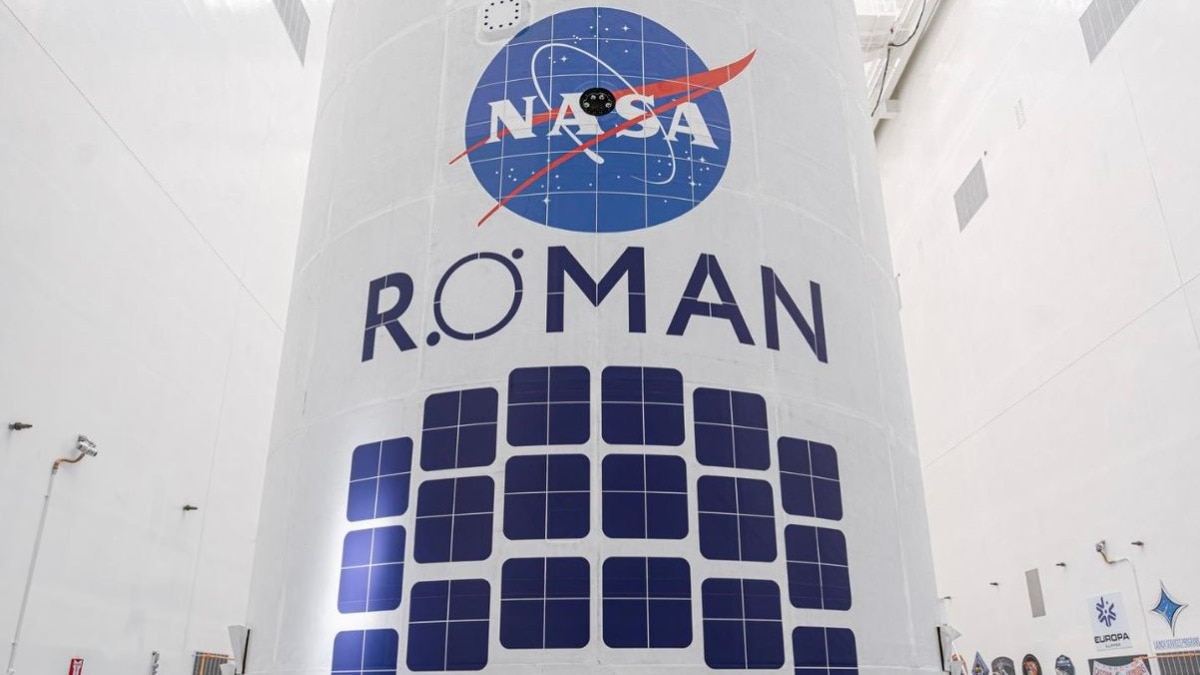
NASA's powerful Nancy Grace Roman Space Telescope is launching today aboard a SpaceX Falcon Heavy rocket. This mission aims to revolutionize our understanding of dark energy and the cosmic landscape.
- The Nancy Grace Roman telescope launches today at 4:56 PM IST.
- It will be deployed via the SpaceX Falcon Heavy rocket.
- The mission focuses on dark matter, dark energy, and wide-field cosmic mapping.
After years of intensive development and rigorous testing, NASA's Nancy Grace Roman Space Telescope is finally prepared to embark on its journey into the cosmos. The powerful observatory is scheduled to launch today, August 30, aboard a SpaceX Falcon Heavy rocket, marking the beginning of a mission designed to provide scientists with an unprecedentedly wide view of the universe.
The launch is targeted for 4:56 pm IST from Launch Complex 39A at NASA's Kennedy Space Center in Florida. Following a successful Launch Readiness Review conducted by both NASA and SpaceX, the mission has received its final 'go' signal, though timing remains contingent on real-time launch-day conditions.
Why This Matters
BozokMedia analysis shows that the Roman telescope is not merely an incremental upgrade to existing technology; it represents a fundamental shift in observational strategy. While the James Webb Space Telescope (JWST) is designed to peer deeply into specific cosmic objects, Roman is engineered to 'zoom out.' Its 2.4-meter primary mirror is comparable to the Hubble Space Telescope, but its Wide Field Instrument can survey an area of sky at least 100 times larger than Hubble's in a single observation.
The Roman telescope will act as a cosmic surveyor, mapping the vast structures of the universe at speeds previously thought impossible.
Once separated from the Falcon Heavy, the telescope will travel to the second Sun-Earth Lagrange point (L2), located approximately 1.6 million km from Earth. At this stable location, it will enjoy an unobstructed view of the cosmos to conduct its primary five-year mission. Key scientific objectives include investigating the mysteries of dark energy and dark matter, studying galaxy evolution, and hunting for thousands of exoplanets.
Historical Background
The telescope is named in honor of Nancy Grace Roman, NASA's first chief astronomer. Often referred to as the "Mother of Hubble," her pioneering work laid the scientific foundation for the Hubble Space Telescope. By naming this wide-field powerhouse after her, NASA honors the legacy of a woman who fundamentally changed how we perceive the heavens.
Comparison: Webb vs. Roman
| Feature | James Webb (JWST) | Roman Telescope |
|---|---|---|
| Primary Objective | Deep, detailed zoom-in | Wide-field cosmic survey |
| Field of View | Narrow/Targeted | 100x wider than Hubble |
| Core Science | Early universe/Exoplanet atmospheres | Dark energy/Galaxy mapping |
Frequently Asked Questions
1. How is Roman different from the Hubble Telescope?
While they share similar mirror sizes, Roman's field of view is much larger, allowing it to map huge stretches of the universe much faster than Hubble.
2. Where will the telescope be stationed?
It will be positioned at the L2 Lagrange point, about 1.6 million kilometers away from Earth.