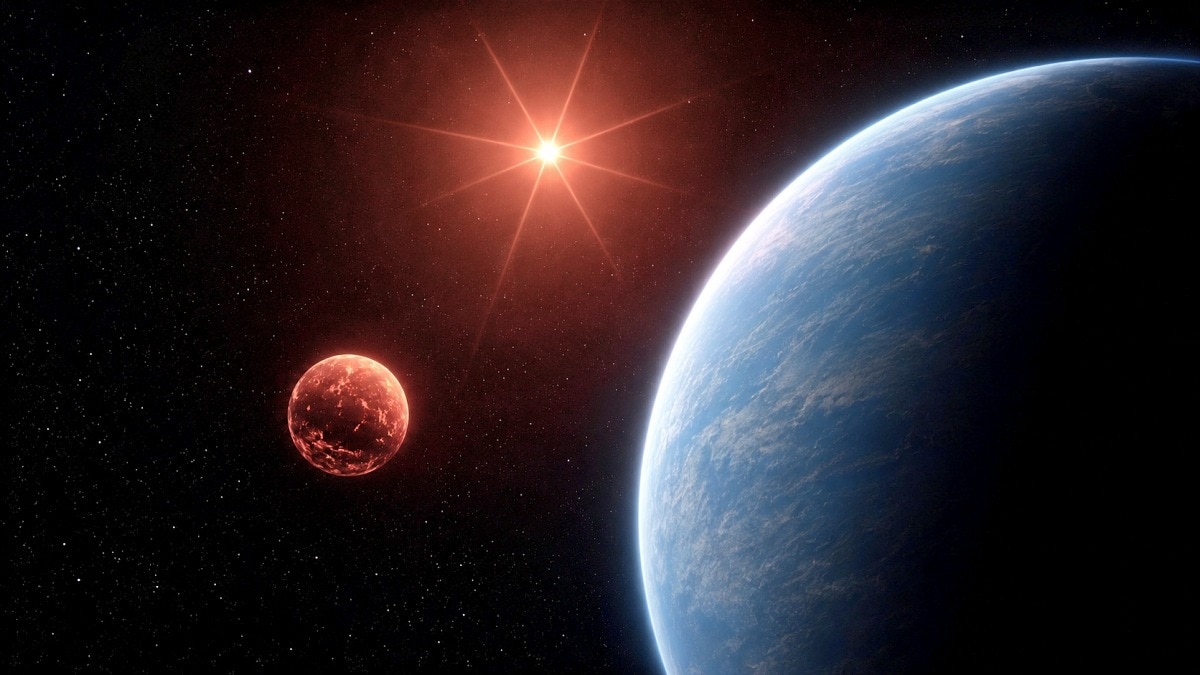
Spanish researchers have identified two new exoplanets orbiting the red dwarf TOI-1752. While one is a scorching lava world, the other is a super-Earth that could potentially support liquid water.
- TOI-1752 b is a massive lava planet with 4.35 times the mass of Earth.
- TOI-1752 c is a potential 'Super-Earth' (5.20 Earth masses) that may host liquid water.
- Both planets orbit a red dwarf star located 337 light-years away in the Draco constellation.
In a groundbreaking announcement, an international team of astronomers led by Spanish researchers has discovered two distinct exoplanets orbiting a nearby red dwarf star, TOI-1752. This discovery highlights the extreme diversity of planetary systems beyond our own Solar System and provides a new target in the enduring search for extraterrestrial life.
A Tale of Two Worlds: Fire and Water
The first planet, TOI-1752 b, is described as a 'scorching lava world.' With an estimated mass 4.35 times that of Earth, it exists in such close proximity to its host star that its surface is likely a molten wasteland of lava. It serves as a stark reminder of the hostile environments that exist in the deep cosmos.
Contrastingly, TOI-1752 c has ignited excitement among the scientific community. Classified as a super-Earth with a mass of 5.20 Earths, this rocky world sits in a region where temperatures might allow for the existence of liquid water. However, the presence of water is contingent upon the planet possessing a suitable atmosphere to maintain pressure and temperature stability.
Why This Matters
BozokMedia analysis shows that targeting red dwarfs is a strategic move in modern astronomy. Because these stars are smaller and cooler than the Sun, they provide a higher signal-to-noise ratio during transits, making it significantly easier to detect smaller, rocky planets that mirror Earth's composition.
"The discovery of TOI-1752 c opens a new window into understanding whether rocky planets around red dwarfs can maintain stable atmospheres capable of supporting liquid water."
The Science Behind the Discovery
The research was spearheaded by Alberto Pelaez Torres from the Institute of Astrophysics of Andalusia and Spain's National Research Council. The discovery utilized the MuSCAT2 instrument at Teide and the MuSCAT3 instrument in Hawaii, involving collaborative efforts from the University of Tokyo's exoplanet group.
| Feature | TOI-1752 b | TOI-1752 c |
|---|---|---|
| Planet Type | Lava World | Super-Earth |
| Mass (Relative to Earth) | 4.35x | 5.20x |
| Key Characteristic | Extreme Heat/Molten | Potentially Habitable |
The team employed the transit method, which involves monitoring the periodic dips in a star's brightness as a planet passes in front of it. The next critical phase for these researchers will be atmospheric characterization. Using next-generation space telescopes, they hope to analyze starlight filtering through the atmosphere of TOI-1752 c to detect chemical signatures of life.
Frequently Asked Questions
Q1: Can humans live on TOI-1752 c?
A: It is too early to say. While it is a 'potentially habitable' candidate, we first need to confirm the existence of a breathable atmosphere and stable liquid water.
Q2: How far away is the TOI-1752 system?
A: The system is located approximately 337 light-years from Earth in the direction of the Draco constellation.