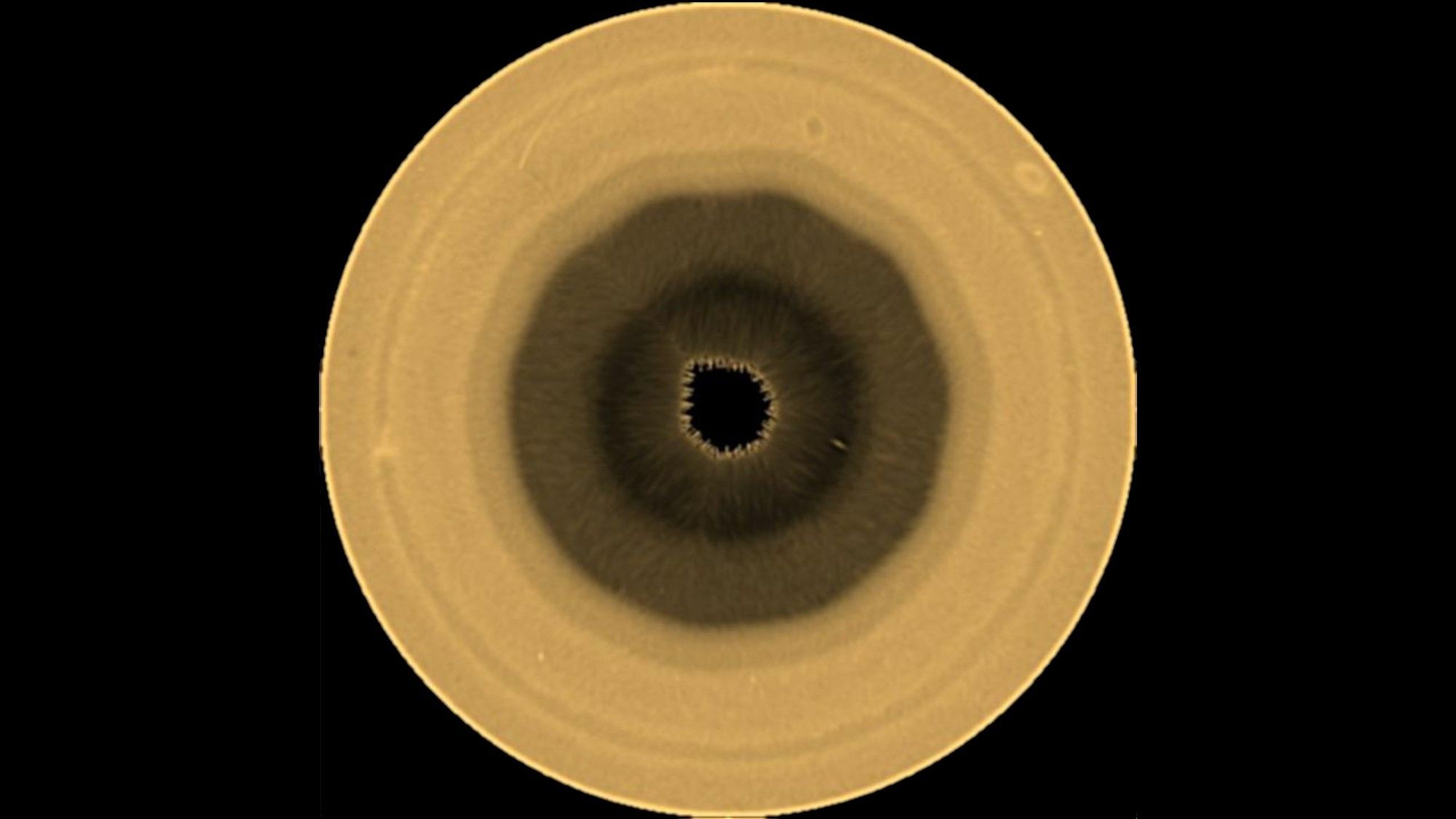
A massive, mysterious decagon-shaped cloud structure has been identified at Saturn's south pole, challenging previous assumptions about the planet's unique atmospheric patterns. This discovery, made via Hubble imagery, reveals a structure far larger than the famous northern hexagon.
- A massive 10-sided (decagon) cloud pattern has been discovered at Saturn's south pole.
- The structure is approximately 167,820 kilometers wide.
- This discovery challenges the idea that Saturn's northern hexagon is a unique phenomenon.
- The pattern is believed to be formed by atmospheric jet streams.
In a groundbreaking astronomical discovery, scientists have identified a colossal and mysterious 10-sided (decagon) cloud structure forming around the south pole of Saturn. This newfound pattern joins the bizarre, decades-old hexagonal cloud formation located at the planet's north pole, but on a much more massive scale.
A Colossal Celestial Enigma
The newly discovered decagon is immense, spanning approximately 104,250 miles (167,820 kilometers) in width. Each of its ten sides measures roughly 10,425 miles (16,782 km). Agustin Sanchez-Lavega, a lead planetary scientist at the University of the Basque Country, stated that this unusual atmospheric phenomenon is crucial for advancing our general understanding of meteorology on gas giants.
The discovery was made possible through the analysis of recent images captured by NASA's Hubble Space Telescope. Due to the tilt of Saturn's axis, the southern hemisphere remained hidden from Earth's view between 2012 and 2023, leaving the decagon undetected until recently.
Why This Matters
BozokMedia analysis shows that this discovery fundamentally shifts our understanding of planetary dynamics. It proves that geometric atmospheric structures are not isolated anomalies but can occur in multiple locations, suggesting a more complex interplay of winds and jet streams than previously modeled in planetary science.
This is a very unusual atmospheric phenomenon that is helping us to advance our understanding of meteorology in general.
The Science of Formation
Researchers believe the decagon was formed by a meandering wave trapped by a curving atmospheric jet stream, similar to the mechanism behind the northern hexagon. However, a key difference exists: while the northern hexagon has remained remarkably stable for decades, the southern decagon shows varying degrees of darkness across its features, suggesting it may still be evolving.
| Feature | Northern Hexagon | Southern Decagon |
|---|---|---|
| Number of Sides | 6 | 10 |
| Approx. Width | 32,000 km | 167,820 km |
| Stability | Highly Stable | Evolving/Dynamic |
Scientists are now working to understand the three-dimensional structure of these clouds, including hazes, winds, and temperatures. They aim to determine if the decagon will become more robust as solar radiation increases toward its peak in 2032, or if it will eventually break apart.
Frequently Asked Questions
1. Why was the decagon not seen before?
Answer: Saturn's axial tilt prevented the southern hemisphere from being visible from Earth between 2012 and 2023.
2. How does it compare to the northern hexagon?
Answer: The decagon is significantly larger and appears to be more dynamic and less stable than the northern hexagon.