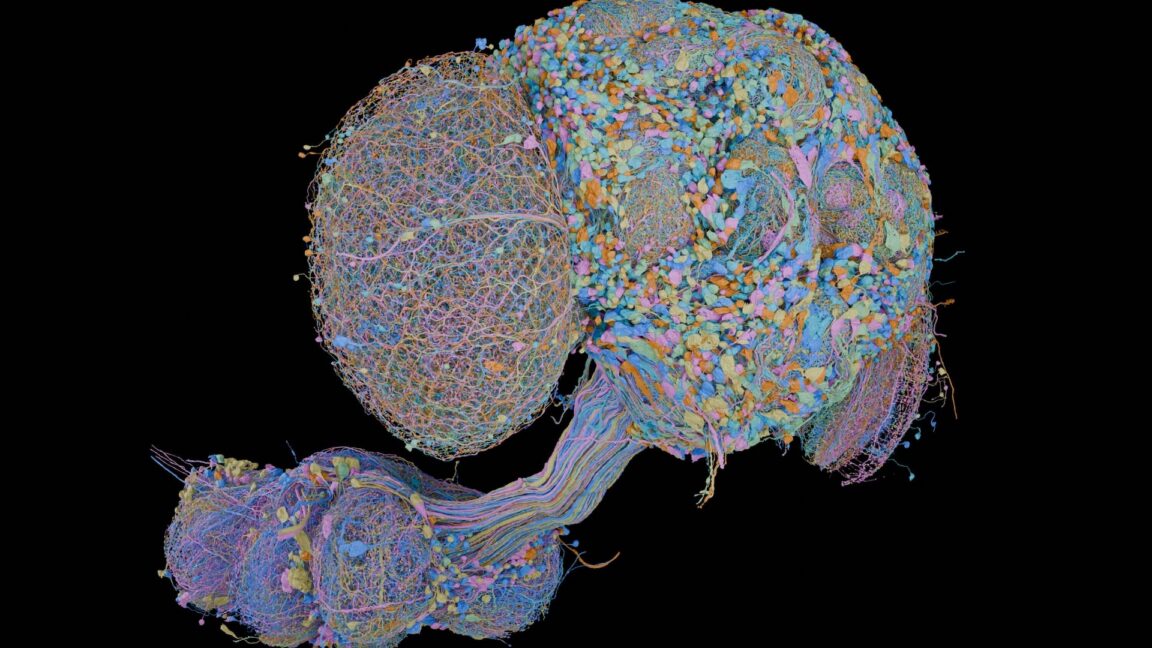
In a landmark neurobiology achievement, researchers have successfully mapped every single neuron and connection in a male fruit fly's brain.
- Researchers have completed the full 'connectome' map of a male fruit fly brain.
- This follows the successful mapping of a female Drosophila brain earlier this year.
- The project was a massive collaboration between Google computer scientists and Janelia Research Campus biologists.
In a monumental leap for neuroscience, researchers have announced the successful completion of a comprehensive map detailing every neuron and connection within the brain of a male fruit fly. This intricate biological blueprint, known as a 'connectome', serves as a transformative tool that promises to significantly accelerate the pace of neurobiology research globally.
The significance of this achievement is compounded by the fact that it follows the completion of a female Drosophila connectome earlier this year. Having both male and female maps provides scientists with a rare opportunity to conduct comparative studies on how biological sex influences neural architecture. Furthermore, the methodologies refined during this process are expected to be applied to increasingly complex nervous systems, potentially including those of vertebrates.
Why This Matters
BozokMedia analysis shows that this milestone represents more than just an insect study; it is a foundational step toward understanding the fundamental principles of neural computation. By decoding the wiring of a small brain, scientists are building the technological and analytical frameworks necessary to eventually tackle the immense complexity of the human brain and associated neurological disorders.
The connectome provides a foundational blueprint that could redefine our understanding of how neural circuits dictate behavior and cognition.
The scale of this endeavor required an unprecedented synergy between two distinct scientific disciplines. Biologists from the Howard Hughes Medical Institute's Janelia Research Campus worked in close tandem with computer scientists from Google. Both teams acknowledged that the project's success was entirely dependent on this interdisciplinary partnership.
Preparing an entire brain for imaging at the required sub-cellular resolution demands specialized biological expertise, while interpreting the resulting data requires massive computational power. Mapping hundreds of millions of synapses in a brain as microscopic as a fruit fly's is a task that would be impossible for humans to perform manually within a reasonable timeframe. Google's advanced computing capabilities were essential in processing and visualizing this massive dataset.
Historical Background
For decades, neuroscientists have attempted to trace the pathways of the brain. While early studies focused on individual neurons or small clusters, the advent of high-resolution electron microscopy and AI-driven image analysis has transitioned the field from studying isolated parts to mapping entire integrated systems.
Frequently Asked Questions
Question 1: What exactly is a connectome?
Answer: A connectome is a comprehensive map of the neural connections in the brain, showing how every neuron interacts with others.
Question 2: How does studying a fly help us understand humans?
Answer: Many fundamental biological processes and neural circuits are conserved across species, meaning what we learn in simpler organisms provides vital clues for human biology.