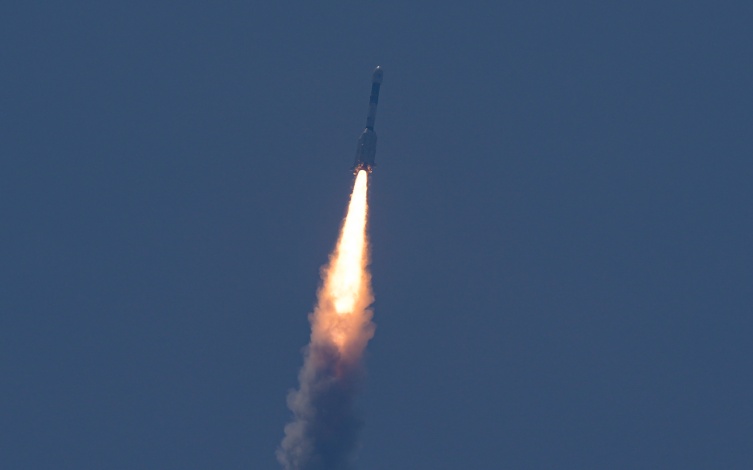
In a landmark achievement, ISRO's GSLV-F17 rocket has successfully deployed the EOS-05 satellite, India's first dedicated imaging satellite designed for geosynchronous orbit.
- GSLV-F17 successfully placed the EOS-05 satellite into a transfer orbit.
- EOS-05 is India's first dedicated imaging satellite for geosynchronous orbit (36,000 km).
- The satellite features a 10-year mission life for disaster monitoring, agriculture, and defense.
- This is the heaviest satellite (over 2,360 kg) launched by the GSLV to date.
New Delhi: The Indian Space Research Organisation (ISRO) achieved a monumental milestone early Friday morning with the successful launch of the EOS-05 Earth observation satellite. Carried by the GSLV-F17 rocket, this mission marks a paradigm shift in India's space capabilities, as EOS-05 is the nation's first dedicated imaging satellite intended for placement in a geosynchronous orbit.
A Leap in Surveillance Capability
Unlike existing Earth observation satellites that operate in Low-Earth Orbits (LEO) and pass over regions periodically, EOS-05 will reside approximately 36,000 km above Earth. In this geosynchronous orbit, the satellite remains stationary relative to a point on the ground, allowing for continuous, real-time imaging of large geographical areas. This capability is vital for monitoring rapidly evolving natural disasters, tracking agricultural patterns, and managing forestry resources.
BozokMedia analysis shows that this transition from periodic to persistent observation will significantly enhance India's strategic autonomy. The satellite's 10-year mission life ensures long-term data reliability for both civilian and defense sectors.
"This success is the culmination of teamwork involving ISRO, industrial partners, and academia, providing a new geo-platform for national activities." - V. Narayanan, ISRO official
Overcoming the 'Naughty Boy' Stigma
The success of the GSLV-F17 comes as a massive relief for the Indian space community. In recent years, the GSLV had earned the nickname 'naughty boy' among scientists due to recurring complexities and failures related to its cryogenic engine technology. After a series of unsuccessful missions in 2025 and 2026, the agency underwent rigorous-extended reviews and additional testing protocols to ensure the reliability of this launch.
Prime Minister Narendra Modi congratulated the agency, stating that the mission reflects the excellence and growing innovation defining India's space ecosystem and its strengthening partnership with Indian industry.
Strategic and Industrial Implications
Lt Gen A K Bhatt (retd), Director General of the Indian Space Association (ISpA), highlighted that the high-frequency observation capabilities of EOS-05 will be critical for situational awareness across India's land and maritime domains. Furthermore, the mission underscores the maturing synergy between ISRO and the private space sector, which is increasingly providing critical components for these high-stakes national missions.
| Feature | Low Earth Orbit (LEO) | Geosynchronous Orbit (EOS-05) |
|---|---|---|
| Altitude | 500 - 2,000 km | ~36,000 km |
| Observation Type | Periodic/Intermittent | Continuous/Real-time |
| Primary Use | General Mapping | Disaster & Defense Monitoring |
Frequently Asked Questions
1. Why is the geosynchronous orbit important for EOS-05?
It allows the satellite to stay fixed over one region, providing constant and real-time imaging instead of periodic snapshots.
2. What sectors will benefit from this satellite?
Key sectors include disaster management, agriculture, forestry, and national defense.