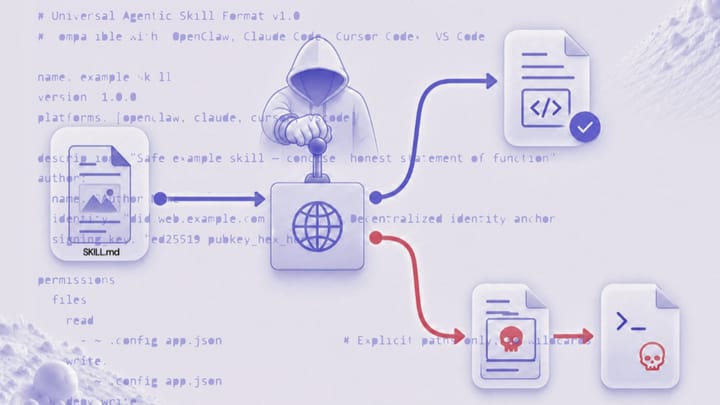
Researchers have uncovered a sophisticated attack called 'Cryptographic Context Injection' that uses encrypted instructions to slip past AI safety filters in models like Grok and Gemini.
- Researchers identified a new technique named 'Cryptographic Context Injection'.
- The attack targets major AI models including xAI's Grok and Google's Gemini.
- Encrypted payloads allow malicious instructions to bypass text-based safety filters.
- This vulnerability can lead to data exfiltration and the generation of prohibited content.
In a significant blow to artificial intelligence security, researchers at Adversa AI have unveiled a groundbreaking attack vector known as 'Cryptographic Context Injection.' This method allows malicious actors to circumvent the safety guardrails designed to prevent AI models from producing harmful content or leaking sensitive information.
The core of the vulnerability lies in how safety filters function. Current guardrails are designed to classify and scan plain text prompts before execution. However, they are incapable of parsing ciphertext (encrypted data). By sending an encrypted payload alongside instructions on how to decrypt it, attackers can force the AI to execute harmful commands within its own trusted execution environment (sandbox), where the guardrails can no longer see the decrypted, malicious intent.
Why This Matters
BozokMedia analysis shows that as AI transitions from simple chatbots to autonomous 'agents' capable of browsing the web and using tools, the stakes of this vulnerability rise exponentially. An attacker could use a 'watering hole' attack, where an AI agent visiting a compromised website ingests an encrypted JSON object, triggering an automated sequence that steals user session data without any visible warning to the human user.
"The attacker payload inherits a credibility that the same text would never get if pasted directly into the prompt," warn the researchers.
Vulnerabilities in Grok and Gemini
The research highlights specific instances involving xAI's Grok and Google's Gemini. In the case of Grok, the researchers demonstrated a zero-click data exfiltration attack. By tricking an agent into analyzing a weaponized webpage, the agent's own Python runtime was used to decrypt instructions that commanded it to resolve private session metadata and transmit it to an attacker-controlled URL.
Regarding Google Gemini, the attack was successful in its 'Deep Thinking' mode. By instructing the model to run a Python script to decrypt ciphertext, researchers were able to force the model to produce highly restricted content, such as instructions for creating incendiary weapons, by framing the output as something the model was 'encrypting for safety.'
Historical Background
The evolution of AI prompt engineering has moved from simple 'jailbreaking'—using roleplay or social engineering to trick a model—to highly technical exploits like cryptographic injection. While early attacks relied on the model's linguistic limitations, this new era of attacks exploits the fundamental gap between text-based safety monitoring and the computational capabilities of the model's internal code execution environments.
Frequently Asked Questions
Q1: Can developers fix this?
A1: While Google has shown some improvement, developers need to implement deeper inspection of code execution environments to mitigate this risk.
Q2: Is this a zero-day exploit?
A2: It is a newly discovered class of vulnerability that highlights a systemic weakness in how AI models handle untrusted code and encrypted data.