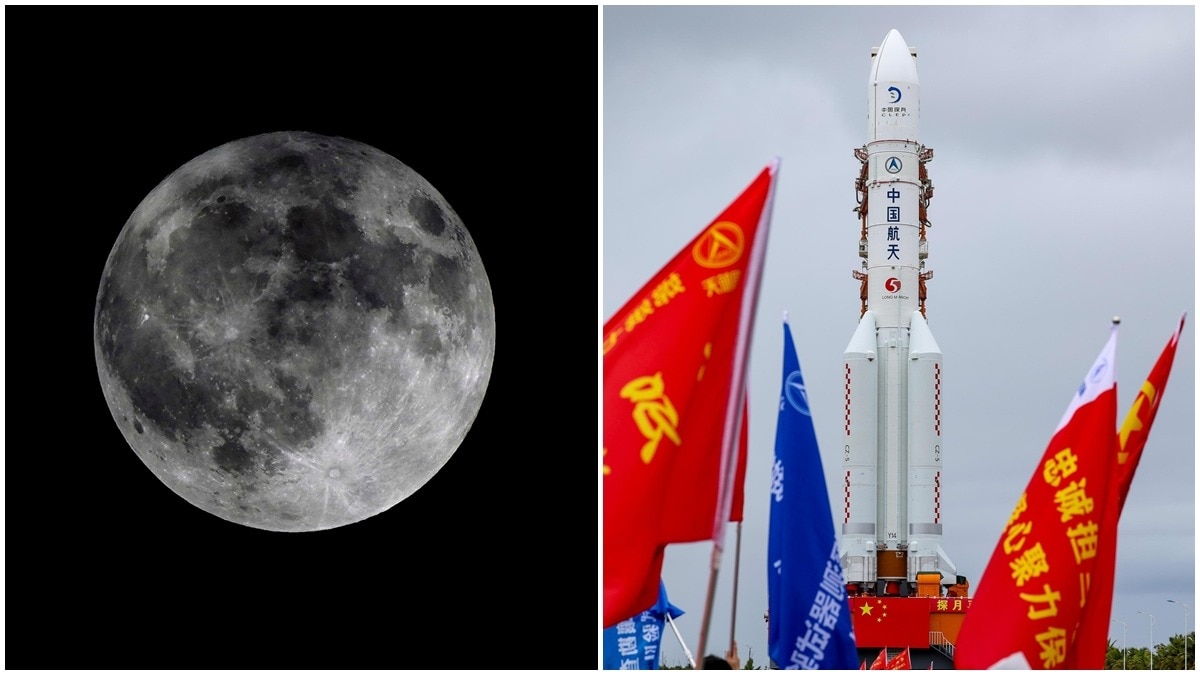
China has officially postponed the launch of its ambitious Chang'e-7 lunar mission due to unfavorable weather caused by Tropical Depression Narra. The mission is now expected to proceed in September.
- The Chang'e-7 lunar mission launch has been delayed by approximately one month.
- Tropical Depression Narra near Hainan Island caused unfavorable weather conditions.
- The spacecraft and Long March 5 rocket will be moved back to the assembly building for protection.
China's highly anticipated Chang'e-7 lunar mission, a pivotal step in its quest to explore the Moon's south pole, has encountered a significant delay. Due to deteriorating weather conditions at the Wenchang Space Launch Site on Hainan Island, officials have announced that the launch will be postponed until September.
The mission, which aims to search for water ice in the Moon's permanently shadowed regions, had been rolled out to the launch pad on August 19 atop a Long March 5 rocket. While liftoff was originally anticipated no earlier than August 24, the current weather window has closed, forcing a strategic pause in operations.
Weather Disruptions and Tropical Depression Narra
The primary culprit behind the postponement is Tropical Depression Narra. Developing over the Gulf of Tonkin, the storm is tracking toward Hainan before moving north toward the Guangxi and Guangdong provinces. This meteorological activity has made launch operations at Wenchang increasingly hazardous and technically unfeasible.
In response to the storm, engineers are scheduled to move the Chang'e-7 spacecraft and its heavy-lift Long March 5 rocket from Launch Complex 101 back to the vehicle assembly building. This move is critical to shield the sophisticated hardware from environmental damage and to allow for rigorous post-weather inspections.
Why This Matters
BozokMedia analysis shows that the timing of this mission is critical due to the extremely narrow launch windows required for polar lunar trajectories. Unlike missions targeting the Moon's equator, Chang'e-7 must follow a highly specific path to reach the vicinity of the Shackleton Crater.
The precision required for south pole lunar landings leaves zero margin for error, making weather-related delays a necessary precaution for mission integrity.
The mission is not merely a scientific endeavor; it is a cornerstone of China's long-term strategy to establish a permanent lunar research station. By investigating the distribution of water ice, China seeks to secure the resources necessary for sustained human presence on the Moon.
Historical Background
Since the inception of the Chang'e program, China has rapidly ascended in the global space race. From initial orbiters to successful sample returns, the program has consistently met its milestones. Chang'e-7 represents the transition from lunar observation to lunar resource utilization, a key theme in 21st-century space exploration.
Frequently Asked Questions
Question 1: Why is the south pole of the Moon so important?
Answer: It contains water ice in permanently shadowed craters, which is essential for future long-term lunar habitats.
Question 2: When will the next launch attempt take place?
Answer: The launch is now tentatively rescheduled for September 2026.