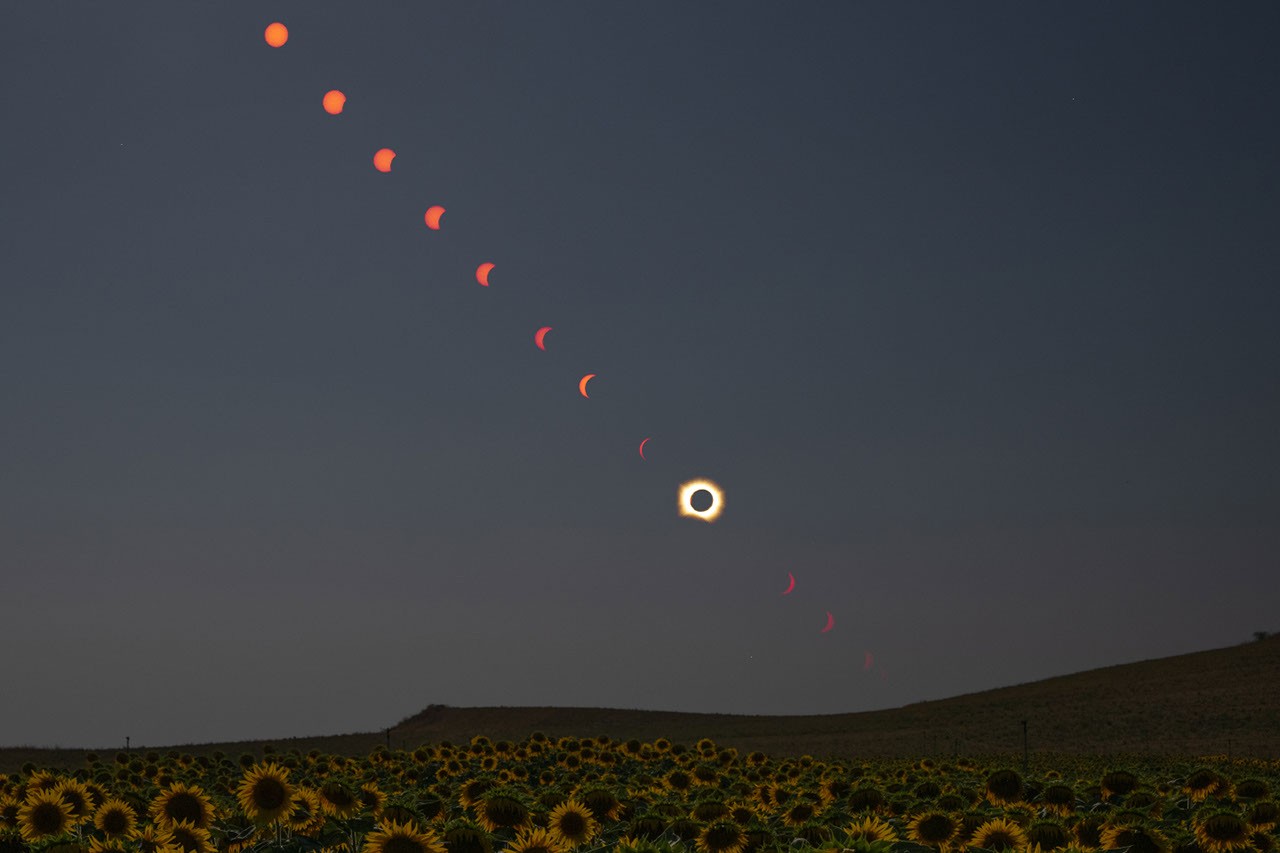
A rare total solar eclipse over northern Spain in August 2026 provided a spectacular view of the Sun's corona and solar prominences. NASA scientists utilized high-altitude jets and balloons to study the atmospheric changes during this celestial event.
- A total solar eclipse occurred on August 12, 2026, visible across northern Spain.
- The eclipse revealed the Sun's outer atmosphere, known as the corona, and solar prominences.
- NASA utilized WB-57 high-altitude jets and scientific balloons for research.
- The next total solar eclipse is scheduled for August 2, 2027.
On August 12, 2026, the Moon slid perfectly between the Sun and Earth, creating a breathtaking celestial spectacle visible from northern Spain. Skywatchers in San Millán de los Caballeros, a town south of León, witnessed the rare phenomenon of totality. During this brief window, the Moon completely obscured the Sun, allowing observers to glimpse the Sun's active outer atmosphere, or the corona.
A remarkable composite image captured the progression of the eclipse, showcasing the Sun's atmosphere before, during, and after the event. During totality, a glowing loop of plasma known as a solar prominence was clearly visible, extending into the corona. These prominences consist of super-hot gas, primarily ionized hydrogen and helium, flowing along the Sun's complex magnetic field lines.
Why This Matters
BozokMedia analysis shows that total solar eclipses are more than just visual wonders; they are critical windows for solar physics. Observing the corona directly helps scientists understand solar winds and their potential impact on Earth's satellite communications and power grids.
The study of solar prominences and the corona during eclipses provides vital data for predicting space weather events that can affect our modern technology.
NASA maximized this scientific opportunity by deploying specialized equipment. Science teams stationed in Iceland utilized NASA's WB-57 high-altitude jets to capture images of the corona in both visible and infrared spectrums. Simultaneously, the Nationwide Eclipse Ballooning Project launched scientific balloons to monitor real-time changes in Earth's atmosphere caused by the sudden drop in solar radiation.
Historical Background
For millennia, solar eclipses have been viewed with awe and sometimes fear by civilizations worldwide. From ancient Babylonian astronomers to modern-day NASA scientists, the quest to understand these alignments has driven advancements in mathematics, physics, and our fundamental understanding of the solar system.
| Feature | Partial Solar Eclipse | Total Solar Eclipse |
|---|---|---|
| Sun Coverage | Partially covered by Moon | Completely covered by Moon |
| Corona Visibility | Not visible | Clearly visible |
| Duration | Several hours | A few minutes |
Frequently Asked Questions
Question 1: When is the next total solar eclipse?
Answer: The next total solar eclipse will take place on August 2, 2027, passing through southern Spain, North Africa, Saudi Arabia, and Yemen.
Question 2: What is the 'umbra'?
Answer: The umbra is the darkest part of the Moon's shadow, which creates the path of totality during an eclipse.