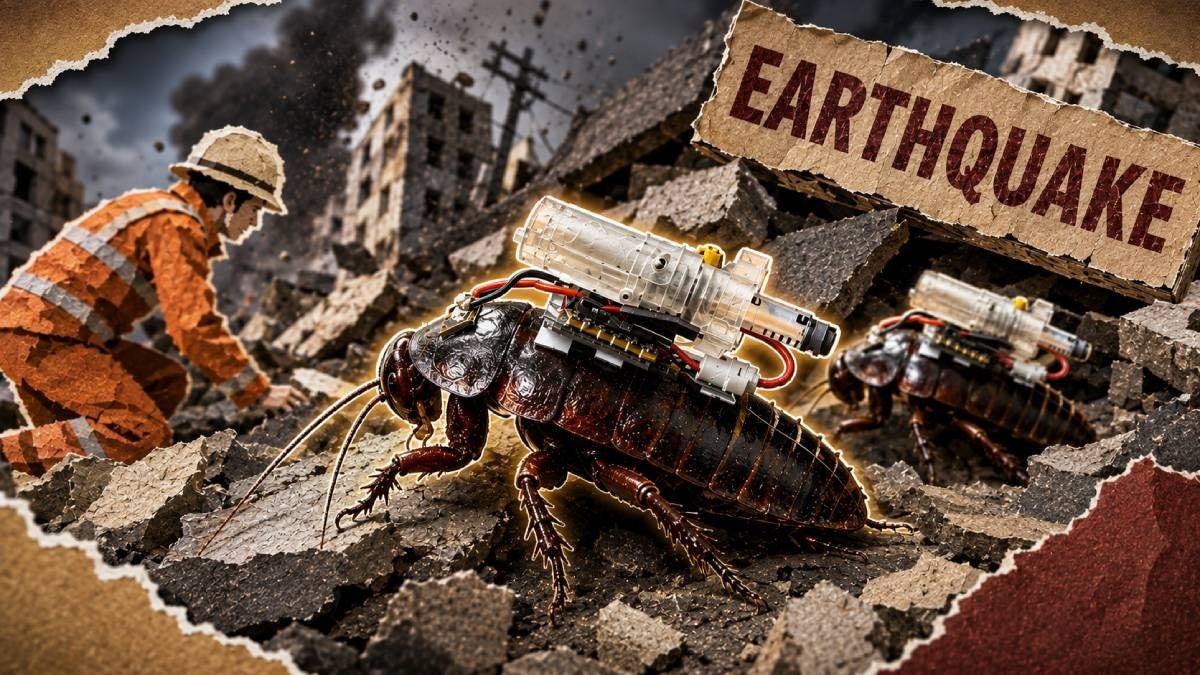
Scientists have developed bio-hybrid 'Cyborg Cockroaches' equipped with cameras and medical injectors to navigate through earthquake rubble and provide life-saving aid.
- Australian scientists have engineered 'Paraborgs' using the Giant Burrowing Cockroach species.
- These cyborgs are equipped with micro-cameras and medical injection systems.
- Laboratory tests showed a 95% success rate in delivering medicine within a 15cm range.
In the aftermath of devastating earthquakes, reaching survivors trapped under heavy debris is one of the most harrowing challenges for rescue teams. Traditional machinery is often too bulky, and human entry is too risky. However, a breakthrough in bio-robotics is changing the narrative. Scientists in Australia are leveraging the natural abilities of the Giant Burrowing Cockroach to create 'Paraborgs'—cyborg cockroaches designed for deep-rubble reconnaissance and medical assistance.
How the Technology Works
The concept involves attaching a lightweight electronic interface to the cockroach's body. This system allows researchers to remotely control the insect's movements, steering them left or right to navigate through incredibly tight crevices. By integrating a micro-camera, rescuers can receive real-time visual data from inside a collapsed structure, providing a 'eye-in-the-sky' perspective from within the ground.
Why This Matters
BozokMedia analysis shows that the integration of biological agility with electronic precision solves a fundamental problem in search-and-rescue: the 'access gap.' While robots struggle with unpredictable terrain, cockroaches are evolutionarily designed to navigate such environments. The addition of a miniature medical injector means these insects can do more than just watch; they can actively deliver critical medication to a trapped victim, potentially stabilizing them until human rescuers arrive.
The convergence of entomology and robotics represents a new frontier where biology provides the mobility that traditional machines lack.
During controlled laboratory experiments, the precision of these devices was tested. Researchers found that when the cockroach was within 15 centimeters of the target, the success rate for the injection system reached 95%. The overall success rate for the entire process—from navigation to successful delivery—stood at 72%.
Historical Context and Future Outlook
While the idea of cyborg organisms has existed in science fiction for decades, translating this into functional rescue tools is a monumental task. Historically, search-and-rescue has relied on canine units and heavy hydraulic tools. The move toward micro-scale biological assistance marks a shift toward more granular, precise disaster response. Current hurdles include maintaining stable signal connectivity through thick concrete and ensuring the longevity of the biological host.
Frequently Asked Questions (FAQs)
1. Are these cockroaches dangerous to humans?
No, they are specialized tools used under strict scientific control to assist in life-saving missions.
2. When will this technology be available for real disasters?
The technology is currently in the research and testing phase and requires further optimization for real-world signal stability.