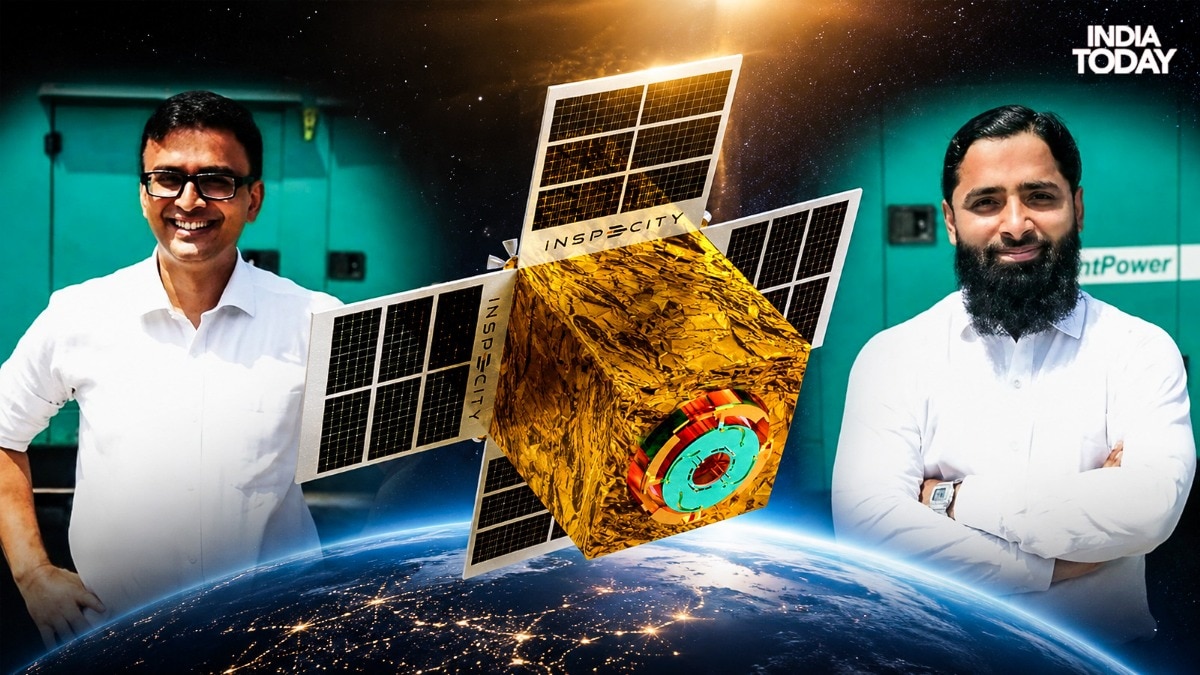
Driven by the vision of building human settlements in space, IIT Bombay professor Arindrajit Chowdhury's startup, InspeCity, has secured Rs 100 crore to develop in-orbit satellite servicing and refueling technology.
- IIT Bombay Professor Arindrajit Chowdhury and Dr. Tausif Shaikh founded 'InspeCity'.
- Raised Rs 100 crore in a pre-Series A round led by Speciale Invest and Ashish Kacholia.
- Focus: Extending satellite lifespan via in-orbit servicing, refueling, and debris removal.
- Ultimate Goal: Establishing factories and human cities in space.
The genesis of InspeCity began not in a lab, but in the grueling traffic of Mumbai. Professor Arindrajit Chowdhury, a mechanical engineering expert at IIT Bombay, found himself contemplating the future of urban congestion during a slow commute. His conclusion was radical: to sustain growing populations and resource demands, humanity must move some of its critical infrastructure beyond Earth.
Alongside his former student, propulsion specialist Dr. Tausif Shaikh, Chowdhury founded InspeCity in 2022. While the long-term vision is inspired by physicist Gerard O'Neill's concepts of space colonies, the company is taking a pragmatic first step by addressing the immediate crisis of satellite obsolescence. Currently, satellites that run out of fuel or suffer mechanical failure become expensive pieces of space junk.
The 'Space Mechanic' Architecture
InspeCity is developing a comprehensive technology stack known as the VEDA architecture, designed to transform how we maintain orbital assets. The system is divided into specialized modules:
| Module | Primary Function |
|---|---|
| GITA | Propulsion and orbital mobility |
| CHAKSU | Sensing, tracking, and precise navigation |
| RAMA | Robotic manipulation and handling |
| SPARSH | Autonomous docking and refueling |
Why This Matters
BozokMedia analysis shows that InspeCity is targeting a critical gap in the global space economy. As the number of LEO (Low Earth Orbit) satellites explodes due to mega-constellations, the ability to service these assets in situ will be the difference between a sustainable space environment and a chaotic debris field. This shifts the industry from a 'launch-and-forget' model to a 'circular space economy'.
"Before building cities in space, we must first build the infrastructure that makes long-term activity in the void possible."
The startup recently secured Rs 100 crore (approx. $10.5 million) in a pre-Series A round. This funding, backed by Speciale Invest, Ashish Kacholia, and others, will fuel four critical in-orbit missions under the RIG-X, VEDA-X, and SAMA-X roadmaps. These missions will test the high-stakes 'final few meters' of rendezvous and docking between two objects moving at orbital velocities.
Frequently Asked Questions
1. What is the primary goal of InspeCity's current missions?
The immediate goal is to prove that one spacecraft can safely approach, dock with, and service another satellite in orbit to extend its life.
2. Who are the key investors in InspeCity?
The company is backed by Speciale Invest, Ashish Kacholia, Antler India, and Shastra VC.