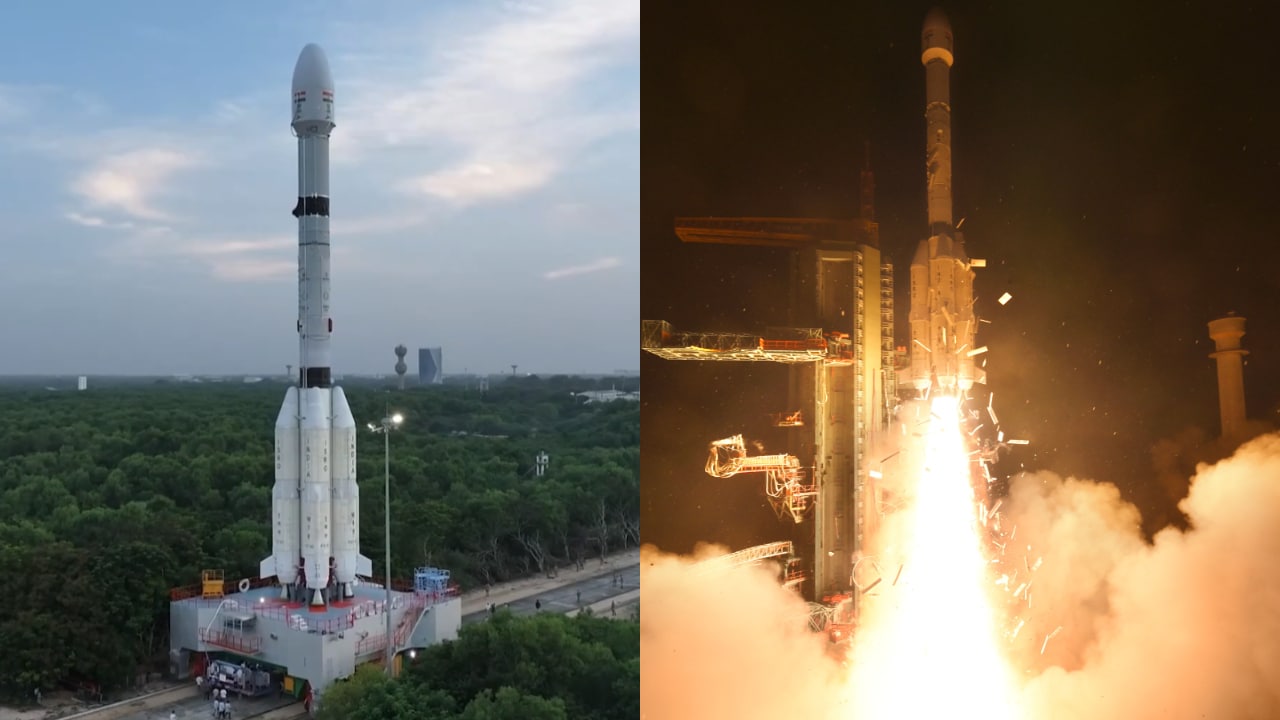
In a major milestone, ISRO has successfully launched EOS-05, India's first dedicated imaging satellite designed to operate in geosynchronous orbit for continuous real-time monitoring.
- EOS-05 is India's first dedicated imaging satellite to be placed in geosynchronous orbit at 36,000 km.
- The mission utilized the GSLV-Mk II rocket, successfully placing the satellite into a transfer orbit.
- At over 2,360 kg, it is the heaviest satellite ever carried by the GSLV rocket.
- The success marks a vital recovery for ISRO following recent mission anomalies in 2025 and 2026.
Sriharikota: The Indian Space Research Organisation (ISRO) achieved a historic milestone early Friday morning with the successful launch of EOS-05, India's first dedicated imaging satellite destined for geosynchronous orbit. Launched via the GSLV-Mk II rocket, the mission marks a significant leap in India's Earth observation capabilities.
Unlike traditional Earth observation satellites that operate in Low Earth Orbit (LEO) and circle the planet periodically, EOS-05 will hover at an altitude of approximately 36,000 km. At this specific altitude, the satellite matches Earth's rotational speed, allowing it to remain stationary relative to a fixed point on the ground. This enables continuous, real-time imaging of specific regions, providing unparalleled data for national security, disaster management, and environmental monitoring.
Technical Execution and Mission Details
Approximately 18 minutes after liftoff, the GSLV rocket successfully deposited the satellite into a transfer orbit at an altitude of over 190 km. Over the coming days, the spacecraft will undergo a series of precise orbit-raising maneuvers to reach its final geosynchronous destination. Weighing in at over 2,360 kg, EOS-05 stands as the heaviest payload ever successfully deployed by the GSLV launch vehicle to date.
"This is a great achievement in our country’s space programme, because this is the first earth observation satellite to be placed in geo-platform for national activities." - ISRO Chairman V. Narayanan
Strategic Significance for ISRO
BozokMedia analysis shows that this launch is a critical moment of redemption for ISRO. The agency has navigated a challenging period over the last two years, facing setbacks in several missions during 2025 and 2026 due to technical anomalies in launch vehicles and engines. Notably, the failure of the PSLV-C62 mission earlier this year had raised concerns regarding the reliability of India's most trusted workhorse rocket.
To mitigate risks, ISRO implemented extended review cycles and additional testing protocols. This mission, which was ready for launch as early as February, was intentionally held back to ensure all systems met the highest safety and performance standards. The successful deployment of solar panels and the healthy status of all satellite systems confirm that the rigorous checks paid off.
Historical Context: From NISAR to EOS-05
Despite recent turbulence, ISRO's trajectory remains upward. The successful operation of the NISAR (NASA-ISRO Satellite Aperture Radar) mission in 2025 remains a cornerstone of India's international space cooperation. NISAR, a joint venture with NASA, has already proven to be one of the most powerful Earth observation tools in existence, setting the stage for advanced missions like EOS-05.
Frequently Asked Questions
1. What is the difference between LEO and Geosynchronous Orbit?
LEO satellites orbit close to Earth and pass over locations periodically, whereas geosynchronous satellites stay fixed over one spot, allowing for constant surveillance.
2. Why is EOS-05 considered a 'heavy' mission?
At 2,360 kg, it is the largest and heaviest satellite ever launched by the GSLV rocket, testing the limits of the launch vehicle's capability.